Variable-Speed Benchtop Drill Press: What It Is, Where It Fits, and What to Check
Most home shops do not have room for a floor-standing drill press, and most home shops do not need one. What they need is a machine that sits on the bench, does not eat the whole corner, and still lets you match the speed to the job. That is the variable-speed benchtop drill press, and for a huge number of woodworkers and hobby machinists it is the sweet spot: compact enough to live on a bench, flexible enough to handle wood and light metal without a belt-swapping ritual. This guide covers what it is, where it fits best, and the specs to check before you commit.
A variable-speed benchtop drill press is a compact drilling machine that clamps to or sits on a workbench and lets you change spindle speed with a lever or dial instead of moving a belt across stepped pulleys. It combines the space savings of a benchtop footprint with the convenience of stepless, on-the-fly speed changes to suit the bit and material.
The short answer on where it fits: it is ideal for a home or hobby shop that drills a variety of materials but does not have floor space or heavy-duty demands. If you only drill one material at one speed, a fixed-speed benchtop press is simpler; if you drill thick steel all day, a floor model has the power. The benchtop variable-speed press owns the broad middle.
What makes it a benchtop machine
A benchtop press stands roughly two to three feet tall and bolts to a bench, trading the height and mass of a floor model for a footprint that fits a normal shop. That size limits two things honestly: the distance between the chuck and the table, which caps how tall a workpiece you can fit under the bit, and the motor size, which caps how hard a cut it can take. Within those limits it does almost everything a home shop asks of a drill press.
What the variable speed adds
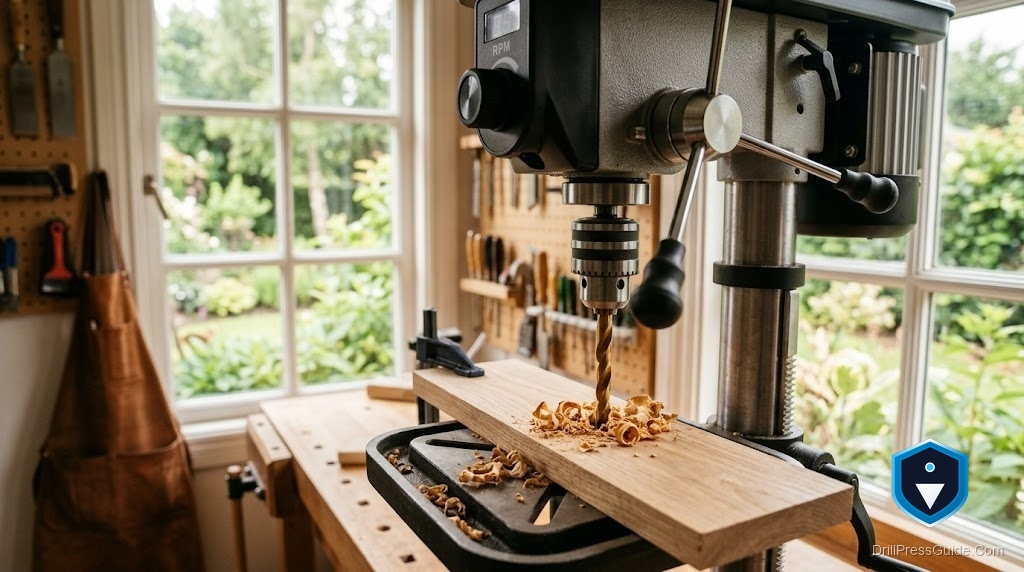
On a benchtop press, variable speed usually means a mechanical split-pulley system moved by a handle, often with a digital RPM readout on better models. You slow it down for large bits and metal, speed it up for small bits in wood, and you do it in seconds without opening the pulley cover or wrestling a belt. That convenience is not a luxury; it is what makes you actually change speed for each job instead of leaving it wrong and burning a bit.
Where it fits, and where it does not
It fits the shop that values flexibility and space: furniture makers, general woodworkers, metal hobbyists, and anyone whose projects jump between materials. It does not fit two extremes. If your work never varies, a simpler fixed press is all you need. If you drill wide holes in thick steel routinely, the benchtop motor will bog and a powerful floor model is the right tool. Knowing which of the three you are is the whole buying decision.
A representative example and what to check
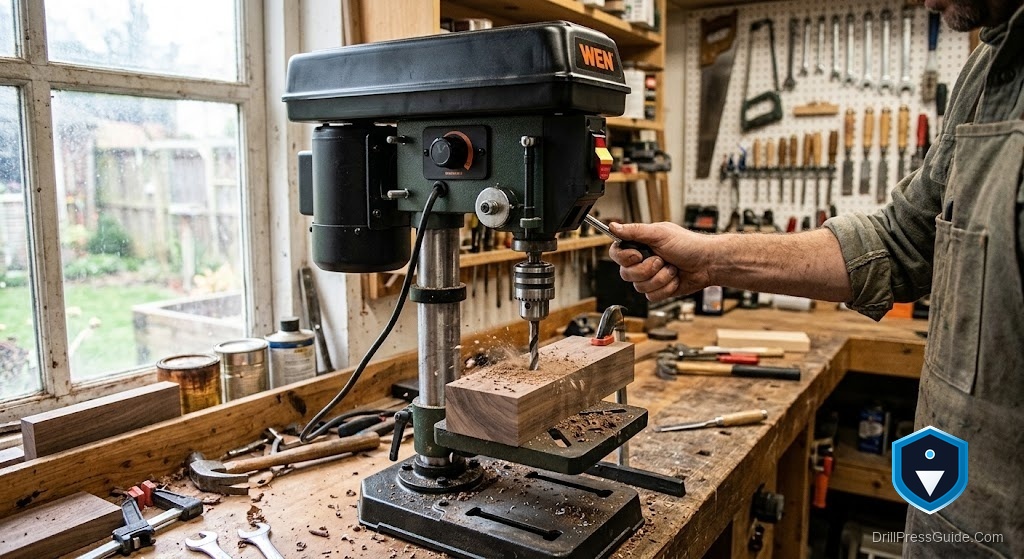
A common, well-regarded machine in this class, the WEN variable-speed cast iron benchtop drill press, shows the shape of the category: a 5-amp motor, a lever-set stepless speed range from the hundreds to a few thousand RPM, a digital speed readout, a table that bevels for angled holes, and a keyed chuck, all on a benchtop. When you shop, check five things: the speed range (wide is better), the motor amperage (more holds speed under load), the swing (how wide a piece you can center), the spindle travel (how deep a hole in one pass), and the chuck capacity. The honest limit to expect is power, because any benchtop motor slows under a heavy cut in hardwood or steel.
The verdict
A variable-speed benchtop drill press is the right machine for the shop that wants to drill many materials without surrendering floor space, which describes most home shops. It is more than a fixed press needs to be for repetitive single-material work, and less machine than heavy steel drilling demands. Before buying, weigh the speed range, motor power, swing, spindle travel, and chuck capacity against your actual projects, and accept that a benchtop motor trades some muscle for its compact size. Match it honestly and it becomes the most-used machine on your bench.
FAQ
What is a variable-speed benchtop drill press? A compact drill press that sits on a workbench and changes spindle speed by lever or dial, rather than by moving a belt on stepped pulleys.
Who is it best for? Home and hobby shops that drill a variety of materials but lack floor space or heavy-duty demands. It owns the middle between fixed presses and floor models.
How does the speed change work? Most use a mechanical split-pulley system moved by a handle, often with a digital RPM readout, so you change speed in seconds without touching a belt.
What are its honest limits? Motor power and the chuck-to-table height. A benchtop motor bogs in heavy cuts, and the compact frame limits how tall a workpiece fits under the bit.
What specs should I check? Speed range, motor amperage, swing, spindle travel, and chuck capacity. Match them to the materials and sizes you actually drill.
Can it handle metal? Light metal work, yes, at low speed with a steady feed. For frequent heavy steel drilling, a more powerful floor model is better.
References
- WEN variable-speed benchtop drill press, product specifications: https://wenproducts.com/products/wen-4212t-10-in-variable-speed-drill-press
- Woodcraft, drill press shop knowledge guide (benchtop use and speeds): https://www.woodcraft.com/blogs/shop-knowledge-guides/drill-press-table