Variable-Speed Drill Press: What It Is, Where It Fits, and What to Check
The first time you burn the tip off a bit drilling steel, or scorch a clean edge boring a big hole in oak, you learn the same lesson every machinist and woodworker eventually learns: speed matters, and one speed does not fit every job. A variable-speed drill press is the machine that lets you match the speed to the material without stopping to move a belt. For a lot of shops it is the upgrade that finally makes drilling feel controlled instead of guessed. This guide explains what it is, where it earns its place, and what to check before you buy one.
A variable-speed drill press lets you change the spindle speed while the machine runs, or with a single lever, instead of shutting down and repositioning a belt on stepped pulleys. Mechanical variable-speed models widen or narrow a split pulley to change the ratio; electronic models vary the motor speed directly. The result is fast, stepless speed changes to suit the bit and material.
The short answer on where it fits: if you drill a range of materials and bit sizes, especially large bits or metal, variable speed saves time and bits. If you only ever bore small holes in softwood, a simpler belt-change press does the same work with less fuss. What to check comes down to speed range, motor power, swing, spindle travel, and how the speed change is actually made.
How variable speed works
Mechanical variable-speed presses, the common benchtop type, use a pair of pulleys whose effective diameter changes when you turn a handle. As one pulley opens wider, its partner narrows, changing the ratio and the spindle speed smoothly through a range. A digital readout on better models shows the current RPM so you are not guessing. Electronic variable-speed presses instead drive the motor through a controller, changing speed at the dial with full torque management. Both beat stopping to shift a belt by hand.
Where it fits, and where it does not
Variable speed pays off when your work spans materials. Metal wants low speed and steady feed; large-diameter bits in wood want low speed to avoid burning; small bits in softwood want high speed. If your day includes several of those, dialing the speed in seconds keeps edges clean and bits alive. Where it does not pay off is a narrow, repetitive workflow, drilling the same small hole in the same material all day, where a fixed or belt-change press never needs adjusting and stays simpler.
What to check before you buy
Five numbers tell you most of what you need. Speed range: a wide span, roughly the high hundreds up to a few thousand RPM, covers big bits to small. Motor power: enough amperage or horsepower to hold speed under load, or the press bogs down in hardwood and steel. Swing: the distance from the column to the spindle centerline, doubled, which sets how wide a workpiece you can center a hole in. Spindle travel: how far the quill plunges, which limits hole depth in one pass. And chuck capacity: the largest bit shank the chuck accepts. Match these to your work rather than to a spec sheet.
A representative benchtop example
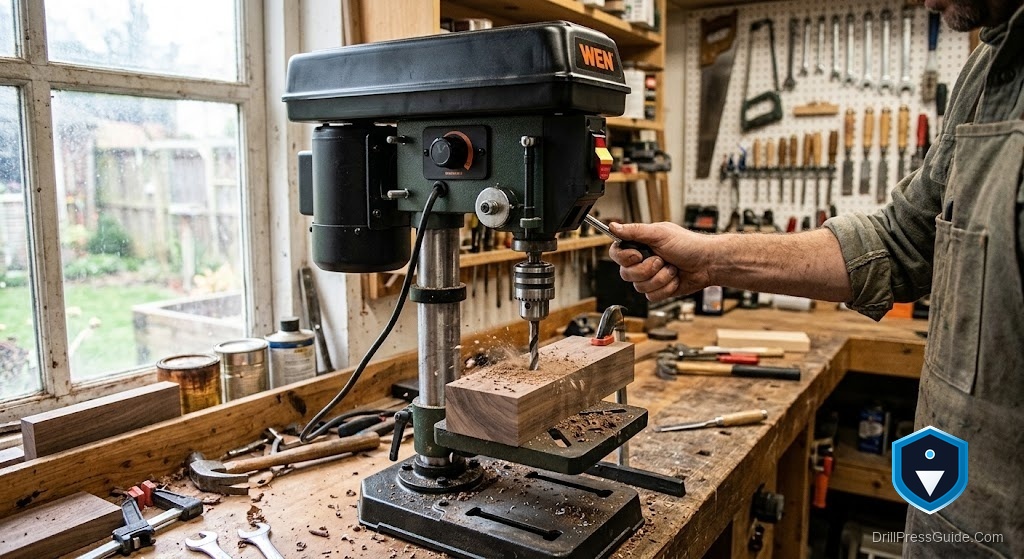
To make the numbers concrete, a widely used benchtop model like the WEN variable-speed cast iron drill press shows the shape of a home-shop machine: a 5-amp motor, a stepless speed range in the hundreds to a few thousand RPM set by a lever, a digital readout, a beveling table, and a keyed chuck, all in a benchtop footprint. That combination handles wood drilling well and light metal work adequately. The honest limit of an entry-level press is power: the motor will slow under a heavy cut in hardwood or thick steel, which is where larger floor models with more amperage pull ahead.
The verdict
A variable-speed drill press is worth it when your work spans materials and bit sizes, because matching speed to the job protects your edges and your bits and saves the time of moving a belt. It is overkill for a narrow, repetitive workflow that never needs a different speed. Before buying, check the speed range, motor power, swing, spindle travel, and chuck capacity against the work you actually do. Get those right and the machine feels like it is finally on your side; ignore them and you will have paid for convenience you never use.
FAQ
What does variable speed actually change? The spindle RPM, without stopping to move a belt. Mechanical models use a split pulley set by a lever; electronic models vary the motor speed at a dial.
Do I need variable speed, or is a belt-change press fine? If you drill a range of materials and bit sizes, variable speed saves time and bits. For one repetitive job, a belt-change press does the same with less complexity.
What speed do different jobs want? Metal and large-diameter bits want low speed; small bits in softwood want high speed. Matching speed to the job keeps edges clean and bits sharp.
What specs matter most? Speed range, motor power, swing, spindle travel, and chuck capacity. Match them to your typical work rather than chasing the biggest numbers.
Why does my press slow down in hardwood? The motor lacks the power to hold speed under that load. Entry-level presses bog in heavy cuts; larger floor models with more amperage hold up better.
Is a benchtop variable-speed press enough for metal? For light metal work, yes. For heavy or frequent steel drilling, a more powerful floor-standing press is the better tool.
References
- WEN variable-speed benchtop drill press, product specifications: https://wenproducts.com/products/wen-4212t-10-in-variable-speed-drill-press
- Woodcraft, drill press shop knowledge guide (speeds and material matching): https://www.woodcraft.com/blogs/shop-knowledge-guides/drill-press-table