
Powermatic 1150 Variable-Speed Drill Press: What Owners Should Check Before Buying or Repairing
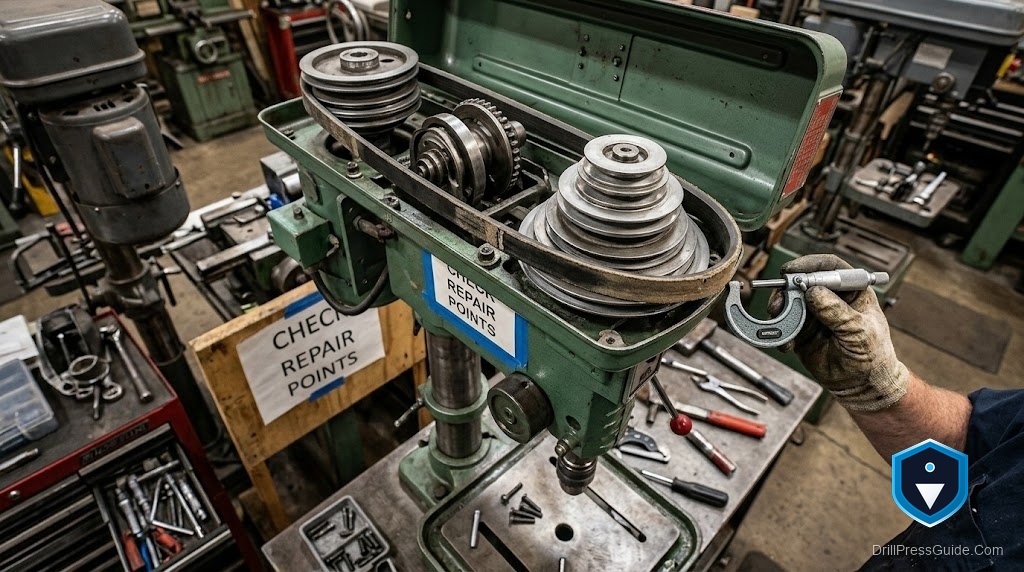
The Powermatic 1150 is a vintage floor-standing variable-speed drill press from Powermatic’s American manufacturing era — a machine that stopped production decades ago but remains highly regarded on the used market for its build quality and genuine variable-speed capability through a mechanical Reeves drive system. If you are considering buying one or repairing one you already own, the inspection and repair priorities are specific to the variable-speed drive, which is the most mechanically complex part of the machine and the first place to assess. This guide covers what to check and what to expect.
Documented specifications from surviving examples and period literature: 15-inch swing (some examples listed as 14-inch), 3/4 HP, 115/230V, 1-phase, 1725 RPM base motor, variable spindle speeds approximately 475 to 4,800 RPM (through the Reeves drive), 6-inch quill travel, 3-inch column diameter, JT33 (Jacobs #33) spindle taper, 14-1/4 by 10-1/4-inch table, approximately 350 lbs shipping weight. The variable-speed range is the defining feature: a true mechanical variable drive allows continuous speed selection within the range without stopping the machine, which is a significant operational advantage over step-pulley alternatives.
Note: Powermatic’s current drill press line (PM2800B, PM2820EVS, PM2815FS) is distinct from the 1150. If you are looking for a current Powermatic machine, check powermatic.com directly. This guide addresses the vintage 1150.
Straight answer: before buying or repairing a Powermatic 1150, inspect the Reeves drive mechanism first. It is the most repair-intensive component and the most likely source of problems in a machine that has sat unused. A working variable drive in good condition makes this machine genuinely exceptional; a seized or damaged drive requires either rebuild or conversion.
The Reeves drive: what it is and what to inspect
A Reeves drive is a mechanical variable-speed transmission using a pair of variable-pitch sheaves connected by a wide flat belt. Turning a handwheel adjusts the sheave pitch, changing the effective drive ratio continuously across the speed range. The result is true stepless speed control from approximately 475 to 4,800 RPM while the machine runs.
What to inspect:
- Handwheel operation: With power off, turn the speed-adjustment handwheel through its full range. It should turn smoothly without binding or grinding. Stiff action indicates a dry or corroded drive that needs lubrication; binding or grinding indicates more serious wear.
- Variable-pitch sheave condition: Inspect the sheaves for scoring, corrosion, and proper alignment. Scoring on the sheave faces means the belt has been slipping.
- Drive belt condition: The wide flat belt for the Reeves drive is a specific size; measure it carefully if replacement is needed. Specialty belt suppliers carry Reeves-type belts by measurement.
- Spindle belt condition: The secondary belt from the drive output to the spindle pulley is a conventional V-belt; replace by measurement.
What machines in good condition look like in practice
A Powermatic 1150 in good working condition is described consistently by experienced users as one of the finest light-industrial drill presses ever produced for a small shop. The cast-iron construction, 6-inch quill travel, and true variable speed combine capabilities that current consumer presses do not match. Community consensus on value for a working, well-maintained example is strong: properly advertised examples have sold for over a thousand dollars.
Quill, table, and column checks
Beyond the Reeves drive:
- Quill bearings: Extend the quill by hand and check for smooth action and no lateral play.
- Table lock and tilt: Verify the table clamps firmly and holds position.
- Column casting: Inspect for cracks, particularly at the base and table bracket.
- On/Off switch: Some examples are missing or have failed switches; replacements are available through motor supply houses.
Parts and support
This is a discontinued machine. Powermatic (powermatic.com) does not carry parts for the 1150. Sources:
- eBay and machinist forums: Used-donor 1150s and individual parts appear on eBay. Practical Machinist and Hobby-Machinist forums have active communities with 1150 knowledge.
- Generic consumables: Chuck by JT33 taper and capacity. A 5/8-inch keyed JT33 chuck fits directly. A universal ratcheting chuck key covers a lost key.
- Belts: Reeves drive belt by measurement from a specialty belt supplier; spindle V-belt by measurement from a standard V-belt supplier.
- Bearings: By OD/ID/width measurement from a bearing supplier.
The honest flaws
Two honest flaws. First, the mechanical Reeves drive is the reason to buy this machine, but also its primary maintenance burden: a seized or worn drive requires significant rebuild effort and parts that are not available new. Second, the machine is large and heavy (approximately 350 lbs); moving it requires planning. Neither is a surprise for a 15-inch floor press of this class, but both set realistic expectations.
Conclusion: a remarkable vintage machine that rewards careful inspection
The Powermatic 1150 is a genuinely excellent machine in good working condition, and its condition depends primarily on the Reeves drive.
- 15-inch swing, 3/4 HP, 475–4,800 RPM variable speed (Reeves drive), 6-inch quill travel, JT33 spindle, 350 lbs.
- Inspect the Reeves drive handwheel action, sheaves, and drive belt first.
- Also check quill bearings, table lock, column casting, and switch.
- Parts via eBay, machinist forums, and used-donor sourcing; chuck and belt by universal measurement.
FAQ
What is a Reeves drive? A mechanical variable-speed transmission using variable-pitch sheaves and a wide flat belt, allowing continuous speed adjustment across the full RPM range while the machine runs.
What speed range does the 1150 offer? Approximately 475 to 4,800 RPM, continuously variable through the Reeves drive.
What spindle taper does it use? JT33 (Jacobs #33).
What is the quill travel? 6 inches.
Where do I find parts? eBay for used components; machinist community forums (Practical Machinist, Hobby-Machinist); belt suppliers for drive and spindle belts; bearing suppliers by measurement.
Is the current Powermatic PM2800B the same machine? No. The PM2800B is a current production machine from a different design generation. The 1150 is a discontinued vintage press.
References
- Powermatic 1150 specifications, The Equipment Hub: https://theequipmenthub.com/product/powermatic-1150-vintage-14-floor-model-variable-speed-drill-press/
- Practical Machinist forum, Powermatic 1150 history: https://www.practicalmachinist.com/forum/threads/powermatic-1150-drill-press-history-lesson.198954/
- Hobby-Machinist forum, Powermatic 1150 thread: https://www.hobby-machinist.com/threads/powermatic-1150-drill-press.120351/
- Garage Journal, Powermatic 1150 value: https://www.garagejournal.com/forum/threads/powermatic-1150-drill-press-capability-and-value.358353/


