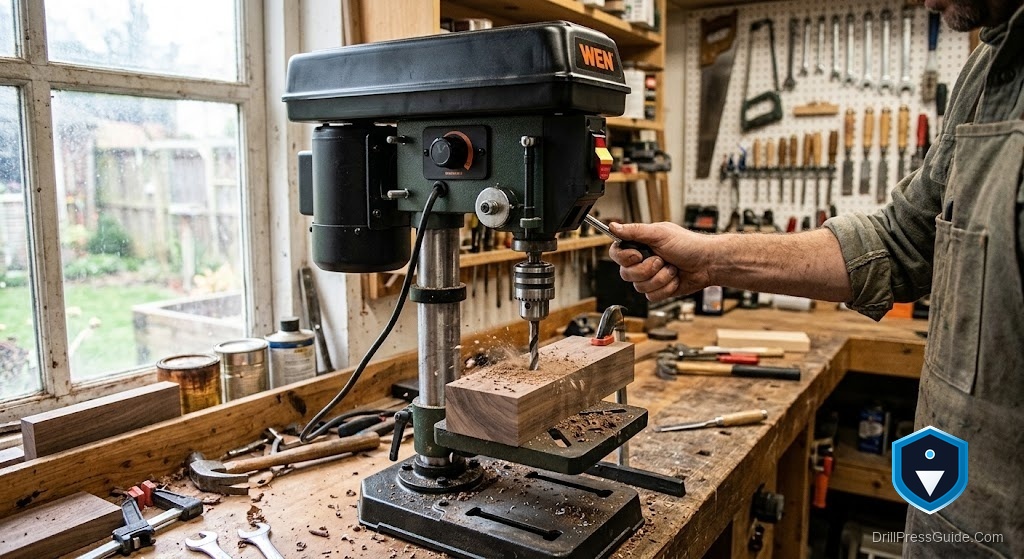
Understanding the Rockwell 3 8 Variable-Speed Drill Press
The Rockwell name sits at an interesting crossroads in tool history. Rockwell Manufacturing owned Delta for decades and built serious stationary machinery, and Rockwell also produced portable drills, including a 3/8-inch variable-speed model that owners mounted in stands to drill upright. When someone says Rockwell 3/8 variable-speed drill press today, they almost always mean that portable drill and stand combination, not one of Rockwell’s big floor machines. Understanding the Rockwell 3 8 variable-speed drill press starts with separating those two worlds, because it changes what you can expect and what you can buy.
The Rockwell 3/8 variable-speed drill press is, in typical usage, a vintage Rockwell 3/8-inch portable drill with a variable-speed trigger, fitted into a drill stand to function as a light pillar drill. Rockwell also made dedicated Delta-Rockwell drill presses, which are separate, heavier machines. The portable-drill version is long discontinued, sold used, and supported today only by universal consumables and salvaged parts.
Straight answer: figure out whether you have the portable drill in a stand or a true Delta-Rockwell press, because they are entirely different in weight, capability, and parts support. For the portable-drill version, the realistic serviceable part is the 3/8-inch chuck. For a genuine Delta-Rockwell press, you are in vintage-machinery territory with its own diagrams and a much more capable machine.
Two very different Rockwells
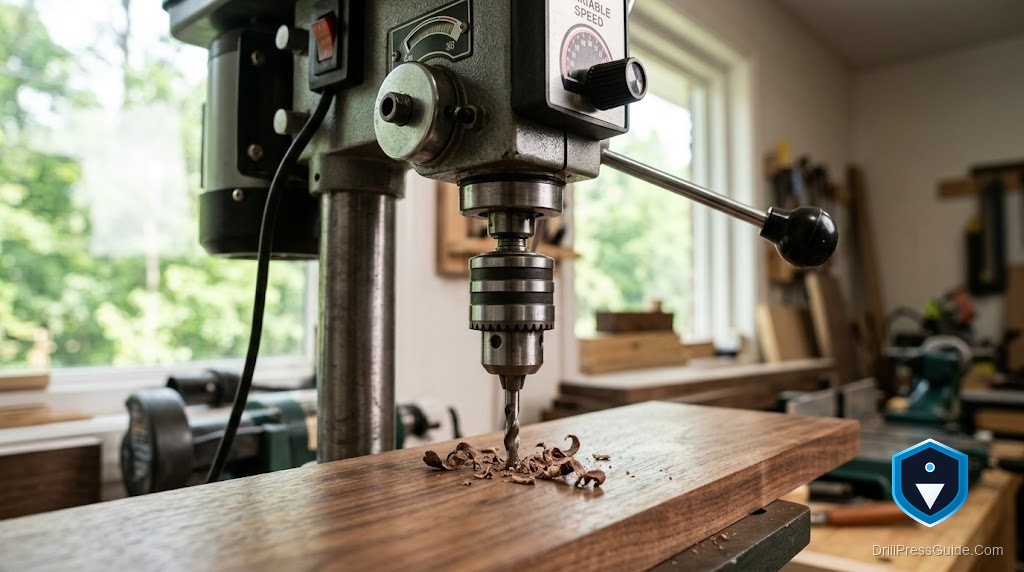
This is the distinction that saves people from disappointment. A Delta-Rockwell drill press is a substantial cast-iron stationary machine with its own motor, spindle, and quill, the kind of press collectors restore and rely on. A Rockwell 3/8 variable-speed drill in a stand is a handheld tool clamped upright, with the drill itself providing the motor and chuck.
Tell them apart by weight and construction. If the head is a self-contained casting with a pulley cover and a dedicated spindle, it is a Delta-Rockwell press, and you should look for its model number and vintage-machinery documentation. If it is a trigger-operated drill held in a frame, it is the portable version, and the drill is the whole engine. Confirm which you own before spending a dollar on parts.
The portable version: what to check
If you have the drill-and-stand type, check the model number stamped on the drill, commonly a Rockwell portable model such as the 4130 series, and note the stand separately if it has its own markings. The variable speed comes from the trigger, so holding a steady RPM takes a practiced hand, unlike the fixed pulley steps of a dedicated press.
The one part you can realistically renew is the chuck. Most of these drills carry a 3/8-inch chuck on a standard threaded or tapered mount, and if it is worn or missing its key, a replacement keyed chuck with a universal ratcheting chuck key restores service once you confirm the mount. Add a drill press vise to make the small table safe and steady. Everything else, the trigger switch, the armature, the stand castings, comes from another used unit.
The honest limits
A portable drill in a stand is a compromise, and it deserves an honest label. The clamp adds play, the trigger makes steady speed harder to hold than a pulley-driven press, and rigidity is modest. It handles light holes in wood and thin metal perfectly well for occasional jobs, which is what it was always meant for. It is not a precision machine, and no parts hunt will make it one. If your work needs repeatable accuracy, this is not the tool.
For the genuine Delta-Rockwell press owners, the story flips: those are rigid, capable machines, and the limit is simply parts availability, since they too are supported by used spares and universal consumables rather than new OEM stock.
Who should keep it, and who should move on
Keep a Rockwell 3/8 variable-speed setup if you own it, it works, and you do light, occasional drilling and enjoy vintage tools. Keep a Delta-Rockwell press eagerly if it is complete and runs, because those are genuinely good machines worth restoring.
Move on from the portable version if you need precision or drill often, or if you are missing either the drill or the stand, since completing a decades-old set rarely beats an inexpensive modern press. And do not buy an incomplete Delta-Rockwell priced like a whole one; a machine missing its spindle or motor is a donor, not a deal.
Conclusion: know which Rockwell you have
The Rockwell 3/8 variable-speed drill press rewards a moment of careful identification more than almost any tool in this class.
- Determine whether you have a portable drill in a stand or a true Delta-Rockwell press.
- For the portable version, the 3/8-inch chuck is the one part you can renew new.
- Expect modest accuracy from any drill-in-a-stand setup.
- Restore a complete Delta-Rockwell; pass on incomplete machines priced as whole.
FAQ
Is the Rockwell 3/8 variable-speed a stationary drill press? Usually not. It is typically a portable 3/8-inch variable-speed drill mounted in a stand. Rockwell’s stationary presses were the separate, heavier Delta-Rockwell machines.
How do I tell the two apart? By construction. A self-contained cast head with a pulley cover is a Delta-Rockwell press; a trigger-operated drill in a frame is the portable version.
Can I buy parts for the portable version? Mainly just the chuck. Most other parts must come from another used unit, while a standard replacement chuck and key still fit.
What model is the Rockwell portable drill? Often a Rockwell portable such as the 4130 series. Check the model number stamped on the drill to be sure.
What chuck size does it use? A 3/8-inch chuck, typically on a standard threaded or tapered mount. Confirm the mount before ordering a replacement.
Is it accurate enough for precise work? No. The clamp and variable-speed trigger introduce play, so it suits light, occasional drilling rather than precise holes.
Are Delta-Rockwell presses worth restoring? Yes when complete and running. They are rigid, capable machines, limited today mainly by used-only parts availability.
References
- VintageMachinery.org, Rockwell Manufacturing Co. (manufacturer index): https://vintagemachinery.org/mfgindex/detail.aspx?id=118
- VintageMachinery.org, Delta-Rockwell drill press publications: https://vintagemachinery.org/pubs/
- Rockwell portable drill references (vintage tool archives): https://chrisgrossman.com/