
RIKON 12 Variable Speed Drill Press Review: A Practical Assessment
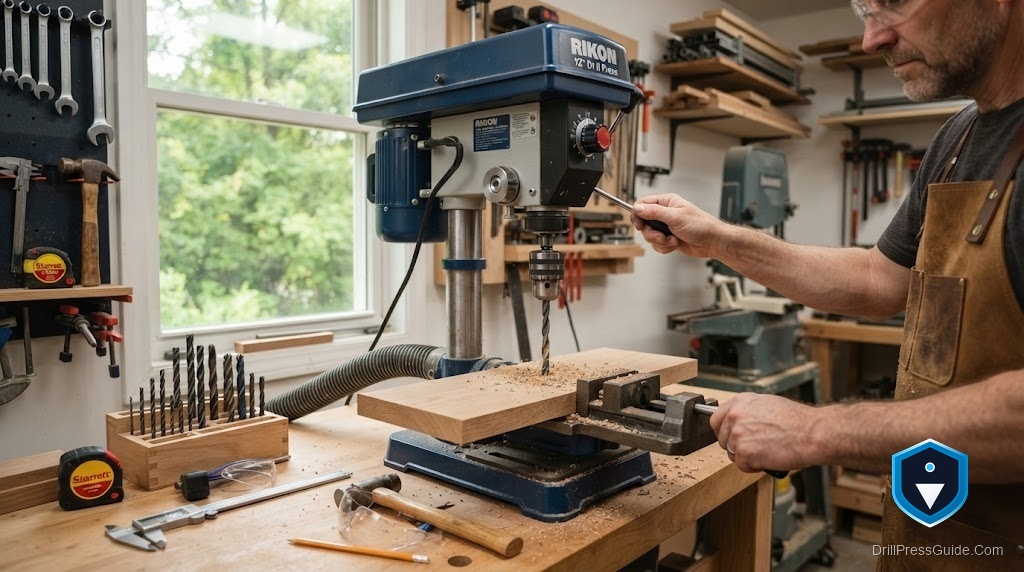
A new drill press is a big addition to any shop. It takes up space, it demands its own circuit, and once it is bolted down, you are committed. The RIKON 30-212VS is a 12-inch variable-speed benchtop model that promises to replace the belt-shifting hassle with a simple lever. It also packs a digital RPM readout, a laser guide, and a 3/4-horsepower motor, which is stronger than most benchtop competitors. But promises and performance are not always the same. I have spent time with this machine, read hundreds of owner reports, and compared it to the WEN and JET models it competes against. Here is what actually matters.
The RIKON 30-212VS is a benchtop drill press with a 12-inch swing, a variable-speed pulley system controlled by a lever, and a 3/4-horsepower induction motor. It includes a digital speed readout, an LED work light, a laser X-Y drilling guide, and a clamp-friendly thin-edge table designed for woodworking. It is sold under the RIKON brand, which is a well-known supplier of woodshop machinery, and it is widely available through major retailers.
The RIKON 30-212VS is a good drill press for woodworkers who want variable speed without belt changes, and who value convenience features like the digital readout and light. It is not the most refined machine in its class, but it offers a strong motor and useful features at a competitive price. For hobbyists and intermediate woodworkers, it is a sensible choice. For professionals who need absolute runout tolerance or heavy metal capacity, there are better options.
Motor and Power
The 3/4-horsepower motor is the standout feature. Most benchtop presses in this price range use 1/3- or 1/2-horsepower motors. The extra power means the RIKON can drive larger Forstner bits and hole saws without stalling. In hardwood, a 2-inch Forstner bit bogs down on a 1/3-horsepress but keeps cutting on the RIKON. The motor is a standard induction type, which runs quietly and does not overheat during long sessions.
The honest flaw is that the motor mounting is not as rigid as on higher-end machines. Some users report slight vibration at the highest speeds, which can be reduced by tightening the motor mount bolts and checking belt tension. It is not a dealbreaker, but it is something you should check during assembly.
Who should skip it: anyone who needs to drill heavy metal daily. The motor is strong for wood, but the speed range and table design are optimized for woodworking, not steel plate.
Variable Speed and Digital Readout
The variable-speed lever is the reason most buyers look at this machine. Instead of opening the head, loosening the motor, and shifting the belt across pulleys, you turn a lever on the side of the head. The speed changes smoothly, and the digital readout tells you the exact RPM. For woodworkers who switch between small brad-point bits and large Forstner bits, this saves serious time.
The flaw is that the lever action is stiff, especially when the machine is cold. You need to apply deliberate pressure. The digital readout is accurate enough for woodworking, but it is not a precision instrument. If you are doing metalwork where exact RPM matters, verify with a tachometer. The readout can drift by 50 to 100 RPM at the extremes of the range.
Who should skip it: metalworkers who need exact, repeatable speed settings. A stepped pulley system or gear-head press is more reliable for that.
Table and Work Area
The table is 12-1/2 inches in diameter, which is adequate for most furniture and cabinet work. The thin edge is designed to let clamps reach over the rim, which is a thoughtful touch for woodworkers who use hold-downs and fences. The table tilts 45 degrees left and right for angled drilling. The crank for height adjustment is smooth, though not as precise as on a JET.
The flaw is table flatness. A small percentage of units ship with tables that are slightly concave or convex. Most are flat enough for woodworking, but if you plan to use a cross-slide vise for precision metalwork, check the table with a straightedge during the return window. The paint on the table is also thin and can chip if you slide metal vises across it.
Who should skip it: machinists and metalworkers who need a dead-flat table surface. This is a woodworking table, not a milling surface.
Chuck and Runout
The included 5/8-inch keyed chuck is functional. Runout is generally acceptable for woodworking, in the range of 0.003 to 0.005 inches. That is fine for most hole-saw and bit work. Some owners report better runout after upgrading to a higher-quality chuck, which is a common upgrade on any benchtop press in this range.
The flaw is the chuck key retention. The onboard storage is a small clip that can loosen over time. It is a minor annoyance, but worth noting. The chuck itself is not a quick-change type, so you will need the key for every bit change.
Who should skip it: anyone who needs quick-change tooling or sub-thousandth runout for precision work.
Laser and Light
The laser X-Y guide projects crosshairs onto the workpiece, which helps beginners align the bit. The LED light is mounted above the table and illuminates the work area adequately. Both are nice to have.
The flaw is that the laser is battery-powered and can shift if bumped. It is not a substitute for a center punch or scribed line. Experienced woodworkers often ignore it. The light is also somewhat dim compared to a dedicated shop light. Treat both as bonuses, not reasons to buy.
Assembly and Build Quality
Assembly takes 30 to 45 minutes. The head is heavy but manageable for one person with a helper. The instructions are clear, and the hardware is organized. The paint is decent, and the castings are generally clean. Some units ship with minor paint chips or rough edges, but nothing that affects function.
The most common complaint from owners is the slight vibration at high speed, which is usually caused by the motor mount bolts being loose from the factory. Tightening them and checking belt tension fixes it. The table is generally flat, but a few units need minor adjustment. The variable speed lever is stiff but loosens with use. Overall, the build quality is good for the price, but it is not JET-level.
Comparison to WEN and JET Competitors
| Feature | RIKON 30-212VS | WEN 4214T | JET JDP-12 |
|---|---|---|---|
| Motor | 3/4 HP | 5A | 1/2 HP |
| Speed | Variable | Variable 580-3200 | 16 speed 200-3630 |
| Swing | 12 in | 12 in | 12 in |
| Table | 12.5 in diameter | 9.5 x 9.5 in | Cast iron, slotted |
| Table tilt | 45 degrees | 45 degrees | 45 degrees |
| Quill travel | 3-1/8 in | 3-1/8 in | 3 in |
| Best for | Woodworking, variable speed | Home shop general | Professional precision |
Final Verdict
The RIKON 30-212VS is a good benchtop drill press for woodworkers who want variable speed without belt changes and a strong motor for large bits. The 3/4-horsepower motor is a genuine advantage over the WEN and JET in this class. The digital readout and light are useful conveniences. The build quality is good but not exceptional. For hobbyists and intermediate woodworkers, it is a sensible choice. For professionals who need absolute precision or heavy metal capacity, the JET JDP-12 or JDP-17 are better investments. The RIKON is a woodworking machine, and it should be judged as such.
FAQ
Is the RIKON 30-212VS good for metal? It can handle thin aluminum and brass with small bits, but the speed range and table are optimized for wood. For regular metal work, a JET or WEN is better.
How does it compare to the WEN 4214T? The RIKON has a stronger motor and a smoother variable speed lever. The WEN has a larger table and a better reputation for consistent quality control.
Can I upgrade the chuck? Yes. The 5/8-inch arbor is standard, and upgrading to a better chuck improves runout and grip. It cannot fix a misaligned spindle.
Is the laser guide useful? It helps beginners align the bit, but experienced users rely on layout lines and a center punch. It is a bonus, not a necessity.
Does the table tilt? Yes, 45 degrees left and right. It is functional but not as smooth as higher-end presses.
Where can I buy this drill press? It is sold through major woodworking retailers, Amazon, and some home improvement stores. Availability varies by region and season.
What is the warranty? Standard RIKON warranty. Support is through the retailer and RIKON customer service. Parts availability is good compared to smaller brands.
How much does it weigh? Approximately 90 to 100 pounds. It is manageable for two people or one person with a dolly.
References
- RIKON Power Tools. “30-212VS 12-Inch Variable Speed Drill Press.” Product manual and specifications. Accessed via manufacturer listing.
- Amazon customer reviews for RIKON 30-212VS. Accessed via retailer listing.
- Woodworking Talk Forum. “RIKON 30-212VS drill press.” Community feedback and owner reports.
SEO Metadata


