
Metal Variable-Speed Drill Press: Speed, Tooling, and Workholding for Clean Holes
The first time you watch a twist bit skate across a piece of steel plate and leave a bright silver scar, you learn the lesson that no drill press marketing page teaches: the machine is only as good as the speed it can hold. A metal variable-speed drill press earns its keep here. It lets you dial the spindle down to where steel wants to be cut, then back up for a small hole in aluminum, without opening a cover and wrestling a belt onto a different pulley. For anyone who moves between materials in a single afternoon, that one feature changes how the whole machine feels.
A variable-speed drill press is a stationary drilling machine whose spindle RPM can be changed continuously, usually by a handwheel that shifts a variable-diameter pulley, rather than in fixed steps set by moving a belt. For metalwork, the point is control: it holds a low, steady speed under the higher feed pressure that cutting steel demands.
If you cut mostly steel and stainless, the honest answer is that variable speed is worth paying for, because those materials need low RPM that stepped-pulley benchtop machines often cannot reach cleanly. If you drill wood and the occasional aluminum bracket, a good stepped-pulley press does the same job for less. Buy the variable speed for the metal, not for the convenience alone.
Why speed is the whole game in metal
Drilling metal is a heat problem before it is anything else. Spin a bit too fast and the cutting edge overheats, loses temper, and stops cutting, and the hole work-hardens under the rubbing. The rule that governs everything is surface speed, the rate the cutting edge travels through the material, measured in surface feet per minute. Every material has a range it likes, and you convert that to spindle RPM with the drill diameter.
The working formula is RPM = (surface speed x 3.82) / drill diameter in inches. High-speed steel drills like mild steel at roughly 80 to 100 surface feet per minute, stainless far lower at 20 to 40, and aluminum much higher at 200 to 300. Run the numbers and a 1/4-inch bit in mild steel wants about 1,375 RPM, the same bit in 300-series stainless wants closer to 460, and in aluminum it happily spins past 2,600. A benchtop press that bottoms out at 600 RPM simply cannot cut stainless correctly at any useful diameter.
That gap is the case for variable speed in one paragraph. When the lowest speed you can reach is still too fast for the material in front of you, no amount of technique saves the bit.
Two presses worth comparing
Most home metalworkers are choosing between a mid-size variable-speed bench press and a heavier floor machine. Two make a clean head-to-head.
The WEN 4214T 12-inch variable-speed drill press dials any speed from 580 to 3,200 RPM with a digital readout, so you can match a number to a material without counting belt steps. It has enough spindle travel for most bench work and a cast table that stays put. Its honest flaw is that its lower limit still sits above where large-diameter stainless wants to run, so for a 1/2-inch hole in stainless you will be feeding gently and babysitting heat. Skip it if stainless plate is your daily work.
The WEN DP1263V 12-inch variable-speed press covers a similar speed band with the same dial-and-read convenience, and buyers pick it for a slightly cleaner low end and a comfortable depth stop. Its drawback is the one every variable-speed mechanism shares: the variable pulley adds parts that a plain stepped-pulley machine does not have, and over years of hard use that is more to eventually service. Against each other, the two are close, and the deciding factor is which speed range and table height suit your bench, not the badge.
Whoever you are, pair either machine with a cobalt bit set for ferrous work. A cobalt M35 drill bit set holds its edge in stainless far better than black-oxide HSS, and in metal that is the difference between a hole and a smoking bit.
Tooling that matches the material
A variable-speed press rewards good bits and punishes cheap ones, because you are finally running the correct speed and the bit becomes the limit. Cobalt (M35 or M42) for stainless and tool steel, standard HSS for mild steel and aluminum, and a proper 118 or 135 degree split point so the bit starts without walking. Screw-machine (stubby) bits are more rigid and wander less in metal than long jobber bits.
For holes past about 1/2 inch, step up with a pilot hole rather than asking a large bit to plunge cold. And keep cutting fluid at the machine. It is the cheapest thing on the bench and it carries heat away, extends edge life, and leaves a cleaner wall on steel and stainless. Skip it on aluminum if you like, but never on anything ferrous.
Workholding is not optional on metal
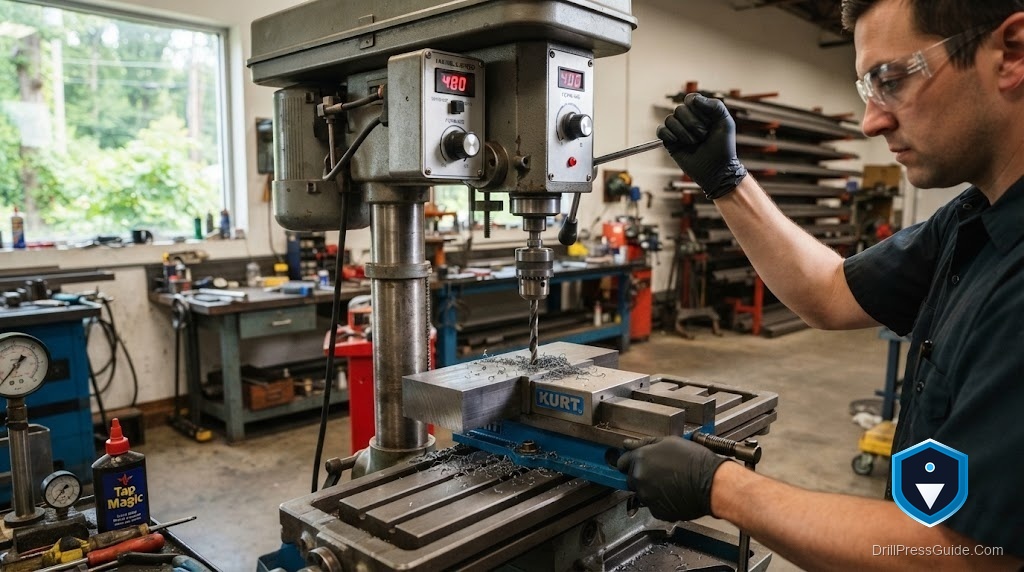
Wood you can sometimes hold by hand. Metal you cannot, ever. A drill bit that grabs in steel will spin the workpiece into a whirling blade faster than you can let go, and that is how people lose fingers and stitches. Clamp every piece: a drill press vise bolted to the table for flat stock, a V-block for round bar, and a clamp on anything the vise cannot fully capture.
The payoff beyond safety is accuracy. A clamped part cannot creep as the bit breaks through, so the hole stays round and on-center, and breakthrough does not snatch. If you can rock the workpiece with a finger, it is not clamped enough.
The verdict
A metal variable-speed drill press is the right buy for anyone whose work regularly includes steel and stainless, because those materials live at low RPM that stepped-pulley benchtop machines struggle to reach. If your metal is occasional and mostly aluminum, save the money and run a solid stepped-pulley press with good bits and fluid. Either way, the machine is half the system.
- Match RPM to the material with the surface-speed formula; stainless and steel want it low.
- Buy variable speed for genuine steel and stainless work, not for convenience alone.
- Run cobalt bits in ferrous metal and keep cutting fluid at the machine.
- Clamp every workpiece; a spinning part is the most common serious injury on a press.
Get those four right and a mid-range variable-speed press out-drills a fancier machine used carelessly.
Frequently asked questions
What speed should a drill press run for metal? It depends on the material and bit size. Use RPM = (surface speed x 3.82) / diameter. Mild steel runs at about 80 to 100 surface feet per minute, so a 1/4-inch bit wants roughly 1,375 RPM. Stainless runs far slower, near 460 RPM for the same bit.
Is a variable-speed drill press worth it for metal? Yes if you regularly cut steel or stainless, because those need low speeds a stepped-pulley benchtop press often cannot reach. For mostly wood and light aluminum, a stepped-pulley machine is fine.
Can any benchtop drill press drill steel? Most can drill mild steel with the right bit, speed, and fluid. Stainless is harder because it needs very low RPM and cobalt bits, and many benchtop presses cannot slow down enough for large stainless holes.
Do I need cobalt bits or will HSS work? Standard HSS works in mild steel and aluminum. For stainless and tool steel, cobalt (M35 or M42) holds its edge far better and is worth the upgrade.
Why does my bit squeal and stop cutting in stainless? Almost always too much speed and not enough steady feed, which lets the bit rub and work-harden the surface. Slow the spindle, push firmly, and use cutting fluid.
How do brands like Jet, Delta, and Grizzly compare? They all make capable variable-speed presses at various sizes. Judge them on lowest attainable RPM, spindle travel, table rigidity, and quill runout rather than the name, since those specs decide how the machine cuts metal.
References
- Norseman Drill and Tool, drilling feeds and speeds chart: http://www.norsemandrill.com/feeds-speeds-drill.php
- Viking Drill and Tool, feed and speed reference: http://www.vikingdrill.com/viking-Drill-FeedandSpeed.php
- Carbide Depot, drill speeds and feeds formulas: https://www.carbidedepot.com/formulas-drills-speeds.htm
- OSHA, machine guarding and point-of-operation safety: https://www.osha.gov/machine-guarding


