
How Does a Variable-Speed Drill Press Work: What It Is, Where It Fits, and What to Check
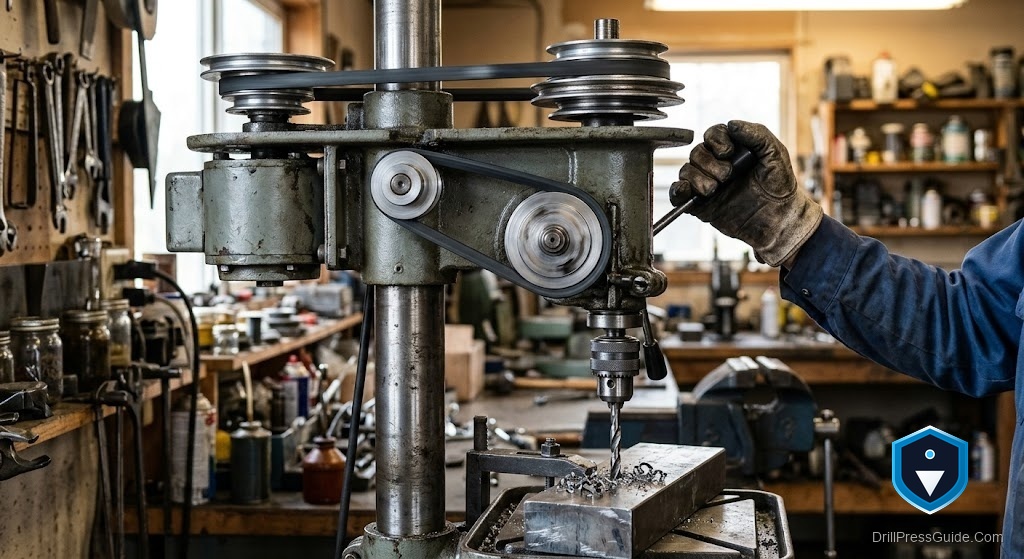
Move the belt on an ordinary drill press and you get maybe five fixed speeds, chosen by opening the cover and wrestling a belt onto different pulleys. A variable-speed machine skips all that: you turn a dial while the motor runs and the spindle smoothly changes speed. It feels like magic the first time, and it is genuinely useful, but it is worth knowing what is actually happening inside, because the mechanism explains both the appeal and the limits of these machines.
A variable-speed drill press changes spindle speed continuously without moving a belt, either by a mechanical variable-diameter pulley system you adjust with a handwheel while the motor runs, or by an electronic drive that varies the motor speed itself. Both let you dial an exact speed for the bit and material, rather than jumping between a few fixed belt positions.
The problem it solves
Speed is the setting that matters most on a drill press, and the right speed changes with every bit and material: slow for large bits and metal, fast for small bits in wood. On a fixed-speed machine you either stop and move the belt or, more often, run the wrong speed because moving the belt is a chore. Variable speed removes that friction, which is why matching speed to the job, the core of guides like Pro Tool Reviews’, suddenly becomes easy to actually do.
The two ways it works
Mechanical variable speed. The common workshop design uses a variable-diameter pulley, sometimes called a Reeves drive. As you turn a handwheel, the effective diameter of the pulleys changes, so the drive ratio changes smoothly and the spindle speeds up or slows down. The motor keeps running at its normal speed while the ratio does the work, which is why you adjust it with the machine on. A model like the WEN 4214T variable-speed drill press works this way, with a dial and a readout instead of a belt to move.
Electronic variable speed. The other approach varies the motor’s speed electrically, typically a suitable motor paired with a drive that changes the power it receives. Here the ratio stays fixed and the motor itself turns faster or slower. This is common on some benchtop and magnetic drills.
Either way, the result at the chuck is the same: a smooth, adjustable spindle speed you set to a number rather than a belt step.
Mechanical versus electronic at a glance
| Feature | Mechanical (variable pulley) | Electronic drive |
|---|---|---|
| How speed changes | Handwheel changes pulley diameter | Drive changes motor speed |
| Adjust while running | Yes, and usually required | Often yes |
| Torque at low speed | Stays strong, ratio does the work | Can drop unless designed for it |
| Typical wear point | Variable-pulley mechanism | Electronics and motor |
What to check before you rely on it
Two honest cautions. First, low-speed torque: a good variable-speed machine holds torque low in the range, but a weak electronic setup can lose pulling power down low, exactly where big bits need it, so look at how the machine delivers torque, not just its speed span. Second, adjust mechanical variable-speed drives the way the manual says, usually with the motor running, since turning the handwheel while stopped can strain the mechanism. And as with any press, the mechanism does not change the safety rules from OSHA and CCOHS: clamp the work and keep the guard closed.
Is it worth it?
If you drill one material at one size all day, fixed speed is fine and cheaper. If you switch between wood and metal, large and small bits, or run hole saws and Forstner bits, variable speed pays for itself in convenience and in bits you do not burn, because you will actually use the right speed instead of settling for whatever the belt was left on.
The verdict
A variable-speed drill press changes spindle speed smoothly without moving a belt, either through a mechanical variable-diameter pulley you adjust while the motor runs or through an electronic drive that varies the motor itself. It solves the real problem that people rarely bother to move a belt, so they run the wrong speed. Three takeaways: the mechanism is either a variable pulley or an electronic drive, both give you an exact dialed speed, and low-speed torque is the spec to scrutinize, not just the speed range. Who gains the most? Anyone who regularly switches materials and bit sizes, where dialing the right speed saves bits and time.
Frequently asked questions
How does a variable-speed drill press work? It changes spindle speed continuously without moving a belt, either by a mechanical variable-diameter pulley adjusted with a handwheel while the motor runs, or by an electronic drive that varies the motor’s own speed.
What is a variable-diameter pulley or Reeves drive? A pulley whose effective diameter changes as you turn a handwheel, which smoothly changes the drive ratio and therefore the spindle speed while the motor keeps running at its normal rate.
Can I adjust the speed while the drill press is running? On mechanical variable-speed machines, usually yes and often you must, since adjusting while stopped can strain the mechanism. Follow your manual. Many electronic drives also allow it.
Does a variable-speed drill press lose power at low speed? A good one holds torque across the range, but a weak electronic setup can lose pulling power down low. Check how the machine delivers torque, not just its speed span.
Is a variable-speed drill press better than a belt-change one? Better if you switch materials and bit sizes often, since you will actually run the right speed instead of leaving the belt wherever it was. For one material and size, fixed speed is fine and cheaper.
What is the difference between mechanical and electronic variable speed? Mechanical changes the drive ratio with a variable pulley while the motor speed stays constant. Electronic keeps the ratio fixed and changes the motor’s speed with a drive.
How does this relate to how a normal drill press works? The rest is the same: a spinning spindle rides in a quill that feeds down and returns on a spring. Variable speed only changes how the drive ratio, and thus the speed, is set.
References
- Pro Tool Reviews, How to Use and Set Up a Drill Press. https://www.protoolreviews.com/how-to-use-drill-press/
- OSHA, Woodworking eTool: Drill Press. https://www.osha.gov/etools/woodworking/production/machines-tools/drill-press
- CCOHS, Metalworking Machines: Drill Presses. https://www.ccohs.ca/oshanswers/safety_haz/metalworking/drillpresses.html


