
How to Adjust a Drill Press, Step by Step
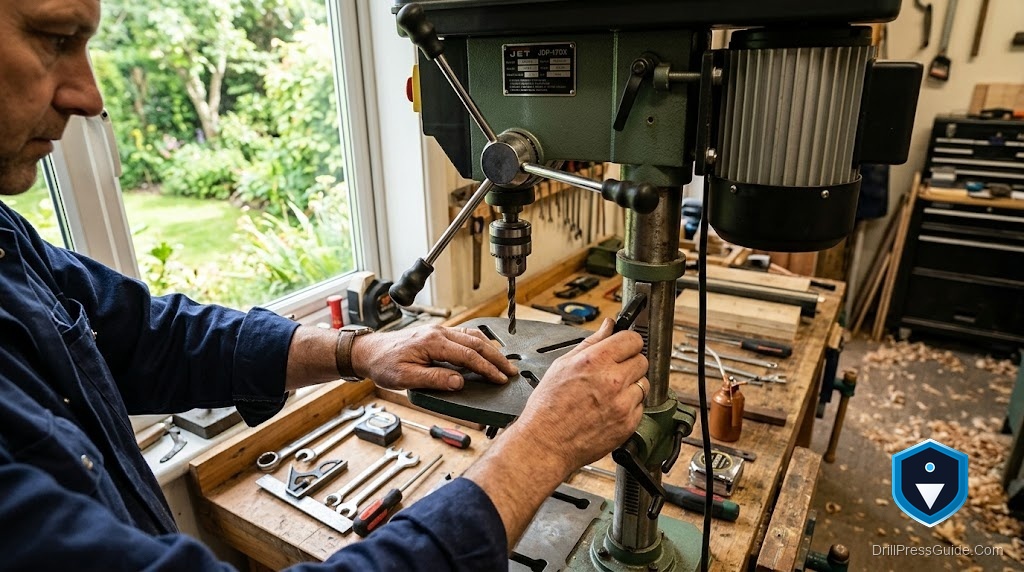
A drill press that is dialed in feels effortless: the table sits right, the speed suits the bit, and the depth stop lands every hole in the same place. A drill press that has never been adjusted feels like a fight. The good news is that every adjustment is simple once you know which knob does what, and none of them requires special tools. Here is the whole machine, tuned in order.
Adjusting a drill press means setting the four things you control before and during a cut: table height, table angle, spindle speed, and drilling depth. Each has its own control, and together they let you position the work, square or tilt it, match the speed to the material, and stop every hole at the same depth. Learning these adjustments turns the machine from a blunt hole-maker into a precise one.
Here is the direct answer, step by step. First, set table height: release the table clamp on the column and crank the table up or down so the workpiece sits close under the bit, then lock it. Second, set table angle: for straight holes, confirm the table is square to the bit; for angled holes, tilt the table to the angle you need and lock it. Third, set the speed: with the machine off, move the belt between the pulley steps, or turn the variable-speed dial, choosing slower for metal and large bits, faster for wood and small bits. Fourth, set the depth stop: lower the bit to your target depth and lock the stop collar so every hole matches. Do those four, height, angle, speed, depth, and the machine is ready to drill accurately.
Table height and angle
Start with height because everything else follows from it. Loosen the table lock, use the crank to raise or lower the table so the workpiece surface sits close under the bit tip, leaving room to feed, then retighten. A table set too low wastes quill travel; too high and the bit is buried before you start.
Angle comes next. For ordinary drilling the table should be square to the spindle, and you can check this by lowering a straight rod in the chuck beside a small square on the table. If your work needs an angle, loosen the table bevel, set the angle against a gauge, and lock it hard, because a tilted table lets the work slide if it is not clamped. Confirm square again when you return to straight drilling, since a bevel that drifts leaves every hole leaning.
Speed and depth
Speed is set with the power off. On a belt machine, open the cover and move the belt to the pulley combination that gives the speed you want; the door usually has a chart. On a variable-speed machine, the WEN 4212T variable speed drill press style dial lets you change speed while running, which is far quicker. The rule holds either way: slower for metal and large bits, faster for wood and small bits, because too much speed burns and too little tears.
The depth stop is what makes holes repeatable. Bring the bit down to the exact depth you want the hole to reach, then lock the threaded stop collar or rod so the quill cannot travel further. Now every hole stops there, which is how you drill a row of matching counterbores or stop a hole short of breaking through. The Occupational Safety and Health Administration reminds you to make all these adjustments with the machine off and the work clamped, keeping the point of operation clear.
Comparison: belt speed change versus variable speed
A belt-and-pulley speed change is simple and reliable and comes on most machines, but changing speed means stopping, opening the cover, and moving the belt, so people often skip it.
A variable-speed dial changes speed instantly, often while running, so you actually set the right speed every time, though it uses a bit more mechanism.
My verdict: if you drill one material all day, a belt machine adjusted once is fine. If you switch materials and bit sizes often, variable speed pays for itself in convenience and cleaner holes, because the easiest adjustment is the one you will actually make.
Conclusion
Adjusting a drill press is four quick moves: set the table height, set the table angle, set the speed for the material, and set the depth stop for repeatable holes. Make them in that order with the machine off and the work clamped, and the press does the precise work for you. A tuned machine is the difference between fighting your holes and simply drilling them.
Key takeaways:
- Adjust in order: table height, table angle, spindle speed, then depth stop.
- Match speed to material: slow for metal and big bits, fast for wood and small bits.
- Set the depth stop so every hole in a run lands at the same depth.
FAQ
How do I adjust the table height? Loosen the table clamp on the column, crank the table to the height you want, and lock it again.
How do I square the table to the bit? Lower a straight rod in the chuck beside a small square on the table and adjust the bevel until they align.
How do I change the speed? With the power off, move the belt between pulley steps, or turn the variable-speed dial if your machine has one.
How does the depth stop work? Lower the bit to your target depth and lock the stop collar so the quill cannot travel further.
What speed should I use? Slower for metal and large bits, faster for wood and small bits.
Should the machine be running when I adjust it? Only a variable-speed dial changes while running. Set table, belt, and depth with the power off.
Why does my table keep drifting out of square? The bevel lock may not be tight. Retighten it hard and recheck square before drilling.
References
- Occupational Safety and Health Administration, Woodworking eTool: Drill Presses (osha.gov)
- WEN Products, drill press adjustment and owner documentation (wenproducts.com)


