Finding What Are the Parts of a Drill Press Without Guessing at Compatibility
The first time you need a replacement part or want to add an accessory, a drill press stops being one machine and becomes a stack of named pieces you suddenly have to know. Learning the parts is not trivia; it is how you order the right belt, describe a problem, and avoid buying an accessory that does not fit. Here is the whole machine, part by part, in plain terms.
The parts of a drill press are the base, the column, the table, the head, and the spindle assembly, plus the controls that drive them. Together they do one job: hold a rotating bit and feed it straight down into a clamped workpiece. Knowing each part by name lets you match replacements and accessories to your exact machine using its model number and serial number, instead of guessing at compatibility and ordering the wrong thing.
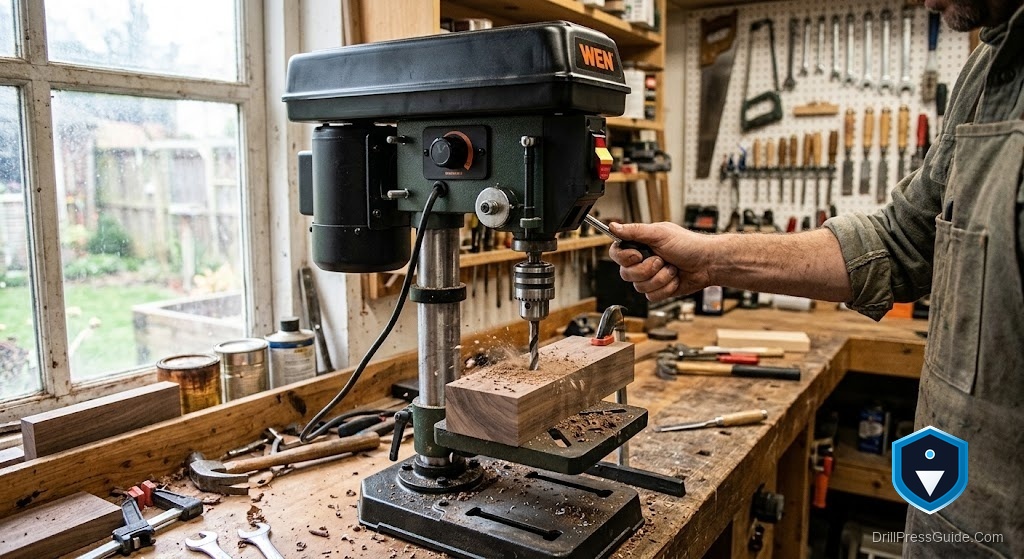
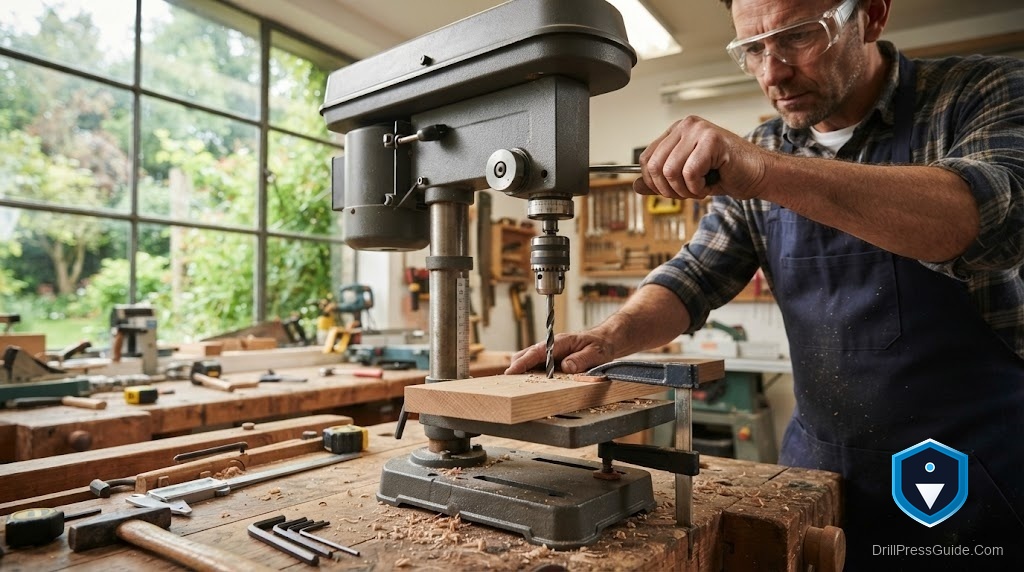
Here is the direct answer, from the floor up. The base anchors the machine and often has slots for clamping. The column is the vertical post that everything mounts to. The table rides on the column, adjusts up and down, and usually tilts; it holds the work. The head sits at the top and contains the motor, the belt-drive system with its pulleys, the speed change, the spindle, the quill, and the chuck. The spindle is the rotating shaft; the quill is the sleeve that carries the spindle and slides straight down; the chuck grips the bit. The controls are the feed handle that lowers the quill, the depth stop that limits travel, and the on/off switch. Every accessory and spare part maps to one of these, so identifying the part is the first step to buying the right one.
The structural parts: base, column, table
The base is the foundation. On floor machines it bolts down or rests heavy; on benchtop machines it clamps to a bench. Many bases have slots so you can clamp a large workpiece directly to them for drilling that will not fit on the table.
The column is the steel post that gives the machine its spine. Its diameter and finish matter, because the table and head clamp around it and slide along it. The table mounts on the column and does the most moving: it cranks up and down to set work height and tilts for angled drilling. When you buy a table upgrade or a fence, it has to match your table and column, which is why the model number matters.
The working parts: head, spindle, quill, chuck
The head holds everything that makes the machine turn. Inside are the motor, the V-belt and pulley steps that set speed, and the speed-change mechanism. The spindle is the rotating shaft that carries the tool. It rides inside the quill, a sleeve that slides straight down when you pull the feed handle and returns on the quill spring. At the bottom, the chuck grips the bit, mounted on the spindle by a taper such as a Jacobs taper or a Morse taper.
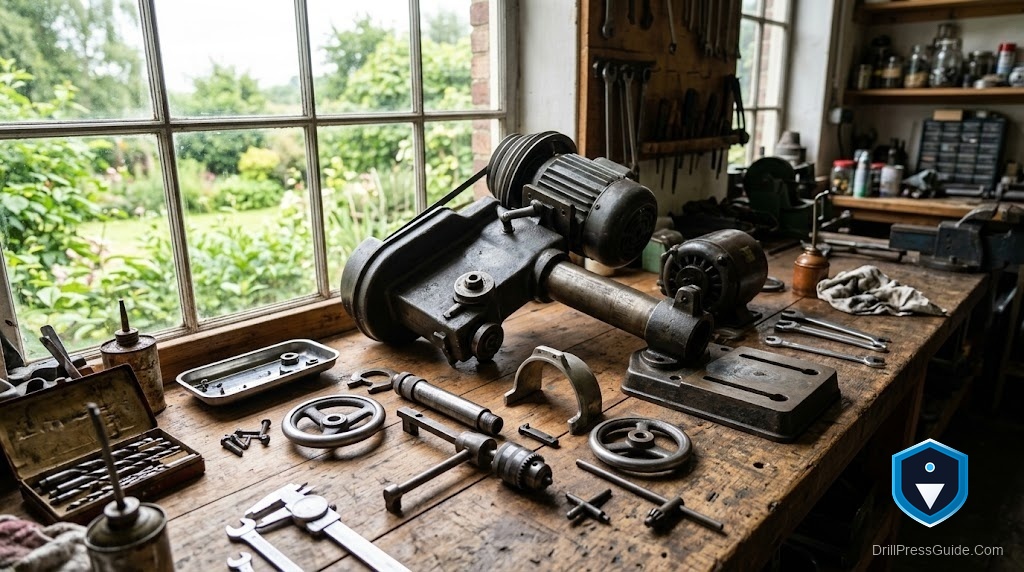
These are the parts that wear and get replaced: belts stretch, bearings in the spindle assembly wear, the quill spring loses tension, the chuck develops runout. When any of them acts up, you identify the part, read the model number and serial number off the ID label, and pull the exploded view or part diagram to find the correct part number. That is how you avoid ordering a belt or chuck that almost fits.
The controls: feed handle, depth stop, switch
The feed handle is the three-armed lever you pull to lower the quill and drive the bit into the work. The depth stop, usually a threaded collar or rod, limits how far the quill travels so you can drill to a repeatable depth. The switch controls power. Learn these three and you can operate any drill press, since the layout barely changes between brands. The Occupational Safety and Health Administration’s guidance ties safety to these controls and parts: guard the belt-drive and rotating chuck, keep the point of operation clear, and know where the switch is before you start.
Comparison: knowing parts by sight versus by the label
Identifying a part by sight helps you describe a problem and understand the machine, but two similar-looking belts or chucks can differ in size, so sight alone risks a wrong order.
Identifying by the model and serial number on the ID label, matched to the exploded view, gives you the exact part number, which is the reliable way to buy replacements and accessories.
My verdict: learn the part names so you can talk about your machine and diagnose issues, but always confirm a purchase against the model number and part diagram. The name tells you what it is; the number tells you which one fits.
Conclusion
A drill press is a base, a column, a table, a head, and a spindle assembly, driven by a feed handle, a depth stop, and a switch. Knowing each part by name turns a mystery machine into something you can maintain, upgrade, and repair. When you need a replacement, pair the part name with your model and serial number so compatibility is never a guess.
Key takeaways:
- The main parts are the base, column, table, head, spindle, quill, and chuck.
- The head holds the motor, belt, pulleys, and speed change; the quill carries the sliding spindle.
- Match part names to your model and serial number and the exploded view before buying.
FAQ
What are the main parts of a drill press? The base, column, table, head, spindle, quill, and chuck, plus the feed handle, depth stop, and switch.
What is the quill? The sleeve that carries the spindle and slides straight down when you pull the feed handle.
What is the difference between the spindle and the chuck? The spindle is the rotating shaft; the chuck mounts on it and grips the bit.
Where is the speed change? Inside the head, in the belt-and-pulley system that sets spindle speed.
How do I find the right replacement part? Read the model and serial number off the ID label and match it to the exploded view for the part number.
What parts wear out most? The V-belt, spindle bearings, the quill spring, and the chuck, which can develop runout.
Why does the base have slots? So you can clamp large workpieces directly to it when they will not fit on the table.
References
- Occupational Safety and Health Administration, Woodworking eTool: Drill Presses (osha.gov)
- WEN Products, drill press parts diagrams and owner documentation (wenproducts.com)