How to Use a Drill Press as a Mill, Step by Step
The question comes up in every home shop eventually. You need to cut a slot, square a corner, or clean up an edge, and the only machine on hand is a drill press. Can it do the job of a mill? The step-by-step answer below will get you through one light cut safely, but it starts with a warning, because this is a job the machine was never built to do and can do badly if you rush it.
Using a drill press as a mill means cutting sideways with a rotating cutter to make slots, pockets, and flats, rather than drilling straight down. A drill press is built to resist downward thrust, not side load: its spindle bearings, its taper-mounted chuck, and its sliding quill all fight sideways cutting. So this works only for the lightest cuts in soft material, with the right setup, and it wears the machine while you do it. Treat it as an occasional workaround, never a routine.
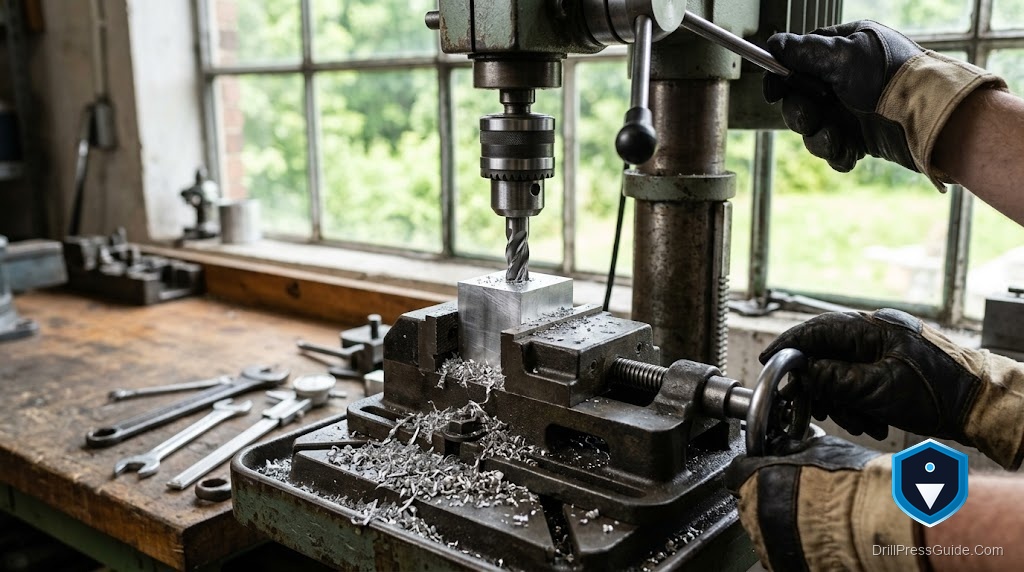
Here is the direct answer, step by step. First, mount the work in a cross-slide (XY) vise bolted firmly to the table, so you can move it in controlled steps instead of pushing by hand. Second, lock the quill at a fixed height so it cannot bounce, since quill play is your enemy in milling. Third, use a center-cutting end mill held as short as possible for stiffness, and if you can fit a collet or drawbar-retained holder rather than a Jacobs chuck, do it, because a plain chuck can pull off under side load. Fourth, set a sensible speed and take cuts of only a few thousandths of an inch per pass, feeding the work slowly with the vise screws. Fifth, clear chips often and stop if you hear chatter. That sequence, rigid vise, locked quill, short cutter, tiny cuts, is the safest way to coax a light milling cut from a drill press.
Set up for control, not speed
Everything about milling on a drill press is about removing the freehand element. A cross-slide milling vise is the heart of it: it moves the work in X and Y with lead screws, so you feed in measured increments instead of shoving the part into a spinning cutter by hand. Bolt it down hard, because any movement of the vise itself becomes chatter and a ruined cut.
Then lock the quill. A drill press quill is designed to slide, which gives it play, and that play is exactly what makes side cuts wander. Set the quill at your cutting depth and lock it there, so the only motion is the vise feeding the work. Between the locked quill and the geared vise, you have taken the two loosest parts of the setup out of the equation.
Cut light and listen
Use a center-cutting end mill so it can plunge to depth, and keep it short in the holder for stiffness. Set a speed appropriate to the cutter and material, then take passes of only a few thousandths, feeding slowly with the vise handle. Soft materials like aluminum and plastic are far more forgiving than steel, so start there. Clear chips frequently and keep the cut cool.
Listen the whole time. Chatter, a buzzing rattle, means the setup is flexing or the cut is too heavy, and it is your signal to back off. The Occupational Safety and Health Administration’s drill press guidance calls for clamped work, a guarded rotating chuck, and eye protection, all of which matter more here because you are loading the machine in a direction it was not built for. If the chuck ever feels like it is working loose, stop immediately.
Comparison: drill press milling versus a mill-drill
A drill press with a cross-slide vise can take a light slot in soft material when you have no other option, using gear you can add easily. It wears the bearings, cannot stay rigid, and leaves a rough finish.
A mill-drill has a spindle and collet made for side load, a rigid column, and precise table feeds, so it cuts cleanly and repeatably, which is what milling actually requires.
My verdict: use a drill press as a mill only for a rare, light, soft cut with a rigid vise and a locked quill, and expect to pay in bearing wear and finish. If milling shows up regularly in your work, a mill-drill is the honest tool and will do in minutes what the drill press struggles at.
Conclusion
Milling on a drill press is possible for one careful light cut: rigid cross-slide vise, locked quill, short center-cutting end mill, tiny passes in soft material, and constant attention to chatter and the chuck. It is a workaround that spends the machine’s accuracy, not a real capability. Respect the limits, and reach for a mill-drill when milling becomes a habit.
Key takeaways:
- A cross-slide vise and a locked quill remove the two loosest parts of the setup.
- Use a short center-cutting end mill and take cuts of only a few thousandths in soft material.
- Stop at the first sign of chatter or a chuck working loose; the machine is not built for side load.
FAQ
Can I use a drill press as a mill? Only for light cuts in soft material, with a cross-slide vise and a locked quill. It is a workaround, not a substitute for a mill.
What is the single most important accessory? A cross-slide (XY) vise, so you feed the work in controlled steps rather than by hand.
Why lock the quill? The quill has designed-in play so it can slide, and that play makes side cuts wander.
What cutter should I use? A short center-cutting end mill, ideally held in a collet or drawbar-retained holder rather than a plain chuck.
How deep should each pass be? A few thousandths of an inch. Light passes reduce flex, chatter, and the load on the chuck.
What does chatter mean? The setup is flexing or the cut is too heavy. Back off the depth or feed, or stop.
When should I buy a mill-drill? Whenever milling becomes a regular need, since a drill press cannot do it well or safely for long.
References
- Occupational Safety and Health Administration, Woodworking eTool: Drill Presses (osha.gov)
- Hobby-Machinist forum, milling on a drill press discussion threads