
How to Use a Drill Press as a Lathe: Setup, Checks, and Common Mistakes
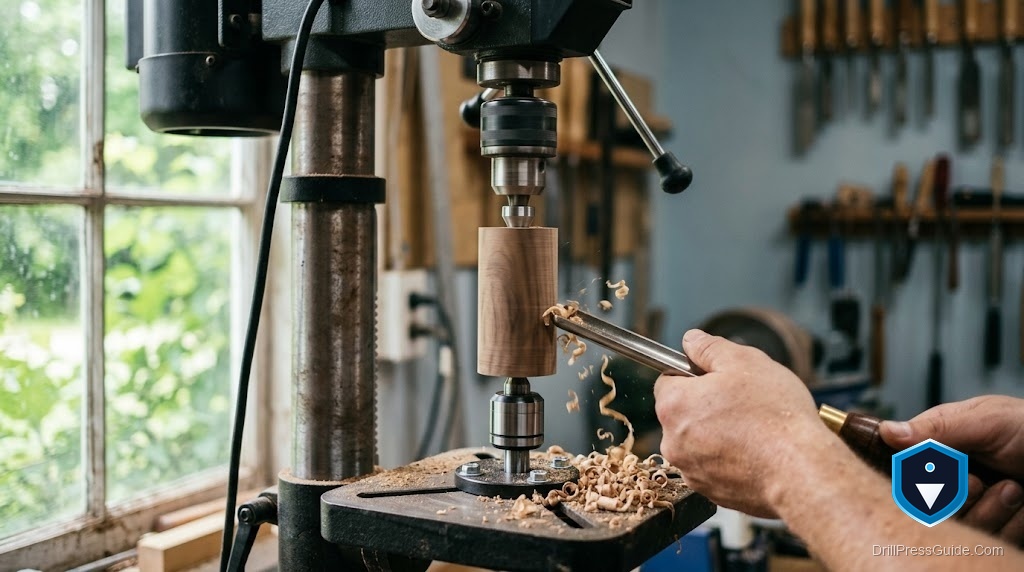
There is a version of this idea that is genuinely useful and a version that will send a chunk of wood across your shop. The difference comes down to whether you use the drill press to spin work for hand shaping, which it does well, or try to make it cut like a real lathe with a fixed tool, which it cannot survive. Knowing which is which is the whole lesson.
Using a drill press as a lathe means chucking a workpiece in the spindle so it spins, then shaping it, instead of spinning a cutting tool to make holes. The drill press spindle turns vertically, and its bearings are built for downward thrust, so it can spin a small, balanced part for sanding, polishing, and light rounding with hand-held abrasives. What it cannot do is take the sideways cutting force of a tool post pressed into the work, because that load is exactly what its bearings and quill were never designed to handle.
Here is the direct answer. Set up for hand-abrasive shaping only. Mount a small, balanced workpiece in the chuck, confirm it spins without wobble, pick a moderate speed (slower for larger diameters), and shape it with sandpaper, a file, or a sanding drum held to the side by hand. This is perfect for rounding small wooden parts, smoothing, and polishing. The common mistake that ruins parts and causes injuries is rigging a fixed tool rest and taking cutting passes, which overloads the spindle bearings, invites chatter, and can pull the chuck off its taper. If you need real turning with a tool bit, use a lathe. Keep the drill press to hand shaping and it stays safe and genuinely useful.
The useful version: a vertical sander
Think of the drill press here as a vertical spindle sander rather than a lathe. Spinning work plus a hand-held abrasive lets you round the end of a dowel, smooth a turned-looking profile on a soft blank, or polish a small metal part. The load stays gentle and roughly in line with what the bearings expect, so the machine is not stressed. Woodworkers use this trick all the time for small parts that do not justify setting up a lathe.
Keep the workpiece short and well balanced. A long overhang whips at speed, and an off-center part shakes the whole machine. Start slow, and remember that surface speed rises with diameter, so a wide blank needs a slower spindle speed than a thin one.
The dangerous version: a fixed cutting tool
The mistake is treating the drill press like a metal lathe with a tool post. A real lathe has bearings and a rigid tool rest built to resist the sideways force of a tool digging into spinning stock. A drill press has neither. Its spindle bearings take downward thrust, and its quill has play so it can slide. Press a fixed tool into spinning work and that side force works the bearings the wrong way, lets the tool chatter and catch, and can wrench the chuck off its taper, throwing the work or the tool.
That is why you keep to hand-held abrasives, which you can pull away instantly if the work grabs, rather than a clamped tool that has nowhere to go. Follow the Occupational Safety and Health Administration’s drill press rules: eye and face protection, no gloves or loose clothing near the rotating chuck, and a controlled point of operation.
Comparison: drill press spinning versus a real lathe
A drill press used for spinning sands, polishes, and lightly rounds small parts with tools you already own, and it saves setting up a lathe for a tiny job. It cannot take a fixed cutting tool or turn true profiles.
A wood or metal lathe is built for turning: bearings and a tool rest made for side cutting force, so it shapes clean profiles safely and accurately.
My verdict: use a drill press as a vertical sander for small parts and enjoy the convenience, but never bolt on a tool rest and cut. For real turning, a lathe is the tool, and it costs far less than the injury or wrecked spindle a fixed-tool setup risks.
Conclusion
A drill press makes a fine occasional spindle sander: chuck a small balanced part, spin it at a sensible speed, and shape it with hand-held abrasives. It makes a dangerous lathe the moment you add a fixed cutting tool, because its bearings and quill cannot take the side load. Stay on the abrasive side of that line and the trick is safe and handy.
Key takeaways:
- Spin small, balanced work and shape it with hand-held abrasives only.
- The drill press spindle takes downward thrust, not the side load of tool-post cutting.
- For turning profiles or working metal with a tool bit, use a real lathe.
FAQ
Can I use a drill press as a lathe? Only to spin small parts for sanding, polishing, and light rounding with hand-held abrasives. Not for tool-post cutting.
Why is a fixed cutting tool dangerous? It puts side load on bearings built for downward thrust and can pull the chuck off its taper, throwing the work.
What can I safely shape this way? Small wooden parts and soft stock you sand, round, or polish by hand.
What speed is right? Moderate, and slower for larger diameters, because surface speed grows with size.
Why keep the workpiece short? Long overhangs whip and vibrate at speed, which is unsafe and gives poor results.
Can I hold a chisel to the work like on a lathe? No. A hand-held abrasive can be pulled away if the work grabs; a clamped or braced cutting tool cannot.
When do I need a real lathe? Whenever you want to cut true profiles or turn metal with a tool bit.
References
- Occupational Safety and Health Administration, Woodworking eTool: Drill Presses (osha.gov)
- Hobby-Machinist and woodworking community threads on spinning work safely on a drill press


