How to Turn a Drill Press Into a Mill Without Losing Accuracy
It is the most common shortcut in the hobby-shop world, and one of the most misunderstood. You have a drill press, you need to cut a slot or flatten an edge, and a mill feels out of reach. Can you convert the one into the other? The truthful answer is that you can add the parts that make light milling possible, but you cannot change what the machine fundamentally is, and pretending otherwise costs accuracy and safety.
Turning a drill press into a mill means adding the ability to move a workpiece precisely in two horizontal directions and to hold a cutter against side load, so the machine can cut sideways to make slots, pockets, and flats. The obstacle is built into the drill press: its spindle bearings are made for downward thrust, its chuck grips by being pulled tight as you drill, and its quill has play so it can slide. Milling loads all three the wrong way. So a conversion can enable very light milling under strict limits, but it never makes a drill press a true mill.
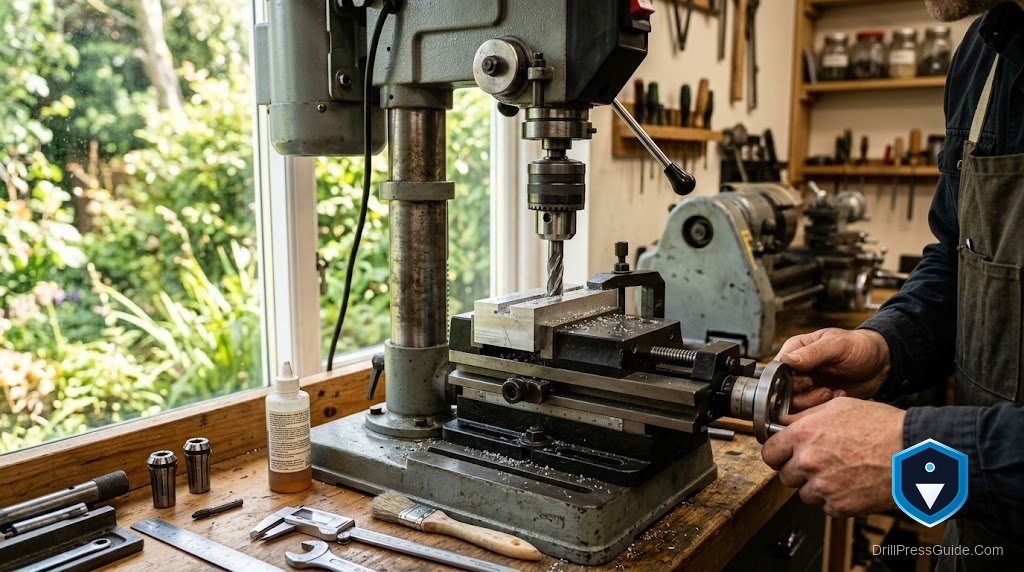
Here is the direct answer. The one meaningful upgrade is a compound cross-slide (XY) vise that lets you move the work in controlled steps under the cutter, replacing the reckless freehand push with a geared feed. Add that, lock the quill so it cannot bounce, hold cutters as short and rigid as possible, take cuts of only a few thousandths in soft material, and accept that you are wearing the spindle bearings faster than normal. What you cannot buy your way out of is the chuck coming loose under side load and the quill play that leaves slots tapered and rough. For anything beyond the lightest occasional cut, a mill-drill is the right machine. The conversion is a workaround, not a transformation.
The three limits you cannot design away
The chuck is the first. A drill chuck seats on a taper meant to tighten under downward force. Milling pulls sideways, which can walk the chuck right off the arbor and launch the cutter. Some people fit a collet or a drawbar-retained holder to fight this, and it helps, but a stock drill press is not set up for it.
The bearings are the second. The spindle rides in bearings built for axial thrust. Side load pounds them, so runout climbs and quill play grows until the machine no longer drills true. You are spending the drill press’s accuracy to buy a poor imitation of a mill.
The quill play is the third. The quill must slide freely to drill, so it has designed-in play. That play is invisible drilling straight down and glaring when you push sideways, which is why converted-drill-press slots come out wavy and oversized. No vise fixes this.
The upgrade that actually helps
The honest improvement is controlled work movement. A cross-slide milling vise mounts to the table and moves the work in X and Y with lead screws, so you feed the work into the cutter in small, measured increments instead of shoving it by hand. That control is the difference between a chance of a usable light cut and a guaranteed mess. Lock the quill at a set height, clamp the vise down hard, and use the lead screws to make the cut.
Even with the vise, keep cuts tiny, speeds sensible, and material soft, and clear chips often. The Occupational Safety and Health Administration’s drill press guidance assumes clamped work and a guarded rotating chuck, and this setup is the minimum to stay near that safe envelope while doing something the machine was not designed for.
Comparison: converted drill press versus a mill-drill
A converted drill press with a cross-slide vise can nibble a light slot in soft material in a pinch, using the machine you own. It sacrifices bearing life and accuracy and can never be rigid enough for real milling.
A mill-drill has a spindle and collet built for side load, a rigid column, and precise table travel, so it cuts cleanly and holds accuracy, which is the entire reason it exists.
My verdict: add a cross-slide vise if you occasionally need one light, soft cut and understand the cost. If milling becomes a regular part of your work, a mill-drill is the correct answer and will save the bearings, the accuracy, and your safety that a converted drill press quietly spends.
Conclusion
You can equip a drill press for very light milling with a cross-slide vise, a locked quill, tiny cuts, and clear eyes about the wear you cause. What you cannot do is change the chuck, the bearings, and the quill play that make it a drill press and not a mill. Treat the conversion as an emergency trick, and reach for a mill-drill the moment milling becomes routine.
Key takeaways:
- A cross-slide vise is the one upgrade that meaningfully helps, by controlling work movement.
- The chuck, spindle bearings, and quill play limit a drill press to the lightest side cuts.
- Regular milling calls for a mill-drill; the conversion wears bearings and loses accuracy.
FAQ
Can I turn my drill press into a mill? Only for very light, occasional cuts in soft material, with a cross-slide vise and a locked quill. It never becomes a true mill.
What is the most useful add-on? A cross-slide (XY) vise, which moves the work in controlled steps instead of a freehand push.
Why is the chuck a problem? It seats on a taper meant to tighten under downward force, so side load can pull it loose and launch the cutter.
Will milling wear out my drill press? Yes. Side load pounds bearings built for downward thrust, raising runout over time.
Why do slots come out rough? The quill has designed-in play to slide, and that play makes side cuts tapered and wavy.
Can a collet or drawbar fix it? It reduces the chuck risk but does not solve the bearing and quill-play limits.
When should I buy a mill-drill? As soon as milling is a regular need rather than a one-time workaround.
References
- Occupational Safety and Health Administration, Woodworking eTool: Drill Presses (osha.gov)
- Hobby-Machinist forum, drill press to mill conversion discussion threads