How to Turn a Drill Press Into a Lathe: A Clear, Shop-Ready Method
A lathe spins the work and brings a tool to it. A drill press spins a tool and pushes it down. They look related, and every so often someone with only a drill press wonders whether they can bridge the gap for a small turning job. The honest answer is that a drill press can do a narrow slice of light lathe work, and it can also hurt you if you ask it to be a real lathe. Let us separate the two.
Turning a drill press into a lathe means using the drill press spindle to spin a workpiece so you can shape it, sand it, or polish it, rather than spinning a cutting tool. Because a drill press spindle rotates vertically and its bearings are built for downward thrust, it can spin a small workpiece for light shaping with hand-held abrasives, but it cannot safely accept the side cutting forces of true tool-post lathe work. So the safe version of this is a vertical spindle sander and polisher, not a metal-cutting lathe.
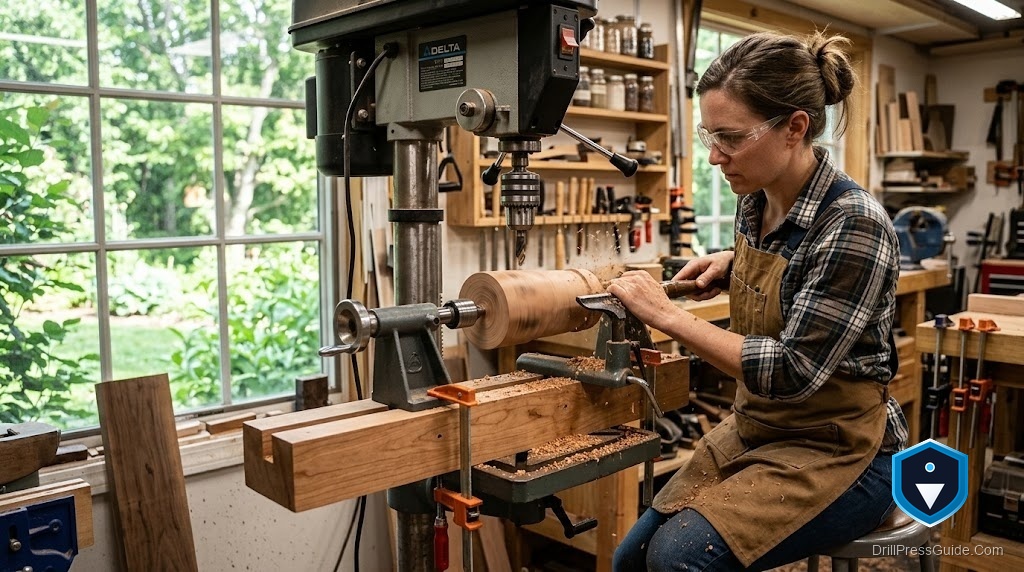
Here is the direct answer. For light, safe work: mount the workpiece in the chuck, spin it at a suitable speed, and shape it with hand-held tools such as files, sandpaper, or a sanding drum held to the side, exactly as you would sand a spinning dowel. This works for rounding small wooden parts, sanding, and polishing. What you must not do is rig a fixed tool post and take cutting passes as a real lathe does, because the side load will overload the spindle bearings and can throw the work or the tool. If you need to cut metal or turn a real profile with a tool bit, a drill press is the wrong machine and a proper lathe is the right one. Keep the drill press to hand-abrasive shaping and it stays safe and useful.
Why a drill press is not a real lathe
A lathe’s headstock bearings are built to take the sideways cutting force of a tool digging into spinning stock, and its tool post holds that tool rigidly against the work. A drill press has neither. Its spindle bearings are sized for downward thrust, and the quill has play so it can slide, so any real cutting force pushed sideways works the bearings the wrong way and lets the tool chatter and grab. Push hard enough and you can pull the chuck off its taper, which turns the workpiece into a projectile.
That is the line. Spinning the work to sand or polish loads the spindle gently and mostly downward or evenly. Cutting with a fixed tool loads it sideways and hard. The first is fine; the second is where people get hurt and machines get wrecked.
The safe method, done well
Mount a small, balanced workpiece in the chuck and make sure it runs without a wobble, since an off-center part vibrates worse at speed. Choose a moderate speed, slower for larger diameters, because surface speed climbs with size. Then shape with hand-held abrasives: sandpaper backed by a block, files for gentle rounding on soft material, or a sanding drum brought to the side of the work. Keep a firm grip and a light touch, let the abrasive do the work, and keep your hands and any rag well clear of the chuck.
Work short pieces held securely; long overhangs whip and vibrate. Follow the Occupational Safety and Health Administration’s drill press guidance on eye and face protection, no loose clothing or gloves near the rotating chuck, and a controlled point of operation. This is the same discipline you would use sanding any spinning part.
Comparison: drill press as a spindle sander versus a real lathe
A drill press used for light spinning handles sanding, polishing, and rounding small parts with hand abrasives, using tools you already own. It cannot take a fixed cutting tool or turn real profiles, and it loads the bearings the wrong way if you try.
A wood or metal lathe is built for the job: bearings and a tool rest made for side cutting force, so it turns clean profiles safely and accurately.
My verdict: treat a drill press as a vertical sander and polisher for small parts, never as a cutting lathe. The moment you want to take real turning cuts with a tool bit, buy or borrow a lathe. Rigging a tool post on a drill press trades a little saved effort for a genuine injury risk.
Conclusion
A drill press can spin a small workpiece for sanding, polishing, and light rounding with hand-held abrasives, and that is a genuinely handy trick. What it cannot do is act as a cutting lathe with a fixed tool, because its bearings and quill are built for downward force, not side load. Keep it to abrasive shaping and it serves you safely; ask for more and it bites.
Key takeaways:
- A drill press can spin small work for sanding and polishing with hand abrasives.
- It cannot safely take a fixed cutting tool; side load overloads the spindle bearings.
- For real turning with a tool bit, use a proper lathe, not a drill press.
FAQ
Can I turn a drill press into a lathe? Only for light work: spinning a small part to sand, polish, or round it with hand-held abrasives. Not for tool-post cutting.
Why can’t it cut like a real lathe? Its spindle bearings and quill are built for downward force, so sideways cutting load overloads them and can throw the work.
What can I safely make this way? Sanded, polished, or lightly rounded small wooden or soft parts.
What speed should I use? Moderate, and slower for larger diameters, since surface speed rises with size.
Is it safe to rig a tool rest? No. A fixed tool takes cutting force the drill press cannot handle, which is a real hazard.
How do I keep it safe? Balance the work, keep pieces short, wear eye protection, and keep hands, gloves, and rags clear of the chuck.
When should I get a real lathe? As soon as you want to cut profiles or work metal with a tool bit.
References
- Occupational Safety and Health Administration, Woodworking eTool: Drill Presses (osha.gov)
- Hobby-Machinist and woodworking community threads on drill press spinning and safety