How to Change the Speed on a Drill Press: A Clear, Shop-Ready Method
Here is a small habit that separates people who get clean holes from people who burn bits: they change the drill press speed to match the job, every time, without a second thought. Most beginners never touch the speed because nobody showed them how, so they drill everything at whatever speed the belt happened to land on. Learning this one adjustment takes a minute and immediately improves your holes and your bits’ lifespan. Here is exactly how.
Why drill press speed changes
A drill press lets you change speed because the correct cutting speed depends on the bit’s diameter and the material. A big bit’s cutting edge travels far with each turn, so it needs a low RPM to avoid overheating; a small bit needs a high RPM to cut at all. Metal wants slower speeds than wood at a given size. So the machine gives you a range of speeds and a way to pick, and matching the speed to the bit and material is what keeps edges sharp and holes clean.
That is the reason behind the whole task: you change speed to protect the bit and cut cleanly, not for its own sake.
How to change the speed on a drill press, step by step
Most drill presses use belts and stepped pulleys. Here is the process:
- Unplug the machine. Your hands are about to be near the belt, so pull the plug, do not just flip the switch.
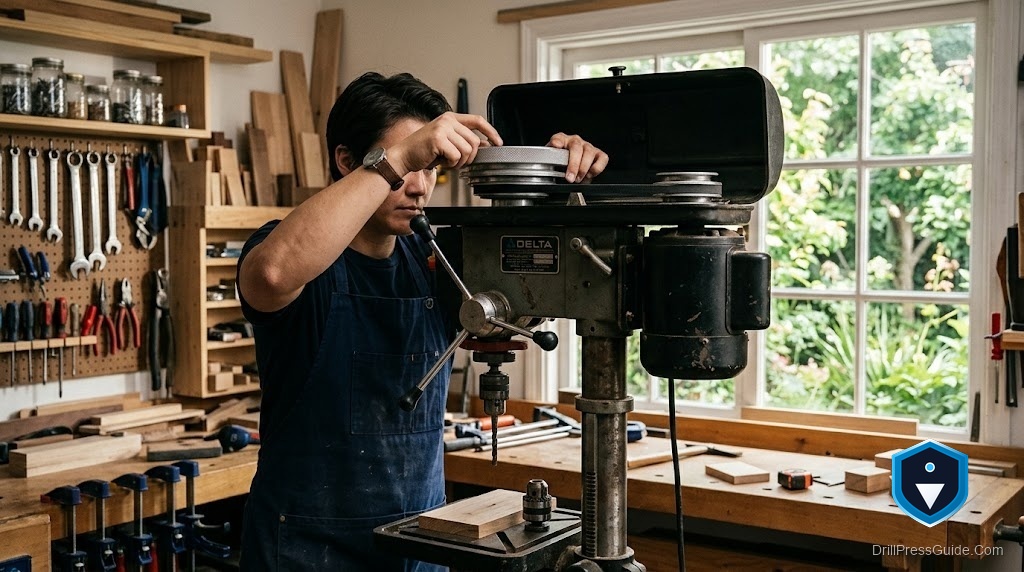
- Open the head cover. Release the latch and lift the top cover to expose the pulleys and belt.
- Release belt tension. Loosen the motor-lock knob or lever and slide the motor toward the spindle so the belt slackens. Some machines have a dedicated tension handle.
- Move the belt to new pulleys. Read the speed chart inside the cover. Small motor pulley to large spindle pulley gives a slow speed; large motor pulley to small spindle pulley gives a fast speed. Lift the belt onto the pair you want.
- Reset the tension. Slide the motor back until the belt deflects about half an inch under light finger pressure, then lock it. Too tight strains bearings; too loose slips.
- Close up, plug in, and test. Run briefly to confirm the belt tracks smoothly at the new speed.
That is the entire job on a two- or three-step machine. Multi-belt models use the same idea with more pulley steps.
The one shortcut: variable-speed machines
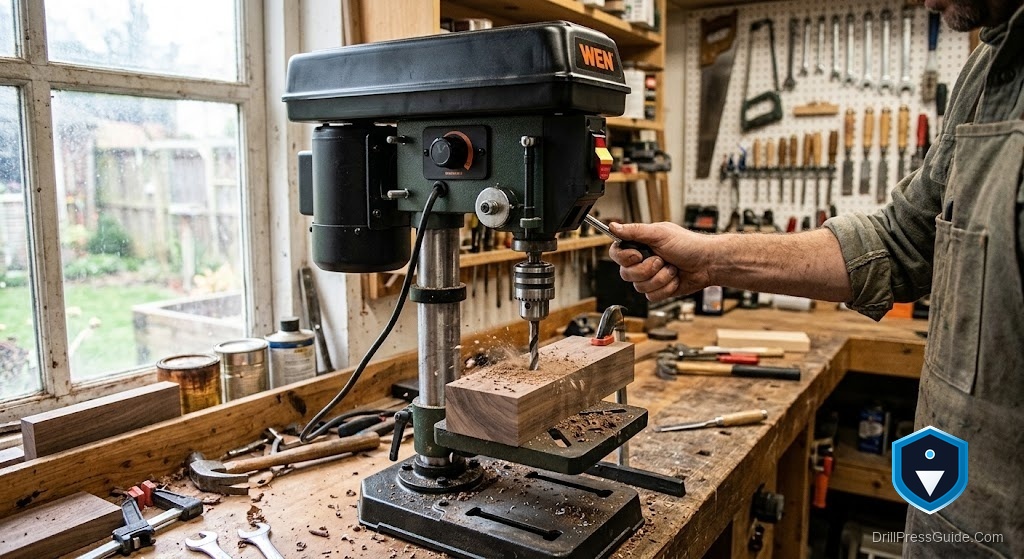
Some drill presses skip the belt-moving entirely. On a variable-speed machine like the WEN 4212T 10-inch variable-speed drill press, you turn a handle while the motor runs and the speed changes smoothly, often with the RPM shown on a readout. No cover, no belt to lift. One rule to remember on mechanical variable-speed drives: change the speed only while the motor is running, because the mechanism shifts by moving pulley halves as the spindle turns, and adjusting it while stopped can damage the drive.
Belt-change versus variable-speed: which fits you
The two systems trade a minute of work for long-term simplicity. A belt-and-pulley machine makes you unplug, open the cover, and move the belt for every speed change, which is mildly annoying if you switch often but is nearly indestructible and simpler. A variable-speed machine changes with a turn of a handle, so you actually bother to use the right speed instead of forcing the wrong one, with the tradeoff of a mechanism with more parts to wear. If you change speed constantly and value clean holes, the variable-speed convenience pays off. If you set a speed and leave it, the belt drive’s simplicity and durability win. Both reach the same speeds; they differ only in how much effort each change costs.
My verdict
Changing drill press speed is a one-minute skill with an outsized payoff: it saves bits and gives cleaner holes. On a belt machine, unplug, slacken the belt, move it to the charted pulleys, and reset the tension; on a variable-speed machine, just turn the handle while it runs. The rule behind both is simple: big bits and metal run slow, small bits and wood run fast. Build the habit of matching speed to the job and you will stop burning bits almost overnight.
Frequently asked questions
How do you change the speed on a drill press? On a belt machine, unplug it, open the cover, loosen belt tension, move the belt to the pulley pair for the speed you want, and reset the tension. On a variable-speed machine, turn the speed handle while the motor runs.
Which pulley setup gives a slower speed? Belt on the small motor pulley driving the large spindle pulley gives the slowest speed. The reverse, large motor to small spindle, gives the fastest. The chart inside the cover lists each combination.
How tight should the belt be after changing speed? About half an inch of deflection under light finger pressure. Too tight strains the bearings, too loose lets the belt slip and lose speed under load.
Can I change a variable-speed drill press while it is off? No. Mechanical variable-speed drives must be adjusted with the motor running, because they shift by moving pulley halves as the spindle turns. Adjusting them stopped can jam the mechanism.
What speed should I use for wood versus metal? Large bits and metal need slow speeds; small bits in wood need fast speeds. Cutting speed rises with bit diameter and RPM, so bigger and harder means slower.
How many speeds does my drill press have? On a belt machine, count the pulley-pair combinations; that is the number of fixed speeds. A variable-speed machine offers a continuous range instead of set steps.
References
- OSHA Woodworking eTool, Drill Presses: https://www.osha.gov/etools/woodworking/production/machines-tools/drill-press
- WEN 4212T product page: https://wenproducts.com/products/wen-4212t-10-in-variable-speed-drill-press
- WEN 4214T variable-speed drill press: https://wenproducts.com/products/wen-4214t-12-in-variable-speed-drill-press