
How to Turn a Drill Press Into a Milling Machine: A Clear, Shop-Ready Method
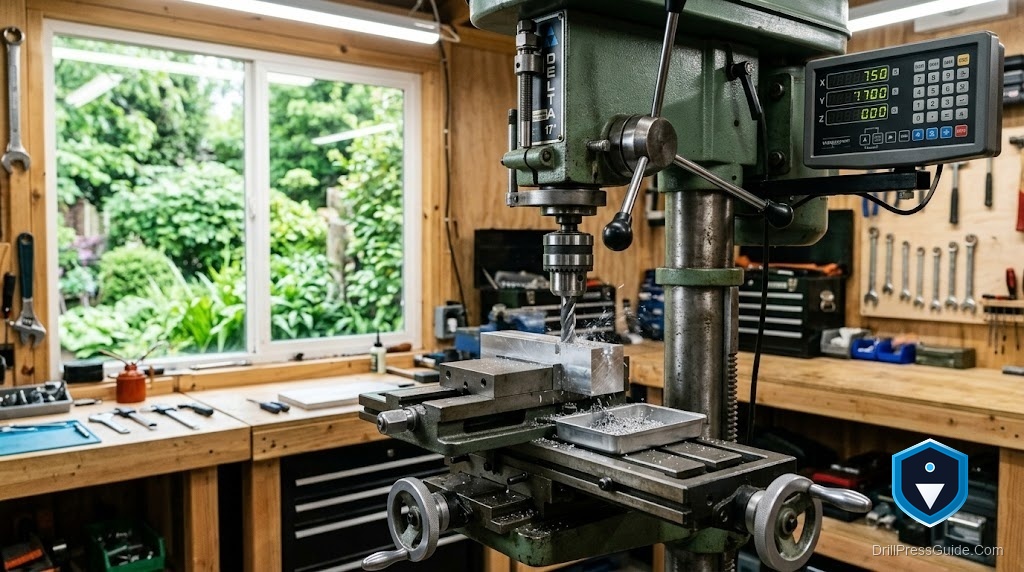
The idea is tempting. You already own a drill press, it spins a cutter and moves it up and down, and a milling machine seems like the same thing with a moving table. So why not add a cross-slide vise, chuck an end mill, and start cutting slots? Because a drill press and a mill are built for opposite forces, and pretending otherwise wears out your machine and gives you wavy, inaccurate cuts. Here is the honest, shop-ready answer about what you can and cannot do.
Why a drill press resists becoming a mill
A drill press spindle is designed for force along its axis: the bit pushes straight up into the spindle as you drill, and the bearings handle that thrust. Milling loads the spindle sideways. An end mill cutting a slot pushes the cutter (and the spindle) laterally, and drill press bearings are not built for that radial load. On top of that, a drill chuck can release under side load, and the table hangs off a round column that flexes and rotates. Hobby machinists are blunt about it: light cuts of a few thousandths are survivable in a pinch, but real milling wears the bearings fast and leaves a poor finish.
So turning a drill press into a mill is not an upgrade you bolt on. It is a fight against the machine’s basic design.
How to turn a drill press into a milling machine (and the honest verdict)
Here is the direct answer. To attempt milling on a drill press with any control, you would have to address three limits, and each has a hard ceiling:
- Hold the work, not by hand. A cross-slide (XY) vise bolted to the table lets you move the work under the cutter in two axes. This is the one genuinely useful part of the setup, and it also helps ordinary drilling.
- Retain the cutter. A drill chuck can pull off its taper under side load. Serious attempts add a collet system with a drawbar through a hollow quill so the cutter cannot come loose. Without it, milling is dangerous.
- Handle side load and flex. Drill press bearings take thrust, not radial force, and the table flexes. Some builders replace the lower bearing with an angular-contact type, but the column and table rigidity still limit you to featherlight cuts.
My verdict: you cannot truly turn a drill press into a milling machine. You can only coax it into very light cuts while wearing its bearings and losing accuracy. If milling matters, buy a mill-drill or a benchtop mill designed for side loads, a drawbar, and a rigid table.
If you try light cuts anyway
If you only need to nibble a tiny amount off soft aluminum once, hold the work in a solid cross-slide vise, keep cuts to a few thousandths, run climb-free passes, and accept that you are spending bearing life to do it. Never take a side cut you would not take by hand, and stop the moment the spindle sounds rough. This is an emergency measure, not a method you build a habit on.
Converted drill press versus a real mill
The honest comparison is short. A converted drill press offers exactly one advantage: not buying another machine. A purpose-built mill or mill-drill offers everything the work needs, a drawbar that holds the cutter under side load, bearings made for radial force, and a rigid table that resists chatter, so it takes real cuts and holds a dimension. The converted drill press pays for its one advantage with worn bearings, loose-cutter risk, and wavy results. If milling is anything more than a rare, tiny cleanup, the real machine is not a luxury; it is the only path that keeps accuracy and keeps your drill press healthy.
My verdict
You do not turn a drill press into a milling machine so much as borrow against its bearings for a few light cuts. The physics do not bend: the spindle takes axial load, milling delivers radial load, and no bolt-on fixes that. Keep the drill press as the fine drilling machine it is, add a cross-slide vise if it helps your drilling, and buy a mill-drill or benchtop mill when you truly need to mill. That is the answer that protects both your accuracy and your machine.
Frequently asked questions
Can you turn a drill press into a milling machine? Not properly. You can take very light cuts with a cross-slide vise, but the spindle and bearings are built for downward force, not the sideways load of milling, so accuracy and bearing life suffer.
What do you need to mill on a drill press? At minimum a cross-slide vise, a drawbar-retained collet so the cutter cannot pull loose, and ideally an angular-contact lower bearing for side load. Even then, cuts must stay featherlight.
Why is milling on a drill press risky? A drill chuck can release an end mill under side load, and drill press bearings wear quickly under radial force. The result is loose-cutter danger, chatter, and a poor finish.
Is a cross-slide vise worth adding to a drill press? Yes for positioning work under the bit while drilling, which is genuinely useful. It does not make the machine a safe mill, but it improves repeatable drilling.
What should I buy instead of converting? A mill-drill or a benchtop milling machine. Both are designed for side loads, use a drawbar, and have rigid tables, so they hold accuracy a converted drill press cannot.
Can I mill aluminum on a drill press? Only tiny, occasional cuts held in a solid vise, knowing you are wearing the spindle. It is an emergency measure, never a reliable method for accurate work.
References
- Hobby-Machinist forum, Using my drill press as a mill: https://www.hobby-machinist.com/threads/using-my-drill-press-as-a-mill.9375/
- Home Improvement Stack Exchange, drill press as a milling machine: https://diy.stackexchange.com/questions/86209/is-it-possible-to-use-a-drill-press-as-a-milling-machine-with-the-proper-bit
- OSHA Woodworking eTool, Drill Presses: https://www.osha.gov/etools/woodworking/production/machines-tools/drill-press


