
How to Drill a Square Hole with a Drill Press: Setup, Checks, and Common Mistakes
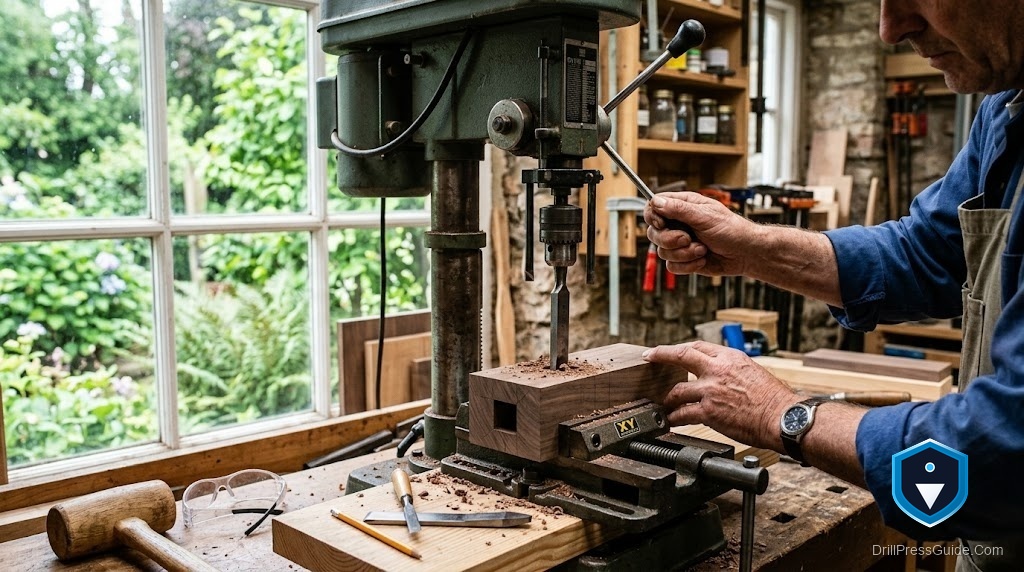
A square hole sounds like a riddle. A round bit cannot cut corners, so how does anyone bore a clean square mortise? The answer is a clever piece of tooling that has been around for over a century: a hollow chisel with a drill bit spinning inside it. The drill removes most of the waste, the four-sided chisel squares the corners, and your drill press supplies the downward force. Set it up correctly and square holes become routine. Set it up carelessly and you get burned chisels and torn walls.
What actually cuts a square hole
A square hole in wood is cut by a mortising attachment: a hollow square chisel with an auger bit running inside it. As you feed it down, the bit drills a round hole and clears the chips out the side slot, while the sharpened square chisel around it pares the round hole into a clean square. Four overlapping square plunges give you a full mortise. The drill press provides the pressing force through its feed handle, and a hold-down and fence keep the workpiece from lifting with the chisel.
That is the direct answer to the riddle: the round bit does the bulk work, the hollow chisel squares the corners, and the drill press presses the pair through the wood.
How to drill a square hole with a drill press, step by step
- Fit a mortising attachment. A kit like the YUEWO drill press mortising attachment clamps to the quill and holds the hollow chisel, while the auger bit chucks into the spindle. Fit the chisel size you want the mortise to be.
- Set the bit-to-chisel gap. Seat the chisel, then set the auger bit so its cutting tip sits slightly below the chisel points, about a 1/16 inch gap. Too tight and the bit rubs the chisel and overheats; too loose and the bit cannot clear chips.
- Square the chisel to the fence. The flat faces of the chisel must sit parallel to the fence, or your mortise walls will step. Sight it and adjust before clamping.
- Set depth with the stop. Use the depth stop so every plunge reaches the same mortise depth.
- Clamp the work against the fence and hold-down. The chisel grips hard on the way out; without a hold-down the workpiece lifts with it.
- Run a moderate speed and plunge firmly. Feed steadily, retract to clear chips on deep mortises, and let the chisel do its work rather than forcing it.
- Overlap your cuts. Make the first square hole, then move over just less than a chisel width and plunge again, chaining holes into a full-length mortise.
That sequence produces clean, square mortises. The two settings people get wrong are the bit-to-chisel gap and squaring the chisel to the fence.
Why the gap and the hold-down matter most
Two details separate clean square holes from frustration. The bit-to-chisel gap controls heat: with the bit tip slightly proud of the chisel points, the bit clears chips freely and the chisel stays cool enough to keep its edge. Set the gap wrong and the chisel scorches and the hole tears. The hold-down controls safety and finish: a hollow chisel grips the mortise walls as it withdraws, and an unclamped workpiece will ride up with it, which is both dangerous and ruins the cut. Get those two right and the rest is straightforward.
Mortising attachment versus a dedicated mortiser
Once you drill square holes often, the question becomes attachment or standalone machine. A mortising attachment on your drill press is compact, uses a machine you already own, and cuts clean mortises for occasional joinery. A dedicated benchtop mortiser has a longer feed lever for more force, a built-in fence and hold-down sized for the job, and more rigidity, so it plunges deep mortises with less effort and better repeatability. For a few mortises now and then, the attachment is the sensible choice and does genuinely good work. For production joinery or big, deep mortises, the standalone machine’s power and rigidity earn their space. Start with the attachment; graduate to the dedicated machine only when volume demands it.
My verdict
Drilling a square hole with a drill press is a tooling trick, not a technique you muscle: a hollow chisel squares what an auger bit drills, and your press supplies the push. Fit a mortising attachment, set the bit-to-chisel gap right, square the chisel to the fence, clamp with a hold-down, and overlap your plunges. Do that and clean mortises come easily. For occasional joinery the attachment is all you need; save the dedicated mortiser for when square holes become a daily job.
Frequently asked questions
How do you drill a square hole with a drill press? Fit a mortising attachment that holds a hollow square chisel with an auger bit inside it. The bit drills the waste and the chisel squares the corners as the press feeds it down.
What is a mortising attachment? A kit that clamps to the drill press quill and holds a hollow square chisel around an auger bit. It converts the press into a mortiser for cutting square holes in wood.
What gap should there be between the bit and the chisel? About 1/16 inch, with the bit’s cutting tip slightly below the chisel points. This lets the bit clear chips and keeps the chisel from overheating.
Why is my mortising chisel burning? Usually the bit-to-chisel gap is too tight, so the bit rubs the chisel, or you are feeding too slowly at too high a speed. Reset the gap and clear chips more often.
Do I need a hold-down for mortising? Yes. The hollow chisel grips the walls as it withdraws and will lift an unclamped workpiece. A hold-down or firm clamp keeps the piece down and the cut clean.
Can any drill press cut square holes? Most benchtop drill presses can take a mortising attachment, but check that the quill accepts the clamp and that the machine has enough force. Very light machines struggle with large chisels.
References
- Grizzly mortising attachment kit for drill presses: https://www.grizzly.com/products/grizzly-mortising-attachment-kit-for-drill-presses/h7789
- WEN CH4314M mortising chisel set: https://wenproducts.com/products/wen-ch4314m-4-piece-premium-mortising-chisel-set-for-woodworking
- OSHA Woodworking eTool, Drill Presses: https://www.osha.gov/etools/woodworking/production/machines-tools/drill-press


