
How to Drill a Pen Blank Without a Drill Press: A Clear, Shop-Ready Method
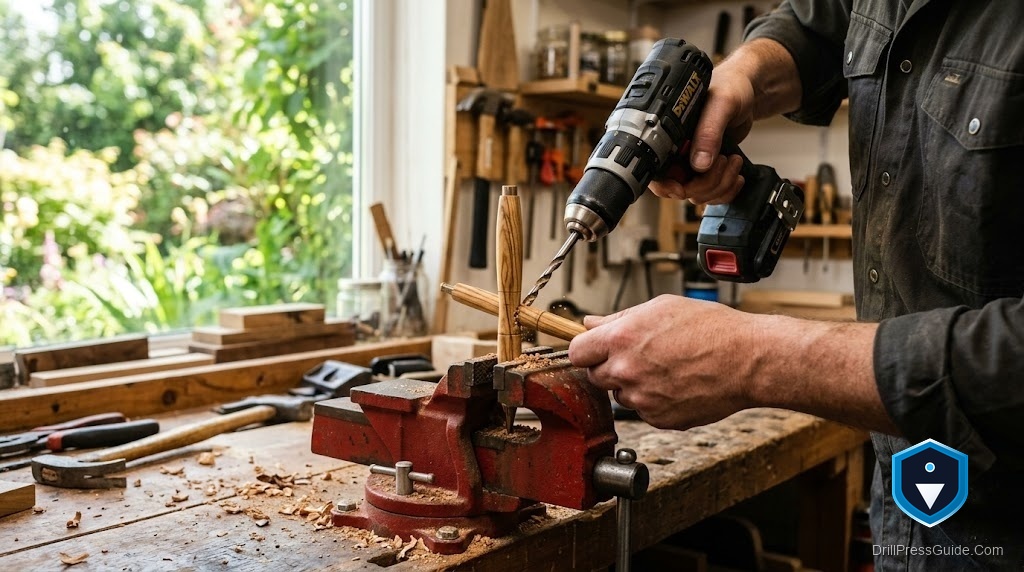
Pen turning has one moment that scares people off: drilling the blank. You have a small, square-ish piece of wood or acrylic, you need a hole straight down its center for the brass tube, and the standard advice assumes you own a drill press. If you do not, the internet tells you it is nearly impossible. That is wrong. People drilled straight holes for a long time before benchtop drill presses were common, and with the right jig and a slow hand you can center a pen-blank hole without one.
Why drilling a pen blank is fussy
A pen blank is a small block, often 3/4 inch square and a few inches long, and the hole has to run straight down its long axis. Two things make it hard by hand: the blank wants to tip, and a long bit wants to wander off center, especially in dense acrylic. If the hole drifts, it can break through the side of the blank, which ruins it. So the whole task is really about two goals: hold the blank perfectly vertical, and keep the bit from wandering. Solve those and the drill press is optional.
How to drill a pen blank without a drill press, step by step
Here is the direct answer, the method that works reliably:
- Mark the center on both ends. Draw diagonals corner to corner on each end of the blank; the crossing point is your center. Punch a small starter dimple there.
- Clamp the blank vertical. This is the whole game. Hold the blank upright in a clamp, a handscrew, or a pen-blank drilling vise so its long axis is dead vertical. Verify with a small square against two faces.
- Use a portable drill guide for the drill. A guide that holds your handheld drill square to the base turns freehand drilling into something close to press accuracy. A portable drill guide keeps the bit perpendicular so it enters straight and stays on the center line.
- Pick the right bit and speed. Use a bit sized to your pen kit’s tube (often a brad-point for wood). Run a moderate speed; too fast melts acrylic and burns wood.
- Drill in short pecks. Plunge maybe a quarter inch, retract fully to clear chips, and repeat. Clearing chips is what keeps the bit from binding, overheating, and wandering, especially in acrylic.
- Go slow near the bottom. Ease off as you approach full depth so you do not blow out the end.
- Check as you go. Back the bit out and sight down the hole once or twice to confirm it is tracking center.
That sequence produces straight, centered pen-blank holes without a drill press. The clamp and the guide do the work your hands cannot.
The tools that make it possible
The two things that replace the drill press are a way to hold the blank vertical and a way to hold the bit square. A pen-blank vise or a simple handscrew clamp covers the first. A portable drill guide covers the second by constraining your handheld drill to a perpendicular path, which is exactly what a drill press does with its column and quill. Together they get you most of the way to press accuracy, and for pen blanks that is enough. Peck-drilling to clear chips is the free technique that ties it together.
Portable drill guide versus fully freehand
You can attempt a pen blank purely freehand, but it is worth being honest about the odds. Fully freehand, you are balancing the blank’s verticality and the bit’s angle at the same time, by eye, on a small target, and drift that breaks through the side is common, especially with long bits in acrylic. A portable drill guide removes one of those two variables entirely by keeping the bit perpendicular, so you only have to focus on holding the blank vertical and clearing chips. The guide is not as rigid as a drill press, but against freehand it dramatically cuts the wandering and wasted blanks. For anything beyond a one-off, the guide is the difference between guessing and controlling.
My verdict
You do not need a drill press to drill a pen blank; you need to hold the blank truly vertical and the bit truly square, then peck slowly to clear chips. A clamp or pen-blank vise plus a portable drill guide covers both, and careful pecking handles the rest. It is slower and a little fussier than a drill press, and dense acrylic will test your patience, but the holes come out centered. Save the drill press purchase for when your volume justifies it, not for your first few pens.
Frequently asked questions
Can you drill a pen blank without a drill press? Yes. Clamp the blank perfectly vertical, use a portable drill guide to keep the bit square, and peck-drill slowly to clear chips. The holes come out centered without a press.
What is the hardest part of drilling a pen blank by hand? Keeping the blank vertical and the bit from wandering at the same time. A clamp handles the first and a portable drill guide handles the second.
Why does my pen-blank hole break through the side? The bit wandered off center, usually from freehand angle error or not clearing chips. Hold the blank square, use a guide, and peck-drill to keep the bit tracking straight.
What speed should I drill acrylic pen blanks at? A moderate speed with frequent chip clearing. Too fast melts the acrylic and the swarf welds to the bit. Peck slowly and back out often to let it cool.
Do I need a special vise for pen blanks? A dedicated pen-blank vise helps, but a handscrew clamp or any clamp that holds the blank truly vertical works. Verticality matters more than the specific tool.
Is a portable drill guide accurate enough for pen blanks? For pen turning, yes. It keeps the bit perpendicular, which removes most of the wandering. It is not as rigid as a drill press, but it is far better than fully freehand.
References
- Rockler, portable drill guide overview: https://www.rockler.com/rockler-portable-drill-guide
- Milescraft DrillMate portable drill guide: https://milescraft.com/product/drillmate/
- OSHA Woodworking eTool, Drill Presses: https://www.osha.gov/etools/woodworking/production/machines-tools/drill-press


