
How to Change Speeds on a Drill Press, Step by Step
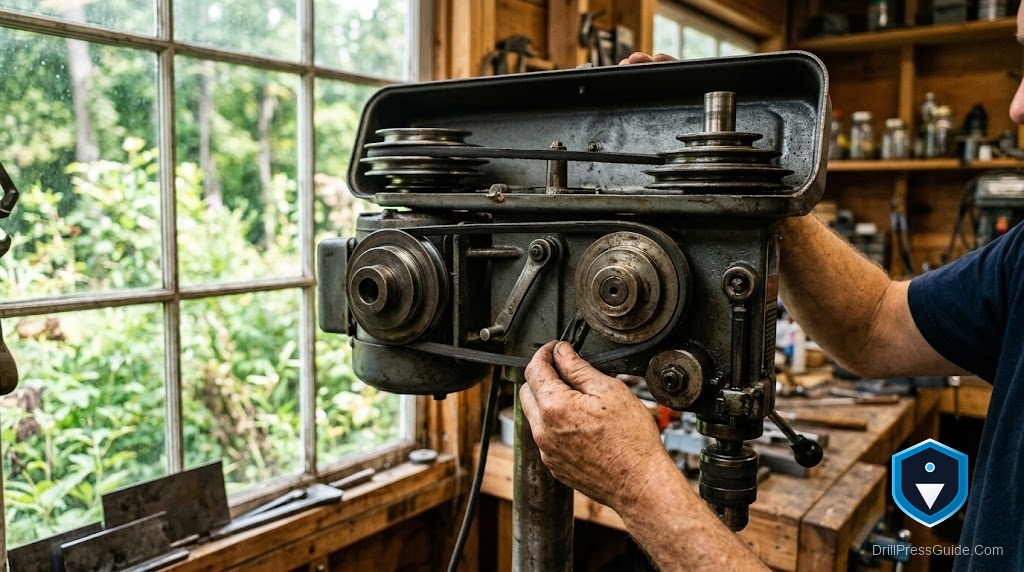
Here is a moment most new drill press owners share: they drill a beautiful hole in pine, then try the same setup in a piece of steel, and the bit screeches and turns blue. Nothing is broken. The speed was just wrong for the material, and changing it is the single most useful skill a drill press owner can learn. It takes a minute and it is the difference between clean holes with long-lived bits and a drawer full of burned, dull ones.
Why drill press speed changes at all
A drill press changes speed because different bits and materials need different cutting speeds. Cutting speed depends on the bit’s diameter and its RPM together. A large bit’s edge travels a long way per turn, so it needs a slow RPM to avoid overheating. A small bit travels a short way per turn, so it needs a fast RPM to cut at all. Metal wants slower speeds than wood at the same bit size. So the machine gives you a range and lets you pick.
That is the direct answer to “why”: you change speed to match the bit and material, and matching is what keeps bits sharp and holes clean.
How to change speeds on a belt-drive drill press
Most drill presses use stepped pulleys and a belt. Here is the process:
- Unplug the machine. Not just switched off, unplugged. Your hands are about to be near the belt.
- Open the head cover. Release the latch and lift the belt-guard cover to expose the pulleys.
- Release belt tension. Loosen the motor-lock knob or lever and slide the motor toward the spindle so the belt goes slack. Some machines have a tension lever.
- Move the belt. Lift the belt onto the pulley pair that gives the speed you want. There is a speed chart inside the cover: smaller motor pulley to larger spindle pulley means slower, and the reverse means faster.
- Reset tension. Slide the motor back until the belt deflects about half an inch under finger pressure, then lock it. Too tight strains the bearings; too loose slips.
- Close the cover, plug in, and test. Run briefly at the new speed to confirm the belt tracks smoothly.
That is the whole job on a two- or three-belt machine. Multi-belt models follow the same idea with more pulley steps.
How to change speeds on a variable-speed drill press
Some machines skip the belt-moving entirely. On a variable-speed drill press like the WEN 4212T 10-inch variable-speed drill press, you turn a handle while the motor runs and the speed changes on the fly, often with the RPM shown on the machine. There is no cover to open and no belt to move. Important detail on mechanical variable-speed machines: change the speed only while the motor is running, because the mechanism relies on the spindle turning to shift. Changing it while stopped can damage the drive.
Belt-change versus variable-speed: which is easier to live with
The two systems trade convenience for simplicity. A belt-and-pulley machine makes you unplug, open the cover, and move the belt every time you change speed, which is a minute of work and mildly annoying if you switch often. A variable-speed machine changes with a turn of a handle and no cover, which is far quicker and encourages you to actually use the right speed instead of forcing the wrong one. The trade is that the variable-speed mechanism has more parts that can eventually wear, while a belt drive is nearly indestructible. If you change speed constantly, the variable-speed machine pays for itself in convenience and better holes. If you set one speed and rarely move it, the belt drive is simpler and lasts forever.
My verdict
Changing drill press speed is a one-minute skill that saves bits and produces clean holes: on a belt machine, unplug, slacken, move the belt to the charted pulleys, reset tension; on a variable-speed machine, just turn the dial while it runs. The rule behind both is the same: big bits and metal run slow, small bits and wood run fast. Learn to change speed without hesitation and you will stop burning bits almost overnight.
Frequently asked questions
How do you change the speed on a drill press? On a belt machine, unplug it, open the cover, loosen belt tension, move the belt to the pulley pair for the speed you want, then reset tension. On a variable-speed machine, turn the speed handle while the motor runs.
Should the drill press be running when I change the belt? No. Belt changes happen with the machine unplugged. Only mechanical variable-speed dials are adjusted with the motor running.
What speed should I use for metal versus wood? Metal and large bits need slow speeds; small bits in wood need fast speeds. Cutting speed depends on bit diameter and RPM, so bigger and harder means slower.
How tight should the drill press belt be? About half an inch of deflection under light finger pressure. Too tight strains bearings, too loose lets the belt slip and lose speed under load.
Why can’t I change a variable-speed drill press while it’s off? Mechanical variable-speed drives shift by moving pulley halves while the spindle turns. Adjusting them stopped can jam or damage the mechanism, so change speed only while running.
How do I know how many speeds my drill press has? Count the pulley steps: the number of pulley-pair combinations equals the number of speeds on a belt machine. A variable-speed machine offers a continuous range instead of fixed steps.
References
- OSHA Woodworking eTool, Drill Presses: https://www.osha.gov/etools/woodworking/production/machines-tools/drill-press
- WEN 4212T product page: https://wenproducts.com/products/wen-4212t-10-in-variable-speed-drill-press
- WEN 4214T variable-speed drill press: https://wenproducts.com/products/wen-4214t-12-in-variable-speed-drill-press


