
16-Speed Drill Press: What the Speed Count Really Buys You
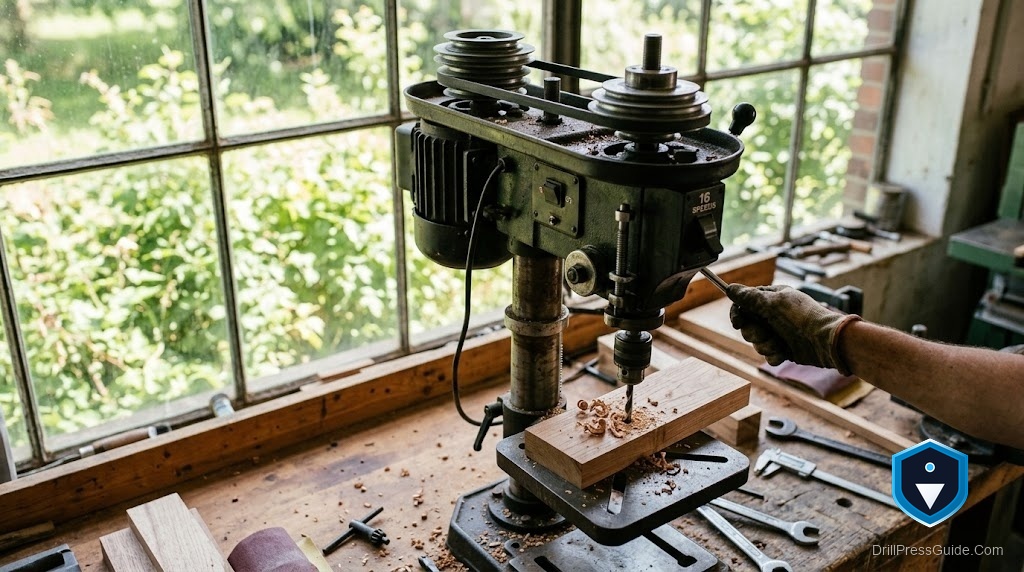
Walk down the drill press aisle and the spec that jumps out is the speed count: 5-speed, 12-speed, 16-speed. More is better, right? Not automatically. A 16-speed drill press promises fine control over spindle RPM, which genuinely matters, but the number alone does not tell you whether the machine is right for you, or even whether those sixteen speeds are the ones you actually need. This guide explains what a 16-speed press really offers, how those speeds are produced, and how to judge whether it beats a variable-speed machine for the work you do.
A 16-speed drill press is a belt-driven press whose pulley system offers sixteen distinct spindle speeds. You select a speed by moving one or more drive belts across a set of stepped pulleys, choosing the RPM that matches your bit and material. The high count means the steps between available speeds are small, so you can get closer to the ideal RPM for any given job.
The direct answer to what it buys you: finer speed selection than a 5- or 12-speed press, which helps when you drill a wide range of materials and bit sizes. What it does not buy you is stepless, on-the-fly adjustment, because you still stop and move a belt to change speed. Whether that trade is worth it depends on how often you switch speeds.
How sixteen speeds are made
A 16-speed press typically uses two or three stepped pulleys and one or two belts. Each combination of belt position gives a different ratio between the motor and the spindle, and with enough pulley steps those combinations add up to sixteen distinct speeds. Changing speed means opening the pulley cover, loosening the belt tension, moving the belt to the pulley step that gives the RPM you want, and re-tensioning. It is a one- or two-minute job, not a turn of a dial.
Why finer steps matter
The reason to want more speeds is the speed chart. Big bits and metal want low RPM; small bits in wood want high RPM. A press with only a few speeds forces you to pick the nearest available step, which might be well off the ideal. Sixteen speeds put a setting close to almost any charted RPM, so you can run each bit and material near its sweet spot, which means cleaner holes, less burning, and longer bit life. The finer the steps, the closer you land to right.
The trade-off against variable speed
Here is the honest comparison. A 16-speed belt press gives you many precise, fixed speeds but makes you stop and move a belt to change them. A variable-speed press gives you stepless speed at a lever or dial without stopping, but often within a set range. If you set a speed and drill for a long stretch before changing, the 16-speed press is excellent and rarely feels limiting. If you jump between materials constantly, the belt changes get old fast and variable speed wins on convenience. Match the machine to how you actually work.
What else to check besides the speed count
Do not let sixteen speeds distract you from the specs that decide whether a press suits your work. Check the swing (how wide a piece you can center a hole in), the spindle travel (how deep a hole in one pass), the motor power (whether it holds speed under load), the chuck capacity, and whether it is a benchtop or floor model. A high speed count on an underpowered, short-travel press is a poor trade. The speed count is one spec among several, not the whole story.
The verdict
A 16-speed drill press buys you fine control over spindle RPM, letting you land near the ideal speed for almost any bit and material, which pays off in cleaner holes and longer-lived bits. What it does not buy is the stepless, no-stopping convenience of a variable-speed machine, since you still move a belt to change speed. Choose a 16-speed belt press if you value precise fixed speeds and do not mind occasional belt changes, and a variable-speed press if you switch speeds constantly. Either way, weigh swing, travel, power, and chuck capacity alongside the speed count, because sixteen speeds on a weak press is still a weak press.
FAQ
What does 16-speed mean on a drill press? The pulley and belt system offers sixteen distinct spindle speeds. You select one by moving the drive belt across stepped pulleys.
Is a 16-speed press better than a 5-speed? For varied work, yes, because the finer steps let you land closer to the ideal RPM for each bit and material. For one repetitive job, extra speeds add little.
How do I change speed on a 16-speed press? Open the pulley cover, loosen the belt tension, move the belt to the pulley step for the RPM you want, and re-tension. It takes a minute or two.
Is a 16-speed press better than a variable-speed press? Different trade. The 16-speed gives precise fixed speeds but needs belt changes; variable speed changes on the fly without stopping. Match it to how often you switch speeds.
Does more speeds mean more power? No. Speed count and motor power are separate. Check the motor amperage or horsepower alongside the speed count.
What else should I check besides speed count? Swing, spindle travel, motor power, chuck capacity, and benchtop versus floor. A high speed count does not make up for weak specs elsewhere.
References
- Woodcraft, drill press shop knowledge guide (speeds and pulleys): https://www.woodcraft.com/blogs/shop-knowledge-guides/drill-press-table
- FineWoodworking, matching drill press speed to material: https://www.finewoodworking.com/project-guides/shop-machines/shopmade-sanding-drums-for-the-drill-press


