
How to Drill Straight Holes Without a Drill Press Without Losing Accuracy
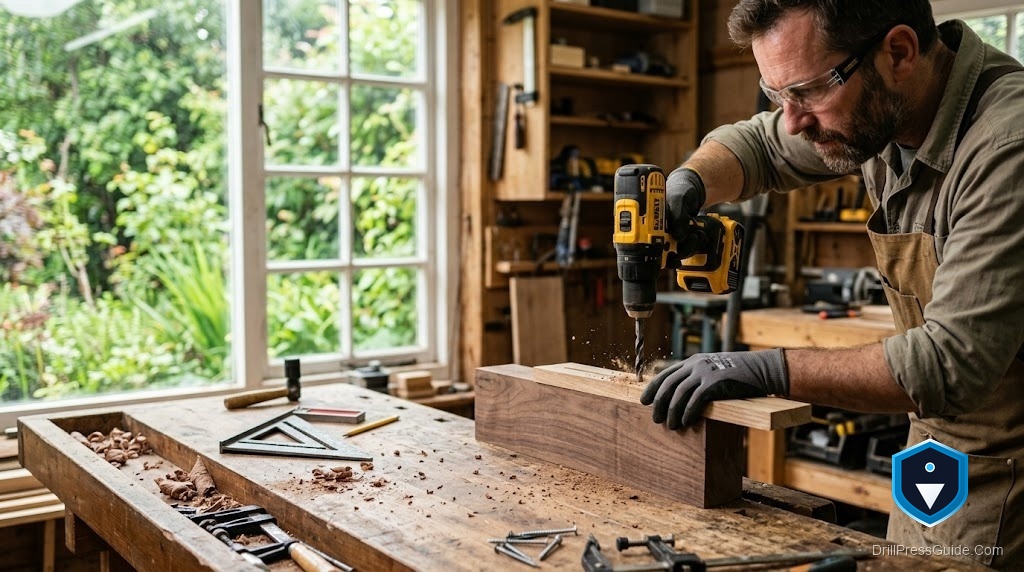
A drill press guarantees a square hole because the machine controls the angle for you. Take that machine away and the whole job lands on your wrist, which is why freehand holes lean, wander, and blow out the back. The good news is that a square hole does not actually require a drill press. It requires a way to hold the drill perpendicular and a workpiece that cannot move, and there are several honest ways to get both. This guide walks through them, from a free trick you can do right now to simple tools that get you within a whisker of drill-press accuracy.
Drilling a straight hole without a drill press means keeping the bit perpendicular to the surface (or at a chosen angle) using a guide, a jig, or a careful sighting method, rather than relying on the fixed spindle of a press. The goal is a hole that enters and exits where you intend, without the bit drifting off square.
The direct answer: for occasional straight holes, use a speed square or a pair of squares as a sighting guide; for repeatable accuracy, use a drill guide block or a portable drill guide that mechanically holds the drill straight. Clamp the workpiece every time, and let the bit cut instead of forcing it.
The free method: sight against a square
Stand a speed square or a combination square on the workpiece right beside your drill point, with the vertical edge pointing up. Line the drill body up parallel to that edge and drill while keeping the bit visually matched to the square. Better still, use two squares set at ninety degrees to each other around the hole, so you can check the drill against both a front and a side reference at once. It is not machine-perfect, but for hanging hardware or a quick shelf pin it is remarkably good and needs nothing you do not already own.
The small upgrade: a drill guide block
A drill guide block is a small precision block with holes bored dead straight in common bit sizes. You set the block on the workpiece, run the bit through the matching hole, and the block keeps the bit square as it enters. Blocks are pocket-sized and simple, they handle the most common bit diameters, and they remove almost all of the human error at the crucial moment the bit bites. For dowel work and general straight holes, a block is the single best fix.
The near-press solution: a portable drill guide
When you want repeatable accuracy, adjustable angles, and a depth stop, a portable drill guide is the closest thing to a press you can carry. A portable drill guide with an adjustable angle base holds your drill in a spring-loaded carriage and guides it straight down, or at a set angle, with a self-centering base for round and narrow stock. The honest caveat is that a portable guide has more play than a floor-standing press, so it rewards firm clamping and a light, patient feed. Used that way, it gets you within a hair of drill-press results in a fraction of the space.
The habits that protect accuracy with any method
Three habits matter regardless of tool. Clamp the workpiece so it cannot creep, because a moving board ruins a straight hole faster than a shaky hand. Start with a punch mark or a shallow pilot so the bit does not skate off the point. And feed slowly, letting the flutes clear chips, since forcing the bit heats it, dulls it, and pushes it off line. Back the workpiece with a sacrificial board so the exit hole does not blow out.
The verdict
You do not need a drill press to drill a straight hole; you need to control the angle and hold the work still. Sight against one or two squares for a free, surprisingly good result, drop in a drill guide block for easy repeatable accuracy, or use a portable drill guide when you want a depth stop and set angles. Whatever the method, clamp the work, punch the start, and feed light. Do that and your holes will land square often enough that the press stops feeling essential.
FAQ
Can I really drill a straight hole without any special tool? Yes. Stand a square next to the drill point and sight the bit parallel to it, or use two squares at ninety degrees. It is not machine-perfect but very good for occasional work.
What is the simplest tool that improves accuracy? A drill guide block: a small block with dead-straight holes in common bit sizes that keeps the bit square as it enters the work.
What gets closest to drill-press accuracy? A portable drill guide, which holds the drill in a carriage and guides it straight or at a set angle, with a depth stop and centering base.
Why does my bit wander even when I start straight? Usually the work moved or you fed too hard. Clamp the workpiece, start on a punch mark, and feed slowly so the bit cuts without deflecting.
How do I stop the exit hole from blowing out? Back the workpiece with a sacrificial board so the bit breaks through into scrap instead of open air.
Can these methods drill angled holes too? Yes. A portable drill guide sets specific angles, and you can sight against a square held at your target angle for occasional angled holes.
References
- Milescraft, DrillMate portable drill guide (guide use and centering base): https://milescraft.com/product/drillmate/
- Rockler, Portable Drill Guide product information: https://www.rockler.com/rockler-portable-drill-guide


