
Delta Drill Press Slow Speed Attachment: How to Go Slower
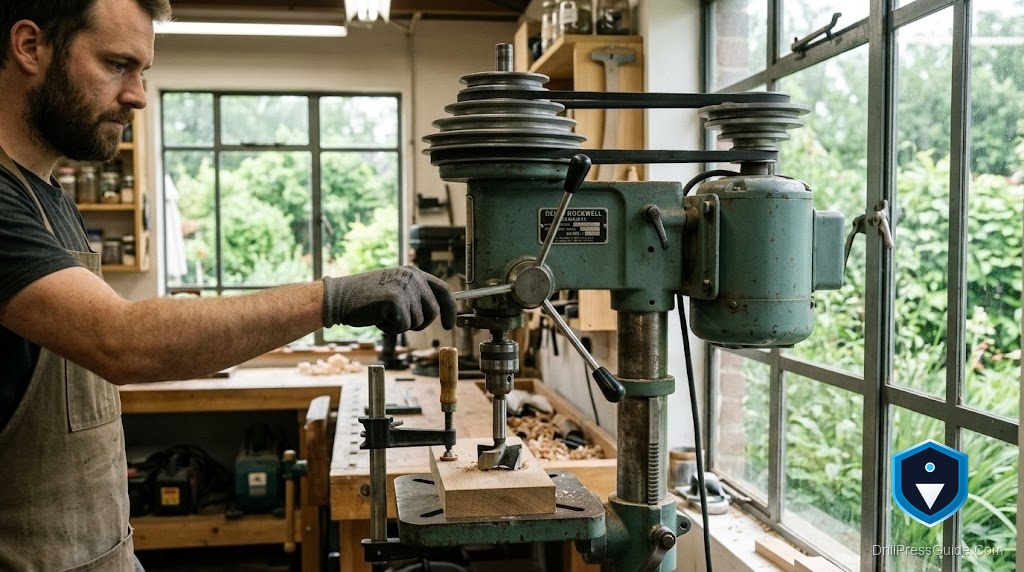
Many Delta drill presses top out their low end around 250 to 300 revolutions per minute, which is fine for wood and small bits but still too fast for a large hole saw in steel. So owners start hunting for a Delta drill press slow speed attachment, imagining a part that bolts on and drops the speed. The reality is more useful than that search suggests, because slowing a Delta press is something you set up, and the methods are proven, affordable, and within reach of a home shop.
A slow speed attachment is any add-on that lowers spindle speed below the machine’s standard pulley range so large bits, hole saws, and metal drilling can run cool and cut cleanly. On a Delta drill press that usually means altering the pulley ratio, adding a jackshaft, or fitting an electronic drive, rather than buying one branded accessory.
The honest answer up front: Delta does not offer a single universal bolt-on slow speed part for every press. What Delta presses do offer is a well-built pulley system that is easy to modify, and three reliable ways to get the spindle turning slower. Pick the one that matches how often you drill metal and big holes.
Why slow speed matters for your Delta
The cutting edge, not the motor, sets the rule. A large bit or hole saw has a big circumference, so at a given spindle speed its outer edge travels much faster than a small bit’s and builds heat quickly. Heat dulls edges, burns wood, and hardens steel until it stops cutting. That is why a two inch hole saw in metal wants a fraction of the speed you would use for a quarter inch bit in pine, often slower than a factory Delta will go. Getting slower is the whole game.
The three ways to slow a Delta press
Change the pulley ratio. The cheapest route. Delta presses change speed by moving the belt across stepped pulleys, so fitting a smaller pulley on the motor or a larger one on the spindle pushes the low end lower. The motor keeps spinning fast where it makes torque and cools itself, while the spindle turns slower. Machinists favor this because you keep your power.
Add a jackshaft. When one ratio change is not enough, mount a third pulley on its own shaft between motor and spindle for a second stage of reduction. This gets a Delta spindle down into the low hundreds of revolutions per minute for big Forstner bits and hole saws, and because the motor stays at full speed, torque holds up. It takes fabrication, but it is a permanent, reliable answer.
Fit a variable frequency drive. The flexible, priciest route: replace the motor with a three-phase unit and control it with a variable frequency drive so you dial speed by frequency. This makes the most sense on a Delta you plan to keep for years and use hard. Avoid the shortcut of putting a router-style speed control on the stock single-phase motor, because it saps torque and can overheat the motor.
How the options compare
For most people, the pulley change is the right first move: cheap, quick, and no lost power. Step up to a jackshaft if you regularly run large holes in metal and a single ratio change will not reach a low enough speed. Go to a three-phase motor and drive only if you want to turn a knob and never touch a belt again, and you are willing to invest for that convenience. All three keep torque where the dimmer-on-a-standard-motor trick throws it away, which is why that shortcut keeps disappointing the people who try it.
The verdict
There is no one Delta slow speed part to add to your cart, and that is fine, because the setups that work are better than a single accessory would be. Swap a pulley for the low-cost win, build a jackshaft when you need to go really slow with full torque, or convert to a three-phase motor and variable frequency drive for dial-a-speed convenience. Match the method to your workload, and your Delta press will bore the large, clean holes in wood and metal that its factory speeds simply cannot manage.
FAQ
Is there a genuine Delta bolt-on slow speed attachment? Not a universal one. Slowing the spindle is done by changing pulleys, adding a jackshaft, or fitting a variable frequency drive.
What is the easiest way to slow my Delta press? Change the pulley ratio with a smaller motor pulley or a larger spindle pulley. It is cheap and keeps motor torque intact.
How slow can a jackshaft take my spindle? Into the low hundreds of revolutions per minute, low enough for large hole saws and metal, while preserving torque.
Can I put a speed controller on the existing motor? Not on a standard single-phase motor. It loses torque and overheats. Use a three-phase motor with a variable frequency drive.
Why do large bits need slow speeds? Their bigger circumference means the cutting edge moves faster and heats up. Slower speeds control heat so the edge keeps cutting.
Which method keeps the most power? Any mechanical method that lets the motor run at full speed, meaning pulley changes and jackshafts, preserves torque best.
References
- The Hobby-Machinist forum, “Slowing Drill Press RPMs” (pulley and reducer methods): https://www.hobby-machinist.com/threads/slowing-drill-press-rpms.102649/
- Practical Machinist forum, “Converting a Drill Press to Variable Speed” (three-phase and drive setups): https://www.practicalmachinist.com/forum/threads/converting-a-drill-press-to-variable-speed.151266/


