Understanding the 5-Speed Drill Press Before You Buy or Set One Up
The 5-speed drill press is probably the most common type of benchtop press in American home shops, and it is also the most misunderstood. Buyers see the five-speed spec and assume more speeds means more versatility, which is partly true. But the real question is whether five belt-driven stepped speeds is enough versatility for what you are drilling, and how to actually use all five of them instead of leaving the belt on one step and drilling everything at the same wrong RPM. Here is what five speeds actually means, how to use them, and whether a 5-speed is right for your shop.
A 5-speed drill press is a benchtop or floor drilling machine with five fixed speeds set by moving a belt between five stepped pulley positions, typically ranging from roughly 620 to 3,100 RPM, allowing the operator to match spindle speed to bit size and material without a variable-speed dial.
Short answer: a 5-speed drill press is a simple, proven machine that gives you five fixed RPM settings to match the bit and material. It is right for your shop if you drill light-to-general holes in wood, plastic, and thin metal, do not mind changing belt position for different jobs, and want the cheapest capable press available. If you want to dial an exact RPM without stopping, look at variable-speed machines. Here is how to understand and use the five speeds.
What “5-speed” actually means
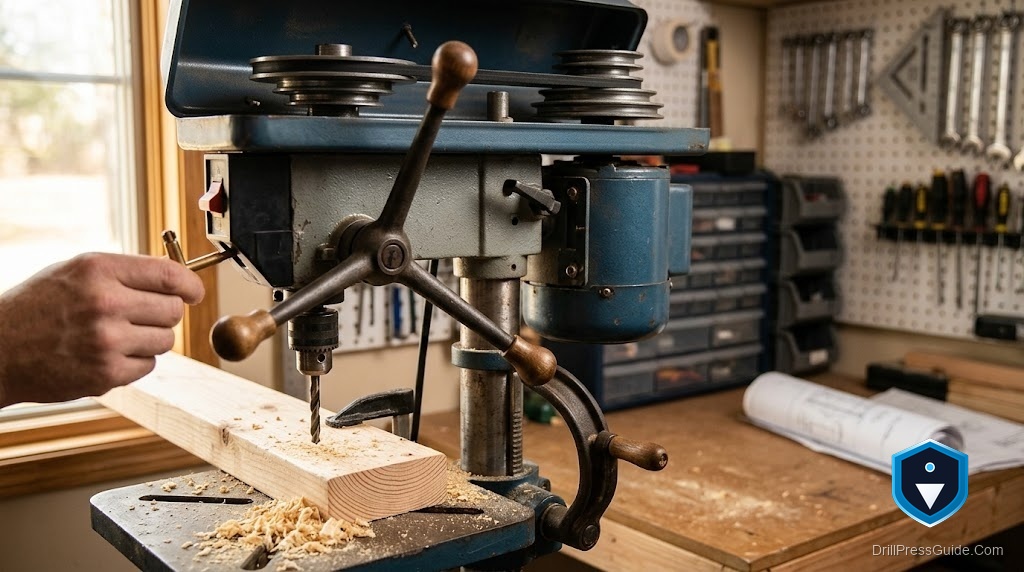
A 5-speed drill press has no motor speed control. The motor runs at one fixed RPM, and the five speeds come from a stepped pulley: a stacked set of five different-diameter pulley steps on both the motor and spindle sides. Moving the belt from one step to another changes the gear ratio and therefore the spindle RPM.
Typical 5-speed RPMs:
- Speed 1 (slowest): ~620 RPM, for large bits (1-inch Forstner and up) and metal.
- Speed 2: ~930 RPM, for medium Forstner bits and large twist bits in wood.
- Speed 3: ~1,300 RPM, for medium bits in wood.
- Speed 4: ~2,000 RPM, for small-to-medium bits in wood and plastic.
- Speed 5 (fastest): ~3,100 RPM, for small bits (1/8 inch and below) in soft wood and plastic.
The exact RPMs vary by model; the manual includes a speed-selection chart.
How to actually use all five speeds
Most owners leave the belt on one step and drill everything at the wrong RPM. Do not do this. The rule:
- Bigger bit = slower speed. Large bits need time to clear chips and generate heat slowly.
- Harder material = slower speed. Metal, hardwood, and thick plastic need more torque and less heat.
- Smaller bit = faster speed. Small bits cut better and cooler at higher RPM.
Practically:
- Large Forstner bits (1 inch and up): speed 1 or 2.
- Medium Forstner bits (1/2 to 7/8 inch): speed 2 or 3.
- 3/8-inch twist bit in hardwood: speed 3.
- 1/4-inch twist bit in softwood: speed 4.
- 1/8-inch bit in pine or plastic: speed 5.
- Any metal: speed 1 or 2 with a center punch and cutting fluid on steel.
Changing speeds means: open the belt cover, release the belt tension (usually by loosening the motor), move the belt to the correct step, re-tension, close the cover. It takes a minute. It is worth it.
Common 5-speed machines
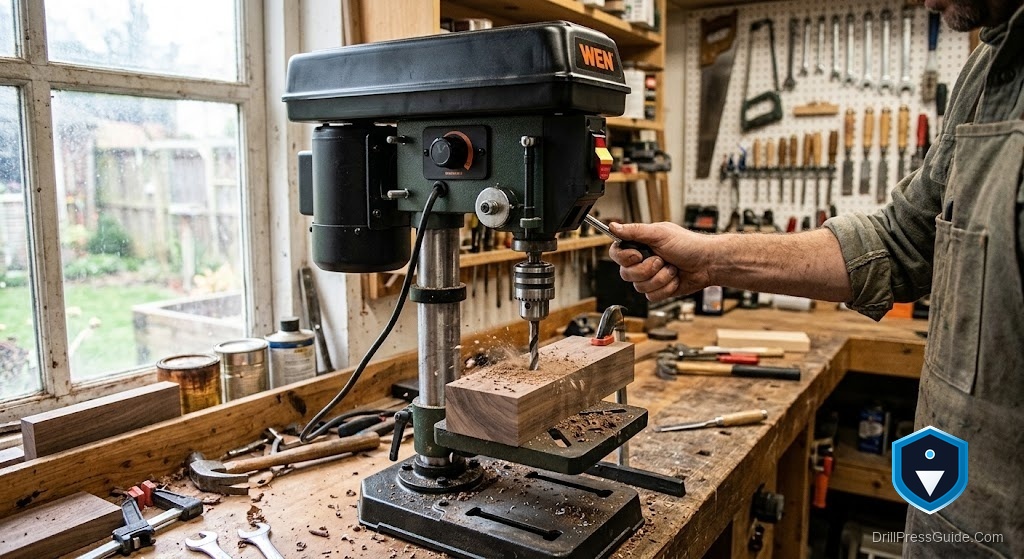
- WEN 4208T 8-inch: A modern benchtop 5-speed with a work light and a two-year warranty. Buy on Amazon.
- Grizzly G0925 8-inch: 5 speeds at 740 to 3,140 RPM, 1/3 HP, JT33 chuck, T-slotted table, one-year warranty.
- Central Machinery 5-speed (item 38199 / similar): Harbor Freight’s entry-level benchtop, the cheapest capable press available.
- RIKON 30-140 radial: A 5-speed radial press with a 34-inch swing and MT2 spindle, for wide-panel work.
- Craftsman, Delta, Ryobi: Many older and current benchtop models use 5-speed belt drives.
When a 5-speed is not enough
Five fixed speeds are not enough if:
- You change materials constantly and resent stopping to move the belt.
- You need very fine speed control for sensitive materials or production drilling.
- You want a digital readout confirming the exact RPM.
In those cases, a variable-speed press like the WEN 4212T (530 to 3,100 RPM via dial, with a digital readout) or the WEN 4214T 12-inch is the better tool.
Setting up a 5-speed press
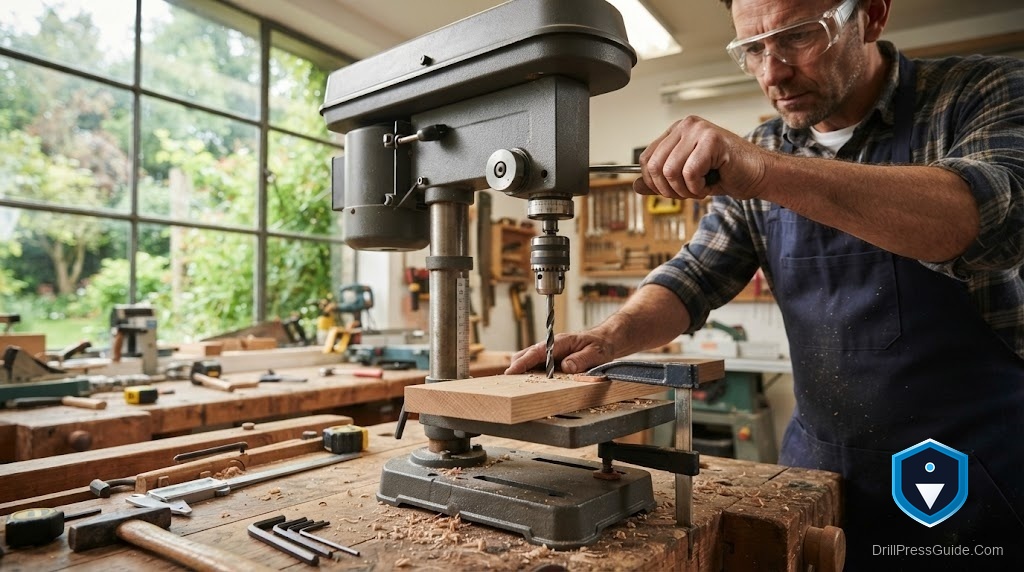
- Mount it solidly to a bench.
- Square the table with a rod and square, in two directions.
- Tension the belt correctly: too loose = slipping and lost speed; too tight = bearing wear.
- Use the depth stop for repeatable holes.
- Consult the speed chart in the manual for every job.
The honest limits
Five discrete speeds. Not 530 to 3,100 RPM continuously, but five fixed steps. On many 5-speed machines you cannot perfectly match the textbook RPM for every bit, only the closest available step.
Belt-change inconvenience. You have to stop the machine, open the cover, and move the belt.
Light-to-general power. Most 5-speed benchtop presses run 1/3 to 1/2 HP.
The verdict
The 5-speed drill press is the right tool for a shop that drills light-to-general holes in wood, plastic, and thin metal, cares about matching RPM to the job (and uses the speed chart), and does not need to dial a fine intermediate RPM without stopping. It is the most common, most affordable press type, and in machines like the WEN 4208T and the Grizzly G0925, it is a genuinely capable tool. The step up to variable speed is worth it when you switch materials often or need an exact RPM; for everything else, five well-chosen speeds do the job.
Frequently asked questions
What does 5-speed mean on a drill press? Five fixed spindle speeds set by moving the belt between five stepped pulley positions, typically from roughly 620 to 3,100 RPM. There is no speed dial; you set the speed by choosing the belt position for the bit and material.
What speed should I use on a 5-speed drill press? Bigger bits need slower speeds; smaller bits need faster speeds. Harder materials (metal, hardwood) need slower speeds with more torque. Consult the speed chart in the manual for exact recommendations, and use speed 1 or 2 for any metal or large Forstner bits.
How do I change the speed on a 5-speed drill press? Open the belt cover, release belt tension by loosening the motor, move the belt to the correct pulley step, re-tension the motor, and close the cover. It takes about a minute.
Is a 5-speed drill press enough? For light-to-general drilling in wood, plastic, and thin metal, yes. If you switch materials constantly and want to dial a fine intermediate RPM without stopping, a variable-speed press is the better tool.
What is the difference between a 5-speed and variable-speed drill press? A 5-speed gives you five fixed RPM settings via belt position; a variable-speed gives you a continuously adjustable range (like 530 to 3,100 RPM) via a dial, often with a digital readout, without stopping to move the belt.
What are some good 5-speed drill presses? The WEN 4208T 8-inch is one of the best value 5-speed benchtops with a two-year warranty. The Grizzly G0925 is a compact 8-inch with T-slotted table and 1-year warranty. Harbor Freight’s Central Machinery 5-speed is the cheapest available.
Can I drill metal with a 5-speed drill press? Yes, with the belt on the slowest speed, a center punch to prevent wandering, and cutting fluid for steel. A 5-speed benchtop is not a metalworking machine, but thin metal and small bits at slow RPM are within its capability.
References
- Fine Woodworking, drill press speed selection and setup guidance: https://www.finewoodworking.com
- Popular Woodworking, benchtop drill press buying and use advice: https://www.popularwoodworking.com
- Popular Mechanics, drill press setup and speed guidance: https://www.popularmechanics.com