
How to Put a Drill Bit in a Drill Press, Step by Step
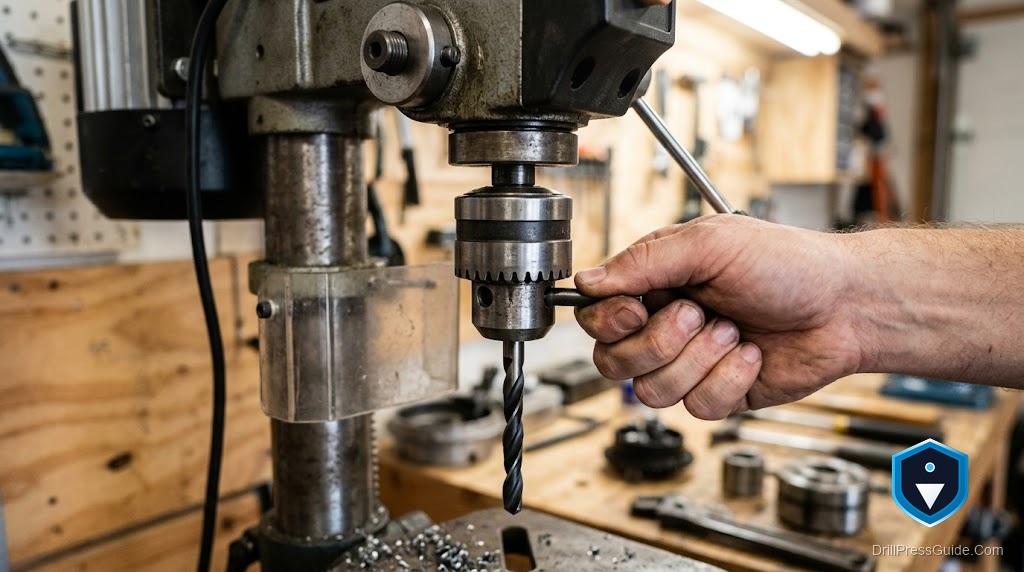
If you have only ever used a handheld drill, a drill press chuck feels familiar and slightly different at the same time. It grips harder, sits at an awkward angle to reach, and punishes a sloppy install with a bit that wanders or slips. Putting a bit in correctly is quick once you know the sequence, and doing it the same way every time is what keeps your holes straight and your fingers safe.
Loading a bit means opening the chuck, seating the shank fully and straight in the three jaws, and tightening evenly so the bit runs true. The chuck is the jawed holder on the end of the spindle, and on most presses a chuck key opens and closes it. The goal is a bit that is centered, deep, and locked.
Short answer: switch off the press, open the jaws with the key, push the bit’s shank all the way in and hold it straight, then tighten with the key at two or three spots around the chuck. Pull the key out before you power on. That sequence gives you a bit that runs true.
Kill the power first
Before your fingers go near the jaws, switch off or unplug the press. A drill press that can start while you are loading a bit is the hazard worth removing first, and it is the heart of what OSHA and CCOHS say about staying clear of the rotating chuck.
Confirm it is truly off by giving the chuck a hand spin. Only then start loading.
The loading sequence
- Switch off or unplug the press and let the spindle stop.
- Fit the chuck key and open the jaws a little wider than the bit shank.
- Insert the bit so the shank seats deep in the jaws, not just at the tips.
- Hold the bit straight and centered, then close the jaws by hand until they just grip.
- Tighten with the key, then move it to a second and third position around the chuck and tighten again for even grip.
- Remove the chuck key and return it to its holder before switching on.
The two habits that matter most are seating deep and tightening at more than one position. A bit gripped at the jaw tips or tightened at a single spot is the classic recipe for slipping and runout.
Matching the bit to the chuck
Not every bit belongs in every chuck. A keyed chuck has a chuck capacity, a maximum shank it will hold, printed on the machine or in the manual. A shank larger than that will not seat; a shank far smaller than the jaws can close on may not center well.
For larger holes, some bits use a reduced shank so they fit a standard chuck. Check your chuck capacity before forcing a big bit. The honest limitation: a keyed chuck on a typical press will not hold the very large bits a drill press can otherwise spin, which is why reduced-shank bits exist.
Keyed chuck versus keyless, and choosing bits
Against a keyless chuck, the keyed chuck most presses use grips heavier bits harder and asks for the extra key step in return. That trade favors the keyed chuck for the metal and larger holes a drill press is built for. If you need bits or a key, you can find a drill press drill bit set sized for your work and a spare drill press chuck key.
Who should slow down
If you are moving from a handheld drill, take the seating and even-tightening steps deliberately until they are habit. If you already load bits fast but see slipping or wandering holes, the fix is almost always deeper seating and tightening at more than one position.
Bottom line
Putting a bit in a drill press is a short, repeatable sequence: power off, open the jaws, seat deep and straight, tighten at three positions, pull the key. Do it the same way every time and your bits run true and your hands stay clear.
- Power off before your hands go near the chuck.
- Seat the shank deep and straight, then tighten at two or three positions.
- Check the bit against the chuck capacity, and remove the key before powering on.
FAQ
How do I put a drill bit in a drill press? Power off, open the chuck with the key, seat the shank deep and straight, tighten at two or three positions, and remove the key before switching on.
Which way do I turn the chuck key to open it? Turn it counterclockwise as you face the chuck to open the jaws, clockwise to close. Open a little wider than the shank first.
Why does my bit sit crooked? It was started cocked in the jaws. Reopen, hold the bit straight and centered, and let the jaws close evenly on it.
What size bit can my drill press hold? Up to the chuck capacity printed on the machine or in the manual. Larger bits often use a reduced shank to fit a standard chuck.
Do I have to remove the chuck key? Yes, always, before powering on. A key left in the chuck becomes a projectile at startup.
Why does my bit slip once I start drilling? Usually shallow seating or single-position tightening. Seat it deep and tighten at more than one point around the chuck.
References
- WEN Drill Press FAQs: https://wenproducts.com/pages/drill-press-faqs
- WEN 4214T 12-Inch Variable-Speed Drill Press: https://wenproducts.com/collections/power-tools/products/wen-4214t-12-in-variable-speed-drill-press
- OSHA Woodworking eTool, Drill Press: https://www.osha.gov/etools/woodworking/production/machines-tools/drill-press
- CCOHS, Metalworking Machines - Drill Presses: https://www.ccohs.ca/oshanswers/safety_haz/metalworking/drillpresses.html


