Sanding Drums for Drill Press: Fit, Capacity, and Setup Explained
The first time you use a sanding drum in a drill press, something clicks. Suddenly those bandsaw curves, jigsaw cutouts, and router-table sweeps that always needed an hour of rasping and file work sand smooth in minutes. A drill press running a sanding drum is one of the most underrated finishing setups in a wood shop - and it’s cheap to do right.
This guide covers everything: how to pick the right drum diameter and grit, how to set up your table for flush sanding, the ideal RPM range for different materials, and the best drum sets on Amazon worth putting in your chuck.
How Sanding Drums Work at the Drill Press
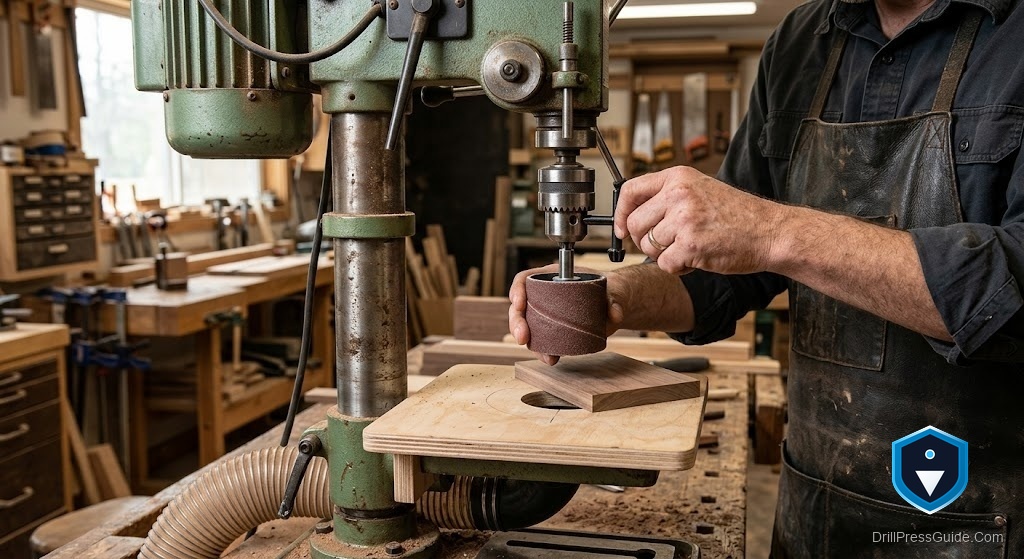
A sanding drum is a rubber-core cylinder that you slip an abrasive sleeve over. The rubber compresses slightly against the sleeve and the workpiece, keeping the sleeve tight during rotation. The shank goes into your keyed chuck, and the drum hangs below, spinning with the spindle.
At a drill press, you’re not raising and lowering the quill to sand - you’re using the depth stop to hold the drum at the exact height where its face sits flush with the drill press table surface. Then you feed the workpiece sideways into the spinning drum.
Setting Up the Drill Press Table for Flush Sanding
Step 1: Cut a piece of MDF to fit your drill press work table. Drill a hole 1/16 inch larger than the drum diameter you’re using.
Step 2: Clamp this auxiliary table flat over the stock table.
Step 3: Lower the drum until the bottom of the sanding surface is level with the top of your auxiliary table. Lock the quill or set the depth stop.
Step 4: Match the drum diameter to the hole. Switch inserts when you change drum sizes.
Choosing the Right Drum Diameter
The drum must be smaller in diameter than the curve radius you’re sanding.
- 1/2-inch drum: Tight inside curves, scrollwork
- 3/4-inch drum: Chair back slats, bracket profiles - the workhorse
- 1-inch drum: Sweeping curves, larger template work
- 1-1/2-inch drum: Gentle curves, edge cleaning on wide boards
Ideal RPM for Drill Press Sanding
| Material | Recommended RPM |
|---|---|
| Softwood | 1,200 - 1,800 RPM |
| Hardwood | 800 - 1,200 RPM |
| Plywood and MDF | 1,000 - 1,500 RPM |
| Plastic / acrylic | 600 - 900 RPM |
| Large drum (1-1/2 in) | 600 - 900 RPM |
The Best Sanding Drum Sets on Amazon
LINE10 Tools 16-Piece Sanding Drum and Sleeves Set
LINE10 Tools 16pk Sanding Drum and Sleeves Set
Four rubber drums (1/2 inch, 3/4 inch, 1 inch, and 1-1/2 inch) and 12 sanding sleeves in 60, 80, and 120 grit. All four drums use a 1/4-inch shank. The 2-inch long sanding surface is the real advantage - standard short drums give you barely an inch of usable surface.
What I like: Extra length makes a genuine difference. Four diameters and three grits cover everything from rough cleanup to finish work.
What I don’t like: The 60-grit sleeves leave scratches you need to work out with 80 and then 120. Plan your grit progression.
Verdict: If you buy one set of sanding drums for your drill press, make it this one.
WEN DS164 20-Piece Sanding Drum Kit
WEN DS164 20-Piece Sanding Drum Kit
Four rubber drums and 16 pieces of sandpaper. Mixed shank sizes (1/8 to 1/4 inch) for compatibility across different drill presses. 80 and 120 grit combination.
What I like: Mixed shank sizing works with small drill chucks as well as standard keyed chucks. The 80 and 120 combination is practical.
What I don’t like: No 60-grit for rough bandsaw cuts. Sanding surfaces are shorter than the LINE10.
Verdict: An excellent complement to the LINE10 set, or the right choice if you work with finished stock.
Pro Tips for Drill Press Sanding
- Move the workpiece against the drum’s rotation. Feed into the leading edge.
- Keep the workpiece moving. Holding still creates burns.
- Don’t press hard. Light contact is all you need.
- Wear dust collection and a dust mask. Fine particles travel far at these speeds.
- Rotate the sleeve periodically. Shift the drum up or down slightly to bring fresh abrasive into contact.
FAQ
What shank size do I need for a drill press sanding drum? Most drill presses with a 3/8-inch or 1/2-inch keyed chuck accept 1/4-inch shanks, which is standard for the LINE10 and WEN DS164.
Do I need an oscillating drill press for sanding drums to work? No. On a standard drill press, keep the workpiece moving and periodically raise or lower the drum to distribute wear.
Can I use sanding drums on metal? Aluminum sands well. Steel loads sleeves fast and generates heat. Use cutting fluid for steel and drop RPM to the lower range.
References
- LINE10 Tools: line10tools.com
- WEN DS164: wenproducts.com