
Drill Press Mill Attachment: Compatibility and Setup Guide
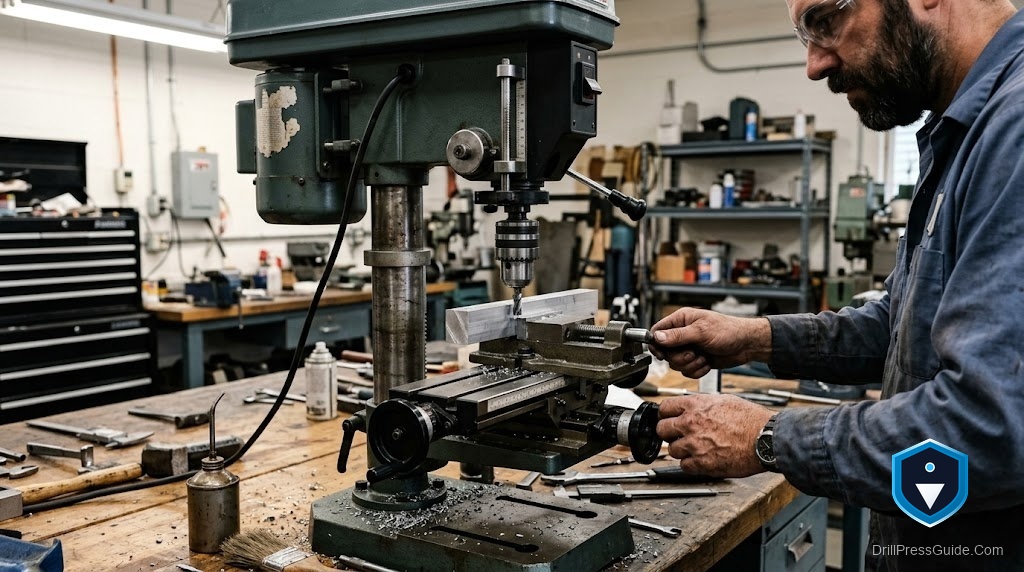
Let’s get one thing straight before we go any further: a drill press is not a milling machine. Every year, woodworkers and hobby machinists damage spindle bearings, ruin workpieces, and occasionally fling parts across the shop by ignoring this fundamental truth.
That said - there’s a real, legitimate overlap between what a drill press can do and what light milling work requires. This guide tells you exactly where that line is, what operations are actually safe on a drill press, and which X-Y compound vise setups on Amazon make the most of what you’ve got.
Why a Drill Press Is Not a Mill
The spindle bearings in a drill press are designed for axial loads - straight down, along the spindle centerline. When you drill, all the cutting force goes in the direction the bearings are built to handle. An end mill working laterally shoves the spindle sideways, applying radial load to bearings that were never designed for it. Do this enough and you’ll develop slop in the quill, chatter in your cuts, and eventually a spindle rebuild.
A real vertical mill uses angular contact bearings and a rigid, non-extending spindle. The column is much more rigid. The table is precision-ground and locks on three axes. None of that is true of a typical benchtop drill press.
What IS Actually Possible on a Drill Press
Safe operations:
- Light slotting with small end mills (1/4-inch two-flute, shallow passes of 0.03-0.05 inch) in wood, soft aluminum, or PCB material
- PCB routing - thin material with low cutting forces
- Precise hole patterns using an X-Y vise
- Mortising attachment work - axial chop motion, not lateral milling
What to avoid:
- Aggressive slotting with large end mills
- Cutting hard steel or cast iron
- Heavy depth-of-cut passes with significant lateral force
- Using the quill extended far out of the spindle housing
The Right Tool: X-Y Compound Vise Tables
Best Overall: WEN CV414 4.25-Inch Cross Slide Vise
WEN CV414 4.25-Inch Compound Cross Slide Vise
Heavy chunk of powder-coated cast iron. The 4.25-by-1.25-inch jaws open to 4.125 inches wide and clamp with over 1,900 pounds of force. Each handwheel is marked in 0.1mm increments, with one full turn representing 3mm of travel. X-axis travel is 5.8 inches, Y-axis is 6 inches.
What I like: The machined 0.1mm markings are real - not printed stickers. Genuinely rigid cast iron construction.
What I don’t like: The jaws are 1.25 inches deep, which is shallow for large or irregular pieces. The gibs will need occasional adjustment as they wear.
Verdict: For drill press hole-pattern work, PCB drilling, and light slotting in aluminum or wood, the WEN CV414 is the benchmark.
Budget Option: Grizzly G1064 4-Inch Cross-Sliding Vise
Grizzly Industrial G1064 4-Inch Cross-Sliding Vise
Dovetailed slides and adjustable gibs. Jaw width is 4 inches with 3-3/4-inch maximum opening, and both axes travel 4 inches. The 0-90 degree swivel base lets you reposition without unclamping.
What I like: Long-proven design, smooth dovetailed slides, useful swivel base.
What I don’t like: 4-inch slide travel is more limiting than the WEN’s 5.8 x 6 inches. More backlash than the CV414.
Verdict: Solid for occasional hole-pattern work. If you want light milling passes, spend up for the CV414.
Setting Up Your Cross-Slide Vise
- Clean the vise and the table with mineral spirits.
- Lower the chuck and rotate the table until the jaws are parallel to the T-slots.
- Bolt it down using the T-slots or clamp bolts.
- Set your depth stop before every plunging operation.
- Zero your handwheels at the reference position.
- For any milling-style work, keep spindle speed between 500 and 1,500 RPM and take shallow passes.
The Honest Verdict
If you want to do real milling - slots, pockets, facing in metal - buy a mill. If you want precise hole patterns, PCB drilling, light slotting in wood or soft aluminum, a drill press with a quality X-Y vise like the WEN CV414 is a legitimate and cost-effective setup.
FAQ
Can I use an end mill in a drill press chuck? Yes, with strict limits. Use a keyed chuck, keep depth-of-cut shallow (0.03-0.05 inch), use small diameter mills (1/4 inch or less), and only cut wood or soft aluminum.
What’s the difference between a mill vise and a drill press vise? A drill press vise holds work in one position. A mill vise (cross-slide vise) adds X-Y axis movement via handwheels.
What RPM for light milling on a drill press? For wood: 1,000-2,000 RPM with small end mills. For soft aluminum: 500-1,000 RPM. Keep depth of cut very shallow.
References
- WEN CV414 product specifications: wenproducts.com
- Grizzly G1064: grizzly.com


