Mortising Bits for Drill Press: Compatibility and Setup Guide
The first square hole most people cut on a drill press comes out looking chewed, not clean. The corners are torn, one wall bows, and the chisel screams on the way down. Then they assume the tool is junk and give up. It usually is not the tool. It is a mismatch between the bit, the chisel, the collar, and the machine, plus a setup step that got skipped. Get those aligned and a drill press cuts mortises that would make a benchtop mortiser jealous.
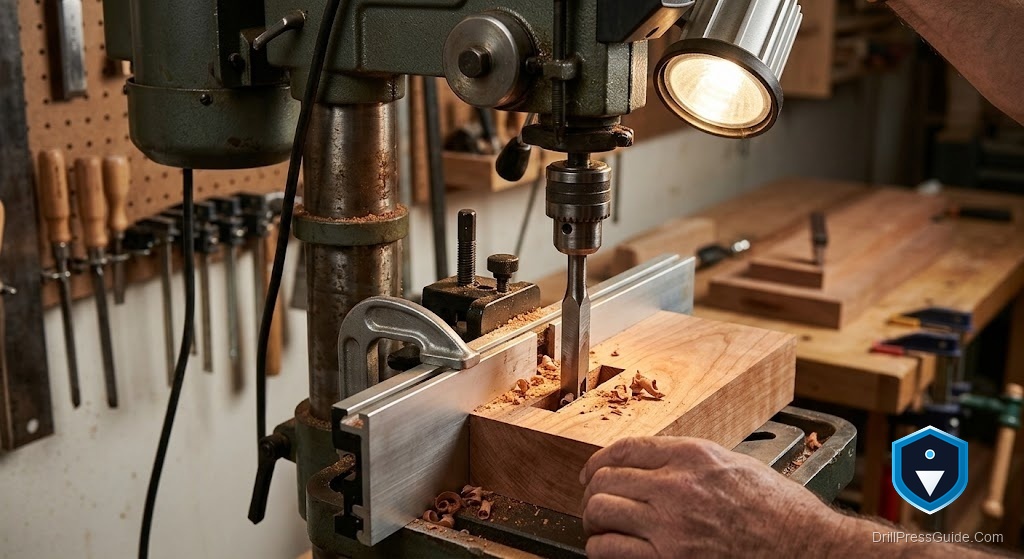
A mortising bit for a drill press is really two parts working together: a hollow square chisel that shears the four corners, and an auger bit that spins inside it to clear the waste. The pair mounts through a mortising attachment that clamps to your quill, with the chisel held by a collar and the bit gripped in the chuck. The whole thing only works when three sizes agree: the chisel shank, the attachment collar, and your quill diameter. Get those three right and everything else is technique.
Can you even use a mortising bit in a normal drill press?
Yes, with a mortising attachment. A drill press does not accept a hollow chisel on its own, because the chisel needs to be held rigid and square while the bit spins freely inside it. That is exactly what a mortising attachment kit does: it bolts a chisel holder and fence to your press, aligns a collar over the quill, and lets the bit run in your existing chuck.
What a drill press cannot match is a dedicated mortiser’s leverage. A drill press handle gives you less mechanical advantage than a mortiser’s long arm, so you work in shallower bites and take more passes. For a hobby shop that mortises occasionally, that trade is easy.
The three sizes that decide compatibility
Chisel shank and collar
Most quality mortising chisels use a 3/4 inch shank, and most attachments and machines are built around a 3/4 inch collar. This is the pairing to aim for, because it is the standard the major chisel sets are cut to.
Quill diameter and bushings
The attachment clamps around your drill press quill, and quills vary. A good kit ships with a range of split bushings so it fits many machines. The Grizzly H7789 mortising attachment kit includes multiple two-piece bushings sized to fit just about any drill press quill, plus a chisel holder, fence, hold-down, and a quill alignment pin. You match your quill’s outside diameter to the nearest bushing.
Chisel and bit as a matched pair
Do not mix a chisel from one set with a random bit. They are ground to work as a pair, and the small gap between the bit’s cutting spurs and the chisel’s inside walls is what keeps the tool from overheating. Buy them as sets.
The mortising chisel and bit sets worth buying
For the chisels and bits themselves, two brands are easy to find as live, currently listed sets and both cut clean when set up right.
CMT makes matched hollow chisel and bit sets across the common sizes with a 3/4 inch shank. The CMT 543.127.51 Mortise Chisel and Bit Set, 1/2 inch is the size I reach for most in furniture work, since 1/2 inch mortises suit table aprons and door rails. Need a wider joint? The CMT 543.190.51 Mortise Chisel and Bit Set, 3/4 inch handles heavier stock. CMT’s honest drawback is that the chisels arrive with a factory edge that benefits from honing before first use. Skip CMT if you want a set that includes a storage case, because these come as single pairs.
The Fisch Mortise Chisel and Bit Set, 3/8 inch is the other one I trust. Made in Austria from high speed steel, it arrives sharp enough to use out of the box. The 3/8 inch size is the workhorse for smaller joinery like face-frame and small door work. If you want the widest size range in one brand, CMT covers more sizes; if you want the sharpest edge out of the box, go Fisch.
A quick way to pick a size:
| Joint | Chisel size | Set |
|---|---|---|
| Small face frames, light doors | 3/8 inch | Fisch 3/8 |
| Table aprons, most furniture | 1/2 inch | CMT 543.127.51 |
| Heavy rails, thick stock | 3/4 inch | CMT 543.190.51 |
Attachment or dedicated machine?
If you already own a solid drill press, an attachment is the sensible path. The Grizzly H7789 mortising attachment kit turns most presses into a mortiser with its bushing range and cast-iron chisel holder. Popular hosts include the Delta 11-990, the JET JDP-17M, and similar cast-iron presses with enough quill travel and a rigid table.
If you mortise often and hate fighting a short handle, a dedicated machine is worth it. The Shop Fox W1671 Mortising Machine is a 3/4 HP benchtop mortiser with a heavy fence and hold-down that fights the “stuck chisel” problem drill press setups are prone to. Owners note the factory chisel is average and the stock table is thin, so many upgrade the chisel and add an auxiliary sub-table, but the motor and the frame are stout.
Setup that separates clean from chewed
Alignment is everything. Seat the attachment so the chisel is dead square to the fence, then sight it from the front and the side before you commit. Set the small gap between the chisel and bit correctly (about a 1/16 inch of the bit’s spurs sitting below the chisel). Clamp the workpiece hard against the fence, ideally with a 4-inch drill press vise or a strong hold-down. And cut in overlapping bites, taking the waste in a series of holes rather than trying to hog a full-width plunge.
The verdict
For most people the answer is not a new machine at all. Buy a mortising attachment with the right bushings for your quill (the Grizzly H7789 fits nearly anything), match it to a 3/4 inch shank chisel set, and set it up square. For the bits, CMT gives you the widest size range across furniture work, and Fisch gives you the sharpest edge out of the box. Only step up to a dedicated Shop Fox mortiser if you cut mortises often enough that a drill press handle’s short throw becomes the thing you resent.
Three things to remember: the three sizes (chisel shank, collar, quill) must agree, always buy the chisel and bit as a matched pair, and honing the chisel before first use fixes half the “bad tool” complaints people post online.
FAQ
Can I use a mortising bit in a normal drill press? Yes, with a mortising attachment that clamps to the quill and holds the hollow chisel square while the bit spins in your chuck. You will take shallower bites than a dedicated mortiser because a drill press handle offers less leverage.
What size shank do drill press mortising chisels use? Most quality mortising chisels use a 3/4 inch shank, and most attachments are built around a 3/4 inch collar.
How do I know if a mortising attachment fits my drill press? Match the kit’s bushings to your quill’s outside diameter. Kits like the Grizzly H7789 include several split bushings to fit most machines.
Why does my mortising chisel burn or bind? Usually a wrong gap between the bit and chisel, a dull or unhoned chisel, or a bite that is too deep. Set the bit spurs slightly below the chisel, hone the chisel before first use, and clear chips between shallow passes.
Do I need matched chisel and bit sets, or can I mix them? Buy them as matched sets. The clearance between the auger bit and the chisel walls is ground to work as a pair, and mixing parts causes overheating and rough cuts.
References
- CMT 543.127.51 Mortise Chisel and Bit Set 1/2 inch: Check on Amazon
- CMT 543.190.51 Mortise Chisel and Bit Set 3/4 inch: Check on Amazon
- Fisch Mortise Chisel and Bit Set 3/8 inch: Check on Amazon
- Shop Fox W1671 Mortising Machine: Check on Amazon