Mortise Drill Press: Compatibility and Setup Guide
If you already own a drill press and you keep staring at those square mortises in furniture plans wondering how you are supposed to make them, I have good news and a little bad news. The good news is that yes, you can cut real mortises on a drill press with the right attachment. The bad news, and I will be honest with you here, is that it takes more fiddling than the marketing photos suggest. I have set these kits up on more than one machine, and the difference between a clean joint and a splintered mess almost always comes down to setup, not the tool itself.
So let me walk you through it the way I would if you were standing in my shop.
What a mortise drill press actually is
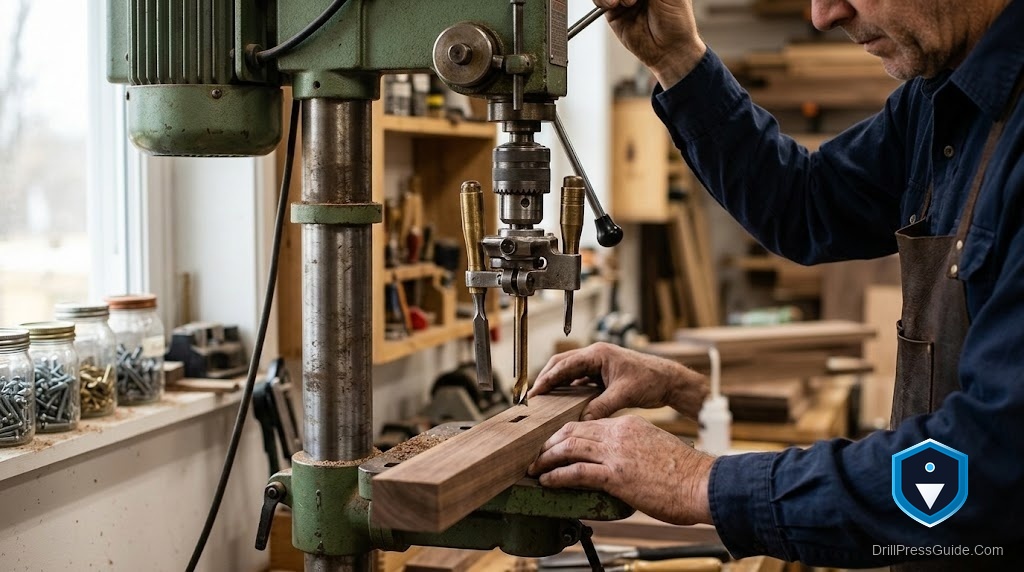
A “mortise drill press” is not a special machine you buy. It is your existing drill press with a hollow chisel mortising attachment bolted to the quill and column. Inside a square hollow chisel sits a spinning auger bit. The bit clears the waste, the chisel squares the corners, and you get that clean rectangular hole a tenon slides into.
That is the whole trick. The bit drills, the chisel chops, and gravity plus your quill feed do the rest.
The parts that make it work
- A chisel holder that clamps around the quill of your drill press.
- A fence and hold-down to keep the workpiece from lifting when the chisel pulls back out.
- A set of hollow square chisels with matching auger bits.
- Bushings or a column collar that adapt the holder to the diameter of your specific quill.
Will it fit your drill press?
This is the question that matters most. A mortising attachment mounts in two places: it clamps to the quill and it braces against the column. If the bushings in the kit do not match your quill diameter, the whole thing wobbles and you will never get a square hole.
Here is my honest experience across a few common machines:
- Grizzly G0485, G0491, and similar floor models. These take standard mortising attachments well. The Grizzly H7789 kit and the G9716 adapter were designed around this family, so fit is rarely an issue.
- Shop Fox W1680 and M1039. Same story. These accept the universal-style holders with the included bushings.
- Delta 11-990 and 17-900. Delta made their own branded attachments, and those fit best. A universal kit usually works, but check your quill diameter first.
- JET JDP-17M. A popular 17-inch drill press that plays nicely with universal kits, provided you use the correct bushing.
The kits I keep recommending are the ones with a generous bushing set, because a bushing you do not need costs you nothing, but a bushing you are missing stops the job cold. The Shop Fox D4031 Mortising Attachment Kit ships with a cast-iron chisel holder, a fence, a hold-down assembly, a quill alignment pin, four chisels (1/4 inch, 5/16 inch, 3/8 inch, and 1/2 inch), and multiple bushings, which is why it fits most drill presses in practice. The Grizzly H7789 Mortising Attachment Kit is essentially the same idea with interchangeable bushings and the same core hardware.
Setting it up so it actually cuts square
- Mount the holder to the quill first, loosely. Let it hang so you can align it later.
- Set the gap between chisel and bit. This is the single most important step. Drop the chisel into its socket, slide the bit through, and push the bit all the way up into the chisel. Then back the bit off by about the thickness of a dime (roughly 1/16 inch) and lock the chuck. If the bit rubs the inside of the chisel, it screams, smokes, and burns. If the gap is too big, the auger will not clear waste ahead of the chisel.
- Square the chisel to the fence. Use a small square against the flat face of the chisel and the fence. If it is even a couple of degrees off, every hole leans and your mortise wall will not be flat.
- Set your speed low. These chisels want a slower spindle speed than a twist bit. High speed equals burning and dull edges fast.
- Clamp the work hard and use the hold-down. When the chisel retracts, it wants to lift your board with it. The hold-down is not optional.
The flaws, spoken plainly
- The 1/4 inch chisel is the weak link. Small chisels have poor cutting geometry, they clog, and they wander. If you can design your joints around a 5/16 inch or 3/8 inch mortise, do it. Your results jump immediately.
- A drill press quill has limited travel and limited leverage. You will crank hard on the feed handle for deep mortises, and benchtop machines flex. This is the honest reason dedicated mortising machines exist.
- Setup is slow. If you need two mortises a year, the attachment is a bargain. If you are building a set of eight chairs, you will start wishing for a purpose-built mortiser by the third leg.
Chisels and bits: buy quality here, not everywhere
You can cheap out on a lot of things. Hollow chisels are not one of them. The Fisch sets from Austria have a strong reputation for holding an edge and cutting clean square walls. A single-size set like the Fisch 3/8 inch Mortise Bit and Chisel Set is a smart starting point because 3/8 inch is the most useful size for typical furniture rails and stiles. If your project calls for a different width, Fisch also offers other sizes.
Mortise without a drill press? Sure.
Since people always ask: you do not need a drill press to mortise. A plunge router with an edge guide and a spiral bit makes gorgeous, consistent mortises with rounded ends. Traditional hand-cut mortises with a mortising chisel and a mallet are slow but deeply satisfying. And a dedicated benchtop mortiser will always outperform an attachment. The attachment route wins on one thing: you already own most of the machine.
The verdict
If you own a compatible drill press and you cut mortises occasionally, a mortising attachment is absolutely worth it. Buy a kit with plenty of bushings so fit is never in question, then spend your money on good chisels. The Shop Fox D4031 kit paired with a sharp Fisch chisel and bit set is the combination I would hand a friend who wants to try this without regret.
Just go in with clear eyes. Set the chisel-to-bit gap correctly, keep the speed low, clamp hard, and skip the 1/4 inch chisel if you can.
FAQ
Can any drill press be turned into a mortiser? Most can, as long as the attachment’s bushings fit your quill and it can brace against the column. Very small hobby drill presses may lack the rigidity and travel to be worth it.
Why is my mortising bit burning and smoking? Almost always the bit is set too close to the inside of the chisel, or your speed is too high. Back the bit off about a dime’s thickness and slow the spindle down.
What size mortise chisel should I buy first? A 3/8 inch chisel is the most versatile for common furniture joinery. Avoid relying on the 1/4 inch chisel, since small chisels cut poorly.
Where can I find a mortise drill press attachment at Harbor Freight? Harbor Freight’s stock changes often and is not consistent for mortising attachments. The universal kits from Shop Fox and Grizzly are more dependable and fit a wide range of machines.
Is a dedicated mortising machine better than an attachment? Yes, for volume and ease. A benchtop mortiser has more leverage, better hold-downs, and faster setup. If you mortise rarely, the attachment saves you money and space.
References
- Shop Fox D4031 Mortising Attachment Kit: Check on Amazon
- Grizzly H7789 Mortising Attachment Kit: Check on Amazon
- Fisch 3/8 inch Mortise Bit and Chisel Set: Check on Amazon