Drill Press Fence: Fit, Capacity, and Setup Explained
I drilled shelf-pin holes in a cabinet side once without a fence, trusting my layout lines and a steady hand. Twenty holes later, the row wandered like a country road, and every crooked hole was on display inside that cabinet. That was the day I stopped treating a drill press fence as optional. A fence is the difference between holes that line up and holes that embarrass you.
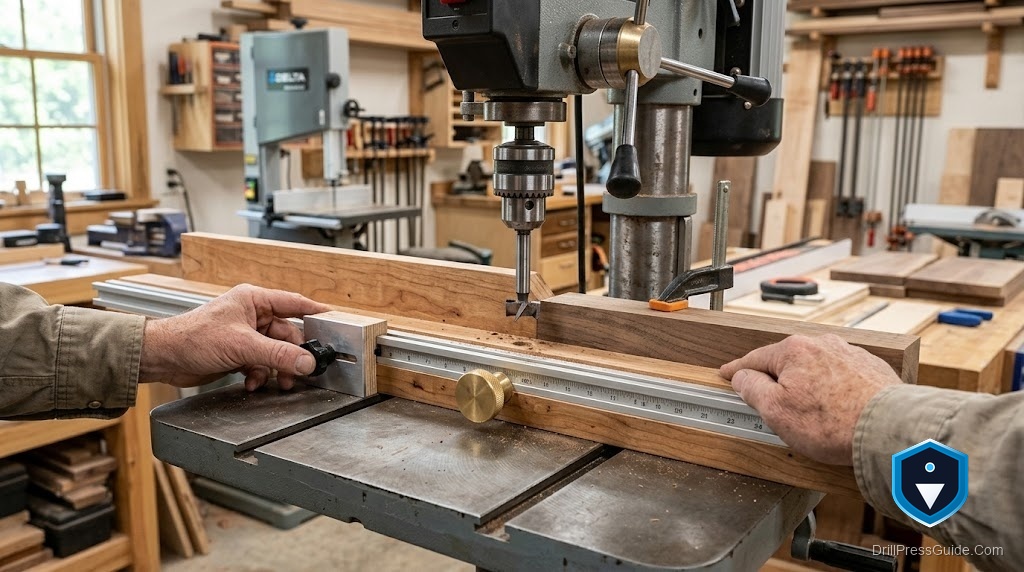
A drill press fence is a straight, rigid guide that clamps or bolts to your table and gives your workpiece a reference edge. Push the board against the fence, and every hole sits the same distance from that edge. Add a stop block and you get repeatable positions along the fence too. It sounds simple because it is, yet it transforms the accuracy and safety of nearly everything you do on the machine.
Why a Fence Matters More Than You Think
Without a fence, you are aligning each workpiece by eye and hoping it does not creep as the bit enters. With one, the fence holds the reference for you, so a row of holes stays perfectly parallel to the board’s edge. For anything involving multiple holes, joinery, or repeat parts, this is not a luxury, it is the whole game.
There is a safety dimension too. A fence backs up the workpiece against the rotational force of the bit, reducing the chance the piece spins out of your hands. Combined with proper clamping, a fence keeps the work where you put it, which matters enormously when a bit grabs unexpectedly.
What Makes a Good Drill Press Fence
The best fences share a few traits. They are dead straight and stay that way, usually thanks to extruded aluminum rather than flexy wood. They lock down firmly with no shifting under load. And they carry a T-track or slots so you can add stop blocks, hold-downs, and other accessories without fuss. The POWERTEC drill press fence system is a solid example, offering an aluminum fence with dual T-tracks that bolt onto many aftermarket tables.
Height matters as well. A taller fence face supports larger workpieces standing on edge, while a low fence keeps clear of small parts. Some fences build in flip stops for instant repeatable spacing, a feature worth having if you drill a lot of identical parts. The Magswitch drill press fence with stops leans into that with adjustable stops for production-style repeat work.
The Fit Problem Nobody Warns You About
Here is the honest part. Not every fence fits every table, and this trips up more buyers than anything else. A fence has to attach to your table’s T-tracks or slots, and those come in different widths and spacings. Before you buy, measure your table’s track width and the distance between tracks, then confirm the fence is compatible.
Many fences are designed to pair with a specific table or table family. If you own an aftermarket table already, check whether its maker sells a matching fence, because that guarantees a clean fit. A universal fence like the Magswitch magnetic fence sidesteps some of this by clamping magnetically to a cast-iron table, which is a clever fix if your table lacks usable tracks.
Capacity, Clearance, and the Quill-Travel Tax
Every accessory you stack on a drill press table costs you something in vertical clearance, and a fence-and-table combination is no exception. A thick table plus a tall fence raises your work and shrinks the gap between the chuck and the workpiece. On a benchtop press with limited quill travel, that can leave you unable to drill tall pieces, so account for it.
Capacity also means how far the fence sits from the bit. You want enough table depth in front of and behind the fence to support your typical workpieces. Measure the reach you actually need, because a fence positioned too close to the column limits how large a panel you can swing under the bit.
Building Versus Buying
Plenty of woodworkers build their own fence from plywood or hardwood, and it is a rewarding project that costs almost nothing. A shop-made fence can be sized exactly to your table, fitted with a wooden T-track, and replaced when it wears. The downside is that wood moves with humidity and is harder to keep perfectly straight over time.
A manufactured aluminum fence buys you guaranteed straightness, a durable T-track, and quick accessory compatibility. For most people who value their time, that convenience is worth the cost. If you enjoy the process and want a custom fit, building your own is entirely legitimate. Neither path is wrong, it comes down to how you want to spend your effort.
Verdict
A fence is one of the highest-value upgrades you can add to a drill press, and I would not run a machine without one. For a robust, accessory-ready option, the POWERTEC drill press fence system covers most needs with its aluminum build and dual T-tracks. If you want built-in repeatable stops, the Magswitch fence with stops is worth the premium, and the magnetic version solves the fit problem elegantly on cast-iron tables. Whatever you choose, measure your table’s tracks first, mind the added height against your quill travel, and you will wonder how you ever drilled without one.
- A fence gives your workpiece a reference edge so rows of holes stay parallel and repeatable.
- Good fences are straight, lock firmly, and carry a T-track for stops and hold-downs.
- Always measure your table’s track width and spacing to confirm fence compatibility before buying.
- A fence and table add height that reduces quill travel, so account for clearance on smaller presses.
FAQ
Do I really need a fence on my drill press? If you drill multiple holes, do joinery, or make repeat parts, a fence is essential for accuracy and repeatability. It gives your workpiece a reference edge so holes line up perfectly. For occasional single holes, you can manage without one, but most people quickly find it indispensable.
Will any drill press fence fit my table? No, fit is the most common problem buyers hit. A fence must match your table’s T-track width and spacing, or attach by another method like magnets. Measure your table’s tracks before buying and confirm compatibility, ideally pairing a fence with its matching table.
What is the advantage of an aluminum fence over a wooden one? An extruded aluminum fence stays dead straight, resists humidity-driven movement, and usually includes a durable T-track for accessories. A shop-made wooden fence costs less and can be custom-sized, but wood can warp and wear over time. Aluminum buys reliability and convenience.
How does a fence affect my drilling depth? A fence, especially combined with an aftermarket table, raises the work and reduces the gap between the chuck and the workpiece. On presses with limited quill travel, this can restrict how tall a piece you can drill. Account for the added height before committing.
Can I add a stop block to any drill press fence? You can if the fence has a T-track or slots to hold the stop. A stop block gives you repeatable positioning along the fence, which is invaluable for identical parts. Some fences include built-in flip stops, while others accept aftermarket ones.
Are magnetic drill press fences any good? Magnetic fences are a clever solution for cast-iron tables that lack usable T-tracks, clamping firmly without bolts. They offer quick repositioning and solve many fit problems. The main limits are that they need a ferrous table and may not match the rigidity of a bolted fence for heavy work.
Should I build my own drill press fence? Building your own is a rewarding, low-cost project that lets you size the fence exactly to your table. The trade-off is that wood can move with humidity and is harder to keep perfectly straight. If you value guaranteed straightness and quick accessory fit, a manufactured aluminum fence is worth buying.
References
- POWERTEC official product documentation and specifications
- Magswitch Tools, fence and magnetic accessory guidance
- Fine Woodworking, drill press fence and table articles
- Popular Woodworking, shop-made fence and jig plans
- Manufacturer owner manuals for benchtop and floor drill presses