
10-Inch Drill Press Replacement V Belt: Diagnose the Fit Before Replacing Anything
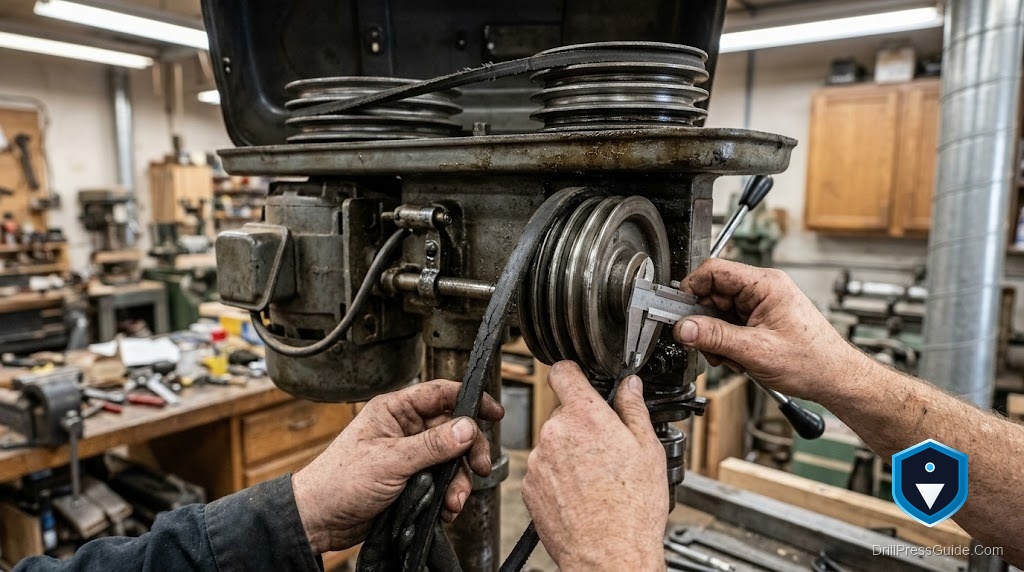
Your belt let go mid-hole, or it is cracked and squealing, and the obvious move is to search “10 drill press replacement v belt,” add the first result to the cart, and get back to work. That is exactly how a lot of people end up with a belt that is too long, too wide, or too stiff to track. A 10 inch drill press replacement v belt is not one standard size, so the smart first move is to diagnose what your machine actually needs before you buy a thing.
A drill press V-belt is the rubber or link loop that carries power from the motor pulley to the spindle pulley. The two numbers that matter are top width and length. Get both right and almost any decent belt runs well; get either wrong and it slips, squeals, or will not seat in the pulley groove. There is no single “10 inch” belt because that measurement refers to the swing of the machine, the distance from the spindle centerline to the column, not the belt.
Read the machine before you shop
Start at the ID label for the model number, serial number, and manufacture date. A craftsman 10 inch drill press belt for one production run can differ from another because makers issued a version code partway through a model’s life. If your press has parts support, the model number pulls up a part diagram and an exploded view, and the belt shows up as its own callout with a part number. That part number is the cleanest path to the right replacement part, no measuring required.
Diagnose the fit: measure the belt or the pulleys
No catalog for your machine? Measure. Two reliable ways:
Measure the old belt. Even a broken one gives you its top width across the wide face and its length. For length, lay it flat and measure the outside loop, or wrap a string around the inside and measure that. Belt part codes read straight off those numbers. A code like 4L380 means a 4L profile (1/2 inch top width) at 38 inches long. A 3L code means a 3/8 inch top width, which many light 10 in drill press models use.
Measure the pulleys. If the old belt is gone, measure the center-to-center distance between the motor and spindle pulleys, run it through a belt length calculator, then read the groove width to get the profile.
Decode the belt sizes you will see
Drill press V belts for these machines are fractional-horsepower belts, softer and more flexible than the stiff belts an auto parts store sells. The two profiles you will meet most are 3L (3/8 inch) and 4L, also called A (1/2 inch). Some imports print a metric code instead, so a listing marked something like V/O 550 is pointing at roughly a 550 mm length. Treat any printed code as a starting point and confirm it against your own measurement, because a code copied into a listing is the easiest place for an error to hide.
Your three real options
Here is where honest tradeoffs matter, because these three choices behave differently on the machine.
A model-specific replacement belt is the closest thing to plug and play. It is cut to your machine’s exact length and profile, so it drops in and tracks right. If you own an older Craftsman, these are still made; a model specific belt such as this Craftsman drill press V belt is the kind of match cut for a particular Craftsman press rather than a generic size. The flaw is narrow fitment: buy the one made for your exact model, because the same seller lists close cousins that will not fit. Skip this route if your press is an orphan with no known model match.
A standard rubber V-belt bought by size (a 3L or 4L in the length you measured) is the widest-stocked and most familiar option. Any hardware store or belt supplier can match a 4L380 or similar. Its weakness is that you have to measure correctly, since nobody is guaranteeing fit; the size is on you. This is the right pick for most people who measured carefully.
An adjustable link belt is the fix-anything option. You size it by snapping links off until it fits, so one product covers many machines, and it runs noticeably quieter because the linkage absorbs vibration. Something like an adjustable link belt like this half inch Power Twist can replace a standard 1/2 inch V-belt on a drill press, lathe, or table saw. The honest drawbacks: link belts can chew up soft die-cast pulleys over time, and they need real tension on a small motor pulley or the sheave will eat them. Match the link width (3/8 or 1/2 inch) to your groove, and skip it if your press has tiny cast pulleys or you want the quietest factory feel.
Multi-speed and 16-speed machines
A single-belt press has one loop to match. A multi-speed or 16 speed drill press uses two belts, one from the motor to an intermediate pulley and one from there to the spindle, or a single belt you reposition across stepped pulleys for speed change. Match each belt to its own run. Getting one right and one wrong still leaves you with a machine that will not hold speed under load.
What not to do
Do not fit an automotive V-belt. They are stiffer and built for high-tension car accessory drives, and on a light drill press they run hot, track poorly, and wear the pulleys. Do not force a 1/2 inch belt into a 3/8 inch groove either; a belt riding proud of the groove slips and glazes fast. And while the belt is off, glance at the pulley grooves for wear, spin the spindle shaft to feel the ball bearings, and test the switch, since a rough bearing or a worn pulley will kill a fresh belt early.
The verdict
Treat the belt as a measurement problem, not a shopping problem, and this repair is quick and painless. The Nu Mark drill press belt replacement, the old Craftsman, the generic import: they all follow the same logic of match the width, match the length, then choose the belt type that suits how you use the machine.
- There is no universal 10 inch belt; that number is the swing, not the belt size.
- Get top width and length from the old belt or the pulley spacing before buying.
- Match the profile: 3L is 3/8 inch, 4L or A is 1/2 inch, and codes are only a starting point.
- Choose model-specific for exact fit, a standard V-belt for availability, or a link belt for quiet, adjustable use.
FAQ
What size is a 10 drill press replacement v belt? There is no single size, because 10 inches is the swing of the machine, not the belt. Measure your old belt’s top width and length, or the pulley spacing, to get the size your press actually uses.
Are drill press replacement belts the same as automotive belts? No. Drill press belts are fractional-horsepower belts, softer and more flexible, while automotive belts are stiff and built for high tension. An automotive belt on a drill press runs hot and wears the pulleys.
How do I find the right craftsman 10 inch drill press belt? Read the model number off the ID label and order the belt made for that exact model, or measure the old belt and match the profile and length. Craftsman issued different belts across model runs, so the model number matters.
What does a code like drill press replacement belts V/O 550 mean? A code like that points to a length in millimeters, here roughly 550 mm, on a metric-labeled belt. Confirm it against your own measurement, since listing codes are copied by hand and easy to get wrong.
Can one belt cover a 16 speed drill press replacement? Usually a 16 speed press runs two belts, so you match each one to its own pulley run. A single link belt can replace either loop as long as you size the length and width to that specific run.
Will a link belt work for a Nu Mark drill press belt replacement? Yes, an adjustable link belt works on most presses, including orphan brands like Nu Mark, because you size it by removing links. Match the link width to your pulley groove and keep the tension firm on small pulleys.
How tight should a new drill press V-belt be? Pressed at the middle of its span, the belt should deflect about 1 to 2 percent of its length. Too tight strains the bearings and pulleys, too loose lets the belt slip and glaze.
References
- Craftsman and Sears drill press owner manuals and parts lists
- VintageMachinery.org drill press documentation archive
- Fine Woodworking and Popular Woodworking drill press tune-up articles
- Practical Machinist forum threads on V-belt and link belt selection
- Fenner Drives PowerTwist link belt technical guidance


