
How to Lubricate a Drill Press Spindle: Smooth Feed Without Gumming It Up
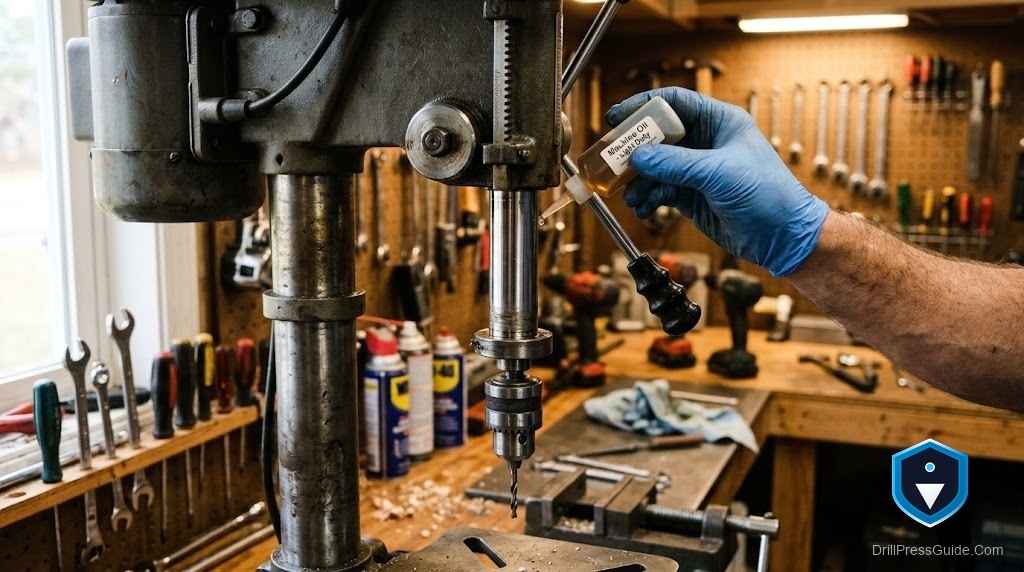
The quill on your press has started to feel sticky, or it drops with a jerk instead of gliding, and the return is lazy. The instinct is to hose it down with oil. Do not. Learning how to lubricate a drill press spindle the right way is as much about what not to do, and where not to put lubricant, as it is about the greasing itself, because oil in the wrong spot ruins accuracy and attracts grit.
The spindle spins inside the quill, and the quill slides up and down inside the head casting for the feed. Those are the surfaces that want lubrication. The tapers that hold the chuck and arbor are the surfaces that must stay bone dry. Mix those up and you trade a sticky quill for a chuck that slips.
The one rule that matters most
Never put oil or grease on the tapers. The Morse taper in the quill and the Jacobs taper on the arbor hold by friction, and any lubricant there makes the chuck or arbor spin loose and drop. Keep lubricant on the sliding and rotating surfaces only, and keep it off anything that grips a taper or a belt.
Where the drill press actually wants lubrication
- The quill (outer sleeve) in its bore: this sliding fit is the main place a light film helps, since it is what feels sticky when it is dry. A thin coat lets the quill glide and return smoothly.
- The spindle bearings: these are usually sealed and do not need added grease. If yours are the older serviceable type, they take a small amount of the correct bearing grease during a rebuild, not a squirt from the top.
- The rack and pinion and the return spring area: a light grease on the gear teeth and moving linkage keeps the feed smooth.
- The column and table elevation rack: on floor presses, a light film here lets the table crank up and down freely.
Choose the right lubricant
Match the lubricant to the surface.
For the quill sliding in its bore, a light machine oil works, but many people prefer a dry film or a light lithium grease because oil attracts sawdust and grit that turn into a grinding paste. A white lithium grease gives a clingy, water resistant film on the rack teeth and slides that stays put without running. For a lighter touch on the quill and general pivots, a versatile multi purpose penetrating and lubricating oil frees a sticky quill and leaves a thin protective film. Use grease where you want cling on gears and oil where you want a light film on a sliding fit.
Avoid heavy grease on the quill sliding surface, since it stiffens the feel and grabs debris.
How to lubricate step by step
- Unplug the press.
- Clean first. Wipe the old, gummy lubricant and sawdust off the quill, the rack, and the pinion with a rag. New lubricant over old grit just makes paste. A little solvent on the rag helps cut hardened grease.
- Extend the quill fully with the feed handle to expose the sliding surface.
- Apply a thin film of oil or light grease to the exposed quill, then work it up and down several times to spread it evenly. Wipe off the excess so it does not sling or collect dust.
- Put a light grease on the rack and pinion teeth and any exposed feed linkage, then cycle the feed to distribute it.
- Wipe everything down so only a thin film remains. More is not better here.
Keep it off the belt and tapers
Worth repeating because it is the most common mistake: no lubricant on the drive belt, the pulleys, or the tapers. Oil on a belt makes it slip and squeal, and oil on a taper makes the chuck drop. If you get any on those surfaces, clean it off with solvent and let it dry before running the press.
Keep the feed smooth long term
A sticky quill often is not a lubrication problem at all but a buildup of old grease and sawdust, so cleaning does more than adding oil. Wipe the quill and re oil lightly a few times a year in a dusty shop, and keep the tapers clean and dry. If the quill still feels rough after cleaning and a light film, the bearings or the quill fit may be worn, which is a different job from lubrication.
The verdict
Lubricating a drill press spindle is quick, and restraint is the whole trick.
- Keep lubricant on the sliding quill, the rack and pinion, and serviceable bearings only.
- Never oil the tapers or the belt, since that makes chucks drop and belts slip.
- Clean off old grit before applying fresh lubricant, or you make a grinding paste.
- Apply a thin film, cycle it in, and wipe the excess, since more is not better.
FAQ
What lubricant should I use on a drill press quill? A light machine oil or a light lithium grease works on the quill sliding in its bore. Many people prefer a light grease or dry film because plain oil attracts sawdust, so match it to how dusty your shop is.
Can I put grease on the drill press spindle taper? No. The taper holds the chuck or arbor by friction, and any grease or oil there makes it slip and drop. Keep the tapers bone dry and clean, and lubricate only the sliding and rotating surfaces.
Why is my drill press quill sticky or jerky? Usually a buildup of old, hardened grease and sawdust rather than a lack of oil. Clean the quill and rack thoroughly first, then apply a thin fresh film, which restores smooth feed more often than adding lubricant alone.
Do drill press spindle bearings need greasing? Most modern spindle bearings are sealed and need no added grease. Older serviceable bearings take a small amount of the correct bearing grease during a rebuild, not a top up from outside.
How often should I lubricate my drill press? A light clean and re oil a few times a year suits most home shops, more often in a dusty environment. The key is cleaning off old grit each time rather than piling new lubricant on top.
Can I use spray lubricant on my drill press? Yes, a light multi purpose oil is fine for freeing a sticky quill and protecting bare metal, applied thinly and wiped down. Keep the spray off the belt, pulleys, and tapers, and clean any overspray from those surfaces.
Why does my chuck keep falling off after I lubricated the spindle? You almost certainly got oil on the taper. Remove the chuck and arbor, clean both the taper and the socket with solvent until bone dry, then reseat, and the chuck will hold again.
References
- Fine Woodworking, Tune Up Your Drill Press (finewoodworking.com)
- Popular Woodworking, Drill Press Maintenance Basics (popularwoodworking.com)
- VintageMachinery.org Knowledge Base, spindle and quill lubrication guidance (vintagemachinery.org)


