How to Fix Drill Press Spindle Play: Track Down the Wobble
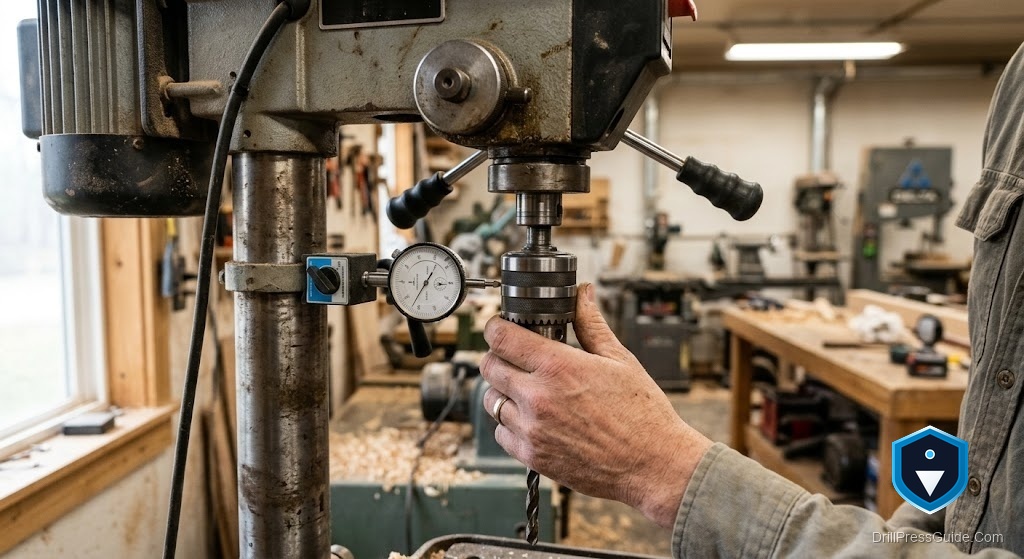
You grab the chuck and wiggle it, and there is a click and a shift that should not be there. Or your holes come out slightly oval and the bit chatters. That slop is spindle play, and learning how to fix drill press spindle play starts with figuring out which of two very different kinds you have, because the fixes are not the same and one of them is free.
The spindle is the shaft that spins the chuck, riding inside the quill, which is the sleeve that slides up and down for the feed. Play can live in either the spindle bearings or the quill fit, and pinning down which one saves you from replacing parts that were never worn.
The two kinds of play, and how to tell them apart
Unplug the press, then test with your hands.
- Radial play (side to side): grab the chuck and push it sideways. Movement here points to worn spindle bearings or a loose quill in its bore.
- Axial play (up and down): pull the chuck straight down and push it up. Movement along the axis points to worn thrust bearings or a loose spindle nut.
- Quill play: extend the quill fully and wiggle it. If the slop grows as the quill extends, the quill to bore clearance is the culprit, not the bearings.
Noting when the play appears, extended versus retracted, side to side versus up and down, tells you where to look before you open anything.
Start with the free fixes
Before buying parts, rule out the simple causes.
- Tighten the quill lock and check adjustment: some presses have a quill lock and a small adjustment that takes up excess clearance. A quill that was simply loose in its bore can tighten right up.
- Reseat the chuck and arbor: play you blame on the spindle is sometimes a chuck that is loose on its taper. Pull the chuck, clean the taper bone dry, and reseat it, since a dirty taper mimics spindle wobble.
- Check the spindle nut or preload: many presses have a nut at the top of the spindle that sets bearing preload. If it has backed off, axial play appears, and correctly retightening it to spec removes the up and down slop.
These cost nothing and fix a real share of play complaints.
Renew the bearings if they are worn
If the play is in the bearings, they need replacing. Spin the spindle by hand with the belt off and feel for roughness or grinding, and listen for a growl, both signs of failed bearings.
Replacing them means dismantling the quill assembly: remove the chuck and arbor, release the quill return spring under its spring cap slowly since it is under real tension, then slide the quill and spindle out. Press out the old bearings and press in new ones of the same size, which are marked on the bearing shields. Reassemble, set the preload nut, and re tension the return spring. If pressing bearings is beyond your setup, a local shop can do the press work while you handle the teardown.
Address a worn quill or spindle
Sometimes the quill itself is worn oval in its bore, or the spindle journals are worn, and no bearing swap fixes that. On a budget press the honest math often favors replacing the quill and spindle as a unit, or weighing that cost against a better machine. On a quality press, a rebuild with new bearings, a trued spindle, and a quill within spec is well worth it and restores the accuracy that made the press worth owning.
Verify the fix
After reassembly, recheck play by hand in all three directions, radial, axial, and quill extended. Then spin it up and drill a test hole in scrap. A clean round hole with no chatter means the play is gone. Confirm the spindle turns freely without binding, since overtightened preload trades play for drag and cooks the new bearings.
The verdict
Fixing spindle play is really about diagnosis, since the free fixes solve a surprising number of cases.
- Identify the play as radial, axial, or quill clearance before touching parts.
- Try the no cost fixes first: quill lock and adjustment, reseating the chuck, and the preload nut.
- Replace bearings only when you feel or hear them failing, matching the size on the shields.
- Weigh a full quill and spindle rebuild against the value of the machine.
FAQ
Why does my drill press chuck wobble side to side? Radial play usually means worn spindle bearings or a loose quill in its bore, though a chuck that is loose or dirty on its taper can mimic it. Reseat a clean chuck first, then check the bearings if the wobble remains.
How do I fix up and down play in my drill press spindle? Axial play often comes from a preload nut at the top of the spindle that has backed off, or worn thrust bearings. Retightening the nut to the correct preload frequently removes the up and down movement.
Is some spindle play normal? A tiny amount can exist, but noticeable click or shift is not normal and shows up as oval holes and chatter. If you can feel it by hand at the chuck, it is worth diagnosing and correcting.
How do I know if my drill press bearings are bad? Spin the spindle by hand with the belt off. Roughness, grinding, or a growling noise means the bearings are worn. Smooth and quiet rotation points to quill clearance or preload instead.
Can I fix spindle play without replacing bearings? Often yes. Tightening the quill lock and adjustment, reseating a clean chuck on its taper, and correcting the preload nut solve many cases at no cost. Replace bearings only when they feel or sound worn.
What causes the quill to get loose when extended? Wear between the quill and its bore increases clearance, so the play grows as the quill extends. Some presses have an adjustment to take up clearance, but a badly worn quill needs replacing.
Is it worth rebuilding the spindle on a cheap drill press? On a budget machine, the cost of a quill and spindle can approach the price of a better press, so weigh it carefully. On a quality press, a rebuild restores real accuracy and is usually worth doing.
References
- VintageMachinery.org Knowledge Base, spindle and quill rebuild guidance (vintagemachinery.org)
- Practical Machinist forums, drill press spindle play and bearing discussions (practicalmachinist.com)
- Fine Woodworking, Tune Up Your Drill Press (finewoodworking.com)