
How to Change Belt Position on Drill Press Without Losing Accuracy
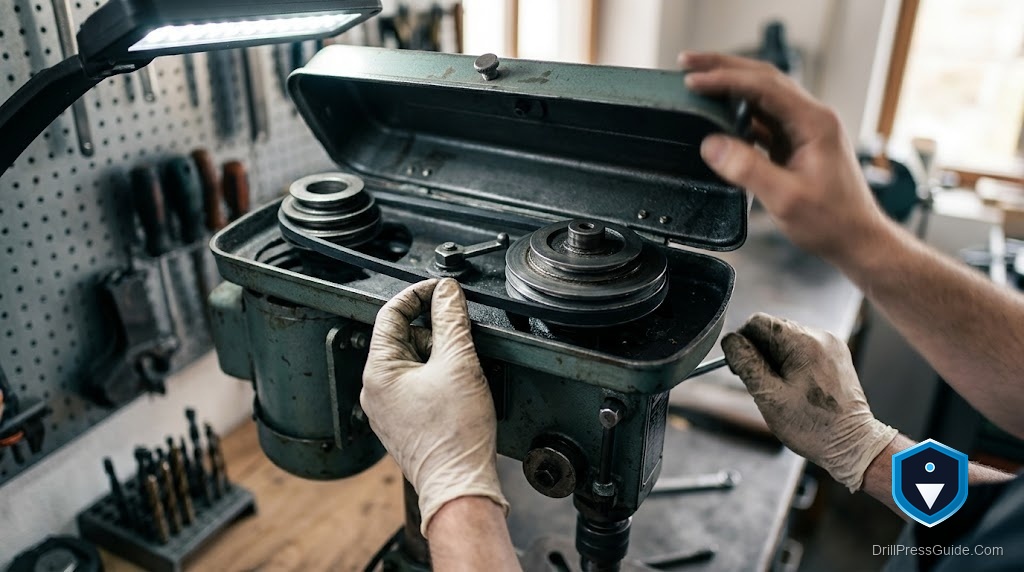
The belt position on a drill press is what sets your speed, and moving it to the right pulley steps is the single change that turns a bit-burning, wandering setup into clean, accurate holes. Knowing how to change the belt position on a drill press takes a minute, and the accuracy comes from matching the speed to the bit and material, then re-tensioning correctly so the belt does not slip.
The belt runs over stepped pulleys, one on the motor and one on the spindle, and its position on those steps sets the spindle speed. Changing the position means moving the belt to a different pair of steps, higher speed for small bits in wood, lower speed for large bits or metal, then resetting tension.
Short answer: unplug the press, open the guard, slacken the motor to release tension, move the belt to the step pair that gives your target speed, then slide the motor back to set about half an inch of deflection and lock it.
Match the speed to the job
Belt position is really speed selection, so choose by bit and material:
- Small bits in wood: highest speed, belt on the small spindle step and large motor step.
- Large bits or metal: lowest speed, belt on the large spindle step and small motor step.
- The speed chart inside the guard maps each step pair to an RPM.
- Slower speeds give more turning force and less heat for big holes and hard material.
Changing it, step by step
- Unplug the press and open the belt guard.
- Loosen the motor mount to slacken the belt.
- Lift the belt off and reseat it on the step pair for your target speed.
- On a three-pulley setup with an idler, route the belt over both stages per the chart.
- Slide the motor back until the belt deflects about half an inch midway, then lock it.
- Spin the spindle by hand, confirm the belt tracks straight, and close the guard.
When the belt fights the change
A glazed or stretched belt slips no matter which steps you choose, and a stiff old belt resists seating cleanly on the steps. If yours is hard, cracked, or worn smooth, an adjustable link V-belt seats easily on the steps, holds tension, and runs cooler, matched to your pulley profile.
The honest drawback: a link belt uses more material per foot than a molded belt and can run slightly louder at top speed. Who should skip a new belt: anyone whose belt is sound and only needed repositioning.
Move the belt, reset the tension
Changing belt position is speed selection: match the step pair to the bit and material, then re-tension so it grips. Get that right and the press drills clean without slipping or bogging.
Three takeaways:
- Belt position sets speed; use the chart to match the bit and material.
- High speed for small bits in wood, low speed for large bits or metal.
- Re-tension to about half an inch of deflection after every change.
FAQ
How does belt position change the speed? The belt’s position on the stepped pulleys sets the ratio between motor and spindle. Moving it to different steps raises or lowers the spindle RPM.
Which position is fastest? The belt on the small spindle step and large motor step gives the highest speed. The reverse gives the slowest speed with the most turning force.
What speed should I use? High speed for small bits in wood, low speed for large bits or metal. Check the speed chart inside the guard for the RPM of each step pair.
Do I need to re-tension after moving the belt? Yes. Slide the motor back to set about half an inch of deflection every time, since different steps change the belt path length.
My belt slips no matter the position. Why? It is likely glazed, stretched, or the wrong size. A worn belt slips at any position and needs replacing.
Can I change position with the press plugged in? No. Always unplug the press before opening the guard and moving the belt.
References
- VintageMachinery.org, drill press speed and belt documentation: http://vintagemachinery.org


