
How to Remove Drill Press Pulley Without a Puller Without Losing Accuracy
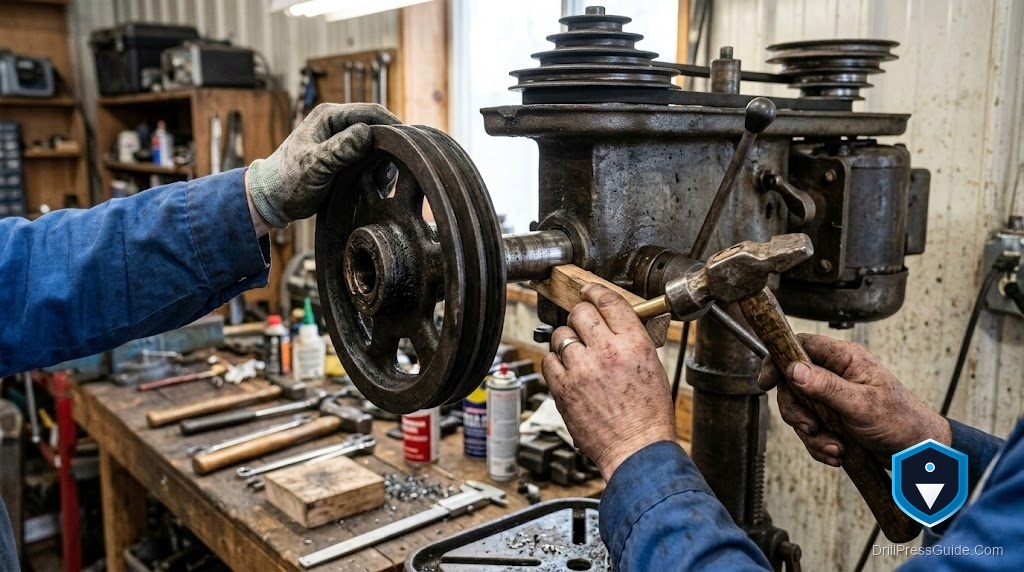
A pulley that will not come off is the wall most people hit mid-repair, usually while chasing a bearing or a seized spindle, and reaching for a dedicated puller is not always an option. Removing a drill press pulley without a puller is possible, and the trick is to apply steady, even lift with what you already have, because the one thing that ruins the job is prying on one side and bending the shaft or pulley.
A drill press pulley is the stepped wheel pressed or set-screwed onto the motor shaft or the spindle shaft, carrying the belt across its steps. Removing it without a puller means freeing any set screw or key, then working the pulley off evenly with improvised pry bars, penetrating oil, and sometimes gentle heat.
Short answer: unplug the press, back out the set screw or free the key, soak the hub with penetrating oil, then lift the pulley evenly using paired pry bars or wedges on opposite sides, or a bearing separator clamped behind it. Never hammer the shaft or pry from one side only.
Why even lift matters
The risk without a puller is uneven force. Pry one edge and you cock the pulley on the shaft, scoring it or bending a thin motor shaft. Everything here is about spreading and balancing the lift.
No-puller methods that work
- Free it first. Back out any set screw fully and remove the shaft key; many pulleys only feel stuck because a screw is still biting.
- Penetrating oil. Soak the hub-to-shaft joint and wait; rust and old grease are often the real grip.
- Paired pry bars. Slip two pry bars or flat wedges behind the pulley on opposite sides and lift together, a little at a time, alternating sides.
- Gentle heat. Warming the hub expands it slightly; keep heat off nearby bearings and seals.
When you truly need a gripping tool
Sometimes a pressed-on pulley simply will not walk off by hand. A bearing separator and puller set clamps its jaws behind the pulley hub and draws it off square, which is the even pull a screwdriver never gives, and it doubles for bearings on the same repair. It is the honest middle ground between no tool and a dedicated pulley puller.
The honest drawback: a separator still needs clearance behind the hub to seat its jaws, so a pulley buried against a casting may need partial disassembly first. Who should skip it: anyone whose pulley slides off once the set screw and key are freed.
Common mistakes
- Hammering the shaft end, which mushrooms the thread and drives grit into the bearings.
- Prying from one side, cocking and scoring the pulley.
- Forgetting the hidden set screw or key and forcing against it.
- Heating right next to a bearing or seal and cooking it.
Even lift, not brute force
Removing a pulley without a puller is about patience and balance: free the fasteners, soak the joint, and lift evenly with paired pry bars or a bearing separator. Keep force off the shaft end and off one side, and the pulley comes away without losing accuracy.
Three takeaways:
- Free the set screw and key first; that alone releases many stuck pulleys.
- Lift evenly with paired wedges or a bearing separator, never one-sided prying.
- Soak with penetrating oil and use gentle heat, keeping heat off bearings.
FAQ
Can I really remove a drill press pulley without a puller? Often yes. Free the set screw and key, soak the joint, and lift evenly with paired wedges. A bearing separator helps when a pressed pulley resists.
Why should I not just hammer it off? Hammering the shaft end mushrooms threads and drives grit into the bearings, and side blows bend the shaft. Even, drawing force is safer.
What holds the pulley on? Usually a set screw against a flat or a key in a keyway, sometimes a light press fit. Free those fasteners before pulling.
Will penetrating oil help? Yes. Much of the grip is rust and hardened grease in the hub. Soak it and wait before applying force.
Is heat safe to use? Gentle heat on the hub helps, but keep it away from nearby bearings and seals, which heat can ruin.
The pulley still will not budge. Now what? Use a bearing separator clamped behind the hub for an even pull, freeing clearance by partial disassembly if the pulley sits against a casting.
References
- VintageMachinery.org, drill press pulley and spindle documentation: http://vintagemachinery.org


