
How to Adjust Belt Tension on a Drill Press: Setup, Checks, and Common Mistakes
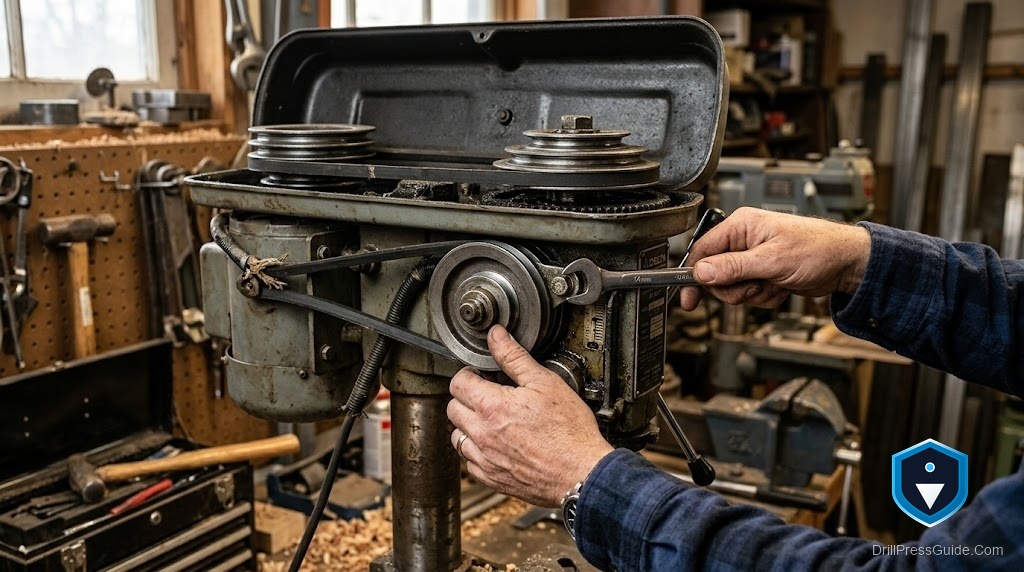
Belt tension is the quiet setting that decides whether your drill press delivers full power or slips, squeals, and wears out bearings early. Too loose and the belt slips under load; too tight and it drags on the motor and spindle bearings. Learning how to adjust belt tension on a drill press takes two minutes and one simple check, and it is the difference between a press that bogs down and one that drills clean.
Belt tension is the tautness of the V-belt between the motor pulley and the spindle pulley. Adjusting it means moving the motor to set the right amount of give in the belt, firm enough to grip and transmit power, loose enough not to strain the bearings.
Short answer: unplug the press, loosen the motor mount, slide the motor to set about half an inch of deflection when you press the belt midway between the pulleys, then lock the motor and confirm the belt tracks straight.
Setup: the half-inch rule
The standard check is deflection. With the belt on your working pulley step, press it midway between the two pulleys with a thumb. It should move about half an inch. More than that is too loose; almost no movement is too tight.
Adjusting it, step by step
- Unplug the press and open the pulley cover.
- Loosen the motor mount lock knobs or bolts.
- Slide the motor away from the spindle to tighten, or toward it to loosen.
- Set the belt so it deflects about half an inch midway between the pulleys.
- Lock the motor mount, keeping the motor pulley parallel to the spindle pulley.
- Spin the spindle by hand, confirm the belt tracks straight, and close the cover.
When tension will not hold
If you cannot get a firm grip no matter how you set the motor, the belt itself is likely glazed, stretched, or the wrong size. A worn belt will keep slipping even at correct tension. An adjustable link V-belt lets you fit the exact length for a proper grip and renew a glazed belt at the same time, matched to your pulley profile.
The honest drawback: a link belt uses more material per foot than a molded belt and can run slightly louder at top speed. Who should skip a new belt: anyone whose current belt is sound and only needed the motor repositioned.
Common mistakes
- Setting the belt drum-tight, which drags the motor and cooks the spindle bearings.
- Leaving it too loose, so it slips and squeals under load.
- Locking the motor with the pulleys out of parallel, which makes the belt track off and wear.
- Blaming tension when a glazed or stretched belt is the real problem.
Set the half-inch, keep the pulleys parallel
Adjusting belt tension is a two-minute job with a simple target: about half an inch of deflection, pulleys parallel, motor locked. Get that right and the press delivers full power without straining the bearings. If tension will not hold, the belt, not the setting, is worn.
Three takeaways:
- Aim for about half an inch of belt deflection midway between the pulleys.
- Keep the motor and spindle pulleys parallel when you lock the mount.
- If tension will not hold, replace a glazed or stretched belt.
FAQ
How tight should a drill press belt be? About half an inch of deflection when you press it midway between the pulleys. Firm enough to grip, loose enough not to strain the bearings.
How do I adjust the tension? Loosen the motor mount and slide the motor away from the spindle to tighten, or toward it to loosen, then lock it at the right deflection.
What happens if the belt is too tight? It drags on the motor and spindle bearings, wearing them out early and wasting power. Too tight is as harmful as too loose.
Why does my belt slip even after tightening? The belt is likely glazed, stretched, or the wrong size. A worn belt slips at any tension and needs replacing.
Do the pulleys need to be aligned? Yes. Keep the motor and spindle pulleys parallel, or the belt tracks off to one side and wears quickly.
How often should I check belt tension? Check it when the press squeals, slips, or bogs under load, and as a routine part of a tune-up. Belts stretch over time.
References
- VintageMachinery.org, drill press belt and pulley documentation: http://vintagemachinery.org


