How to Change the Belt on a Rockwell Drill Press: Setup, Checks, and Common Mistakes
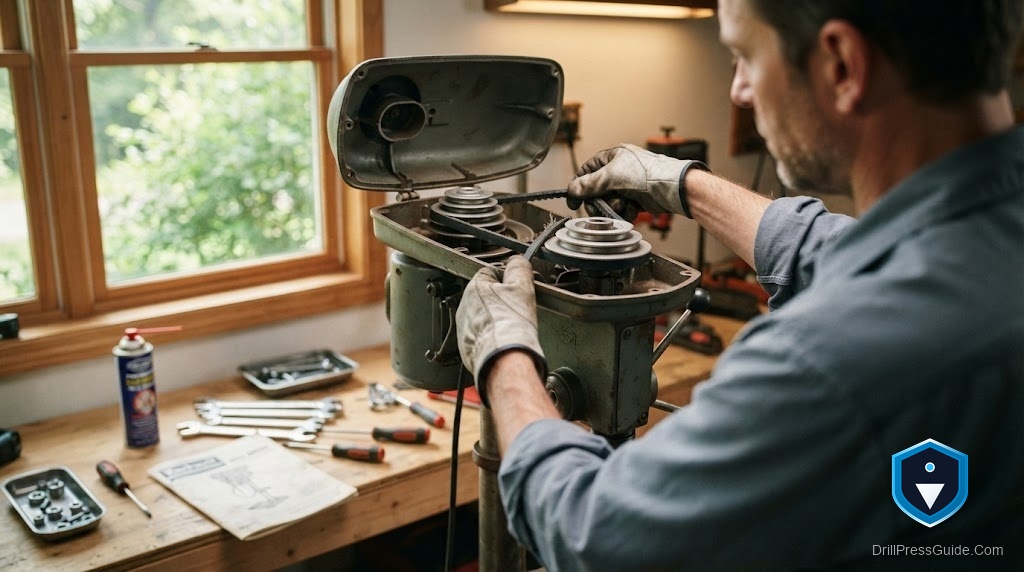
Rockwell drill presses were built in an era when a machine was meant to be repaired, not replaced, which is good news when the belt finally cracks. The belt is one of the few wear parts on these old workhorses, and changing it is a job the original owner would have done without a second thought. Knowing how to change the belt on a Rockwell drill press comes down to releasing tension correctly and matching the new belt to the machine, not to a part number that may be decades out of print.
The belt is the V-belt that carries motor power to the spindle across stepped pulleys. On a vintage Rockwell it is almost always a standard A-section V-belt, which means you can match it by profile and length even if the factory number is long gone.
Short answer: unplug the press, open the belt guard, release tension by loosening the motor mount and sliding the motor forward, roll the old belt off, then fit a matching A-section belt (or an adjustable link belt) and re-tension to about half an inch of deflection.
Setup: release tension the right way
The mistake that ruins knuckles is trying to force a belt over a pulley that is still under tension. On most Rockwell presses the motor sits on a hinged or sliding mount held by lock bolts. Loosen those, swing or slide the motor toward the spindle, and the belt goes slack. Only then does it come off easily by turning the pulley and walking the belt off by hand.
Match the belt without the original number
Measure two things off the old belt:
- Top width, typically about 1/2 inch for an A-section on these presses.
- Outside length, measured around the belt or by wrapping a string on the pulley path.
With those two numbers you can buy a molded A-section V-belt to match, or step up to an adjustable link V-belt that you build to the exact length. The link belt is the reliable route on an old machine whose original size sits between common belts, and it runs cooler and smooths out the vibration these vintage presses can develop.
The honest drawback: a link belt uses more material per foot than a molded belt and can be slightly louder at top RPM. Who should skip it: anyone who found the exact molded A-section length, since a matched molded belt runs a touch smoother.
Common mistakes to avoid
- Forcing the belt on under tension. Always slacken the motor first.
- Ignoring pulley alignment. Old presses drift out of line; sight down the pulleys so the new belt tracks straight.
- Over-tightening. A drum-tight belt drags the bearings. Aim for half an inch of give.
- Skipping the speed step. Seat the belt in the pulley steps that match your intended speed before locking the motor.
A vintage press rewards a careful swap
Changing the belt on a Rockwell drill press is straightforward once you stop hunting the original part and start matching the profile and length. Slacken the motor, roll the old belt off, fit a matched A-section or link belt, and set the tension by feel.
Three takeaways:
- Release motor tension before removing or fitting the belt.
- Match the A-section profile and length; the factory number is not needed.
- Check pulley alignment on an old press so the new belt tracks and lasts.
FAQ
What belt does a Rockwell drill press use? Most use a standard A-section (about 1/2 inch top width) V-belt. Measure your old belt’s width and length to match, since exact lengths vary by model.
How do I release the belt tension? Loosen the motor mount lock bolts and slide or swing the motor toward the spindle. That slackens the belt so it rolls off by hand.
Can I use a link belt on an old Rockwell? Yes. An adjustable link belt is a good match when the original length is hard to find, and it runs cooler and quieter on a vintage press.
How do I find the right length without the part number? Measure the old belt’s outside length, or wrap a string around the pulley path at your usual speed and measure that.
How tight should the new belt be? About half an inch of deflection midway between the pulleys. Too tight wears the bearings; too loose slips and squeals.
My new belt keeps wearing fast. Why? Usually misaligned pulleys on an old machine. Sight down the pulleys and correct alignment before blaming the belt.
Do I need to set the speed while changing the belt? Yes. Seat the belt on the pulley steps for your target speed before you re-tension and lock the motor.
References
- VintageMachinery.org, Rockwell/Delta drill press manuals and documentation: http://vintagemachinery.org