
How to Adjust Belt Speed on a Ryobi Drill Press: A Clear, Shop-Ready Method
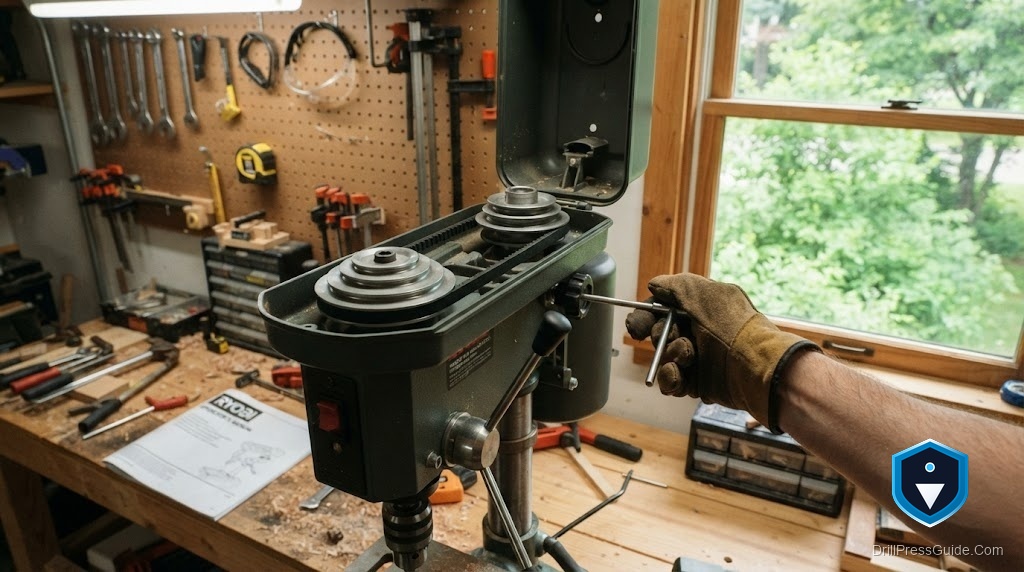
The bit is smoking, the hole edges are scorched, and you are pretty sure the wood is about to catch a tan. That is a Ryobi drill press running the wrong speed for the job, and the fix is not a knob, it is the belt. Learning how to adjust the belt speed on a Ryobi drill press takes about two minutes once you understand that speed lives in the pulley steps, not in the motor.
Belt speed adjustment means moving the drive belt between the stepped pulleys so the spindle turns faster or slower. On a Ryobi benchtop press there is no electronic control; you slacken the belt, lift it to a different pair of pulley steps, and re-tension it. Faster suits small bits and wood, slower suits large bits and metal.
Short answer: unplug the press, open the pulley cover, release belt tension by loosening the motor lock knobs, move the belt to the pulley steps that match your target speed on the chart inside the cover, then slide the motor back until the belt has about half an inch of give and lock it.
Read the speed chart first
Inside the belt cover, Ryobi prints a chart pairing pulley positions with spindle RPM. The rule behind it is simple: when the belt rides a large step on the motor and a small step on the spindle, the spindle spins fast; reverse that and it spins slow with more torque.
- Small bits in wood want high speed.
- Large bits, hole saws, and metal want low speed.
Match the bit and material to the chart before you touch anything. Guessing at speed is what glazes bits and burns wood.
Step by step
- Unplug the press.
- Open the pulley cover.
- Loosen the two motor lock knobs (or the tension lever) and push the motor toward the spindle to slacken the belt.
- Lift the belt onto the pulley steps that give your target speed.
- Slide the motor back until the belt deflects about half an inch under firm thumb pressure, then lock the knobs.
- Spin the spindle by hand, confirm the belt tracks, and close the cover.
When the belt fights you every time
Here is where a lot of Ryobi owners lose patience: the stock belt is stiff, and wrestling it across the steps for every speed change gets old fast. If you change speeds often, an adjustable link V-belt is flexible, runs cooler, and moves across the steps with far less fuss. One honest fit note: this is the 1/2 inch A-profile belt, and smaller Ryobi models use a narrower belt, so measure your pulley groove width first and match the profile.
The drawback of a link belt is that it uses more material per foot than the molded original and can run slightly noisier at the very top speed. Who should skip it: anyone whose stock belt is in good shape and who rarely changes speeds, since the molded belt is smoother for a set-and-forget setup.
Speed lives in the pulleys, not a dial
Adjusting belt speed on a Ryobi drill press is really about matching the pulley steps to the job and re-tensioning to that half-inch of give. Read the chart, slacken, move the belt, lock it, and the scorched holes stop.
Three takeaways:
- Set speed by moving the belt across the pulley steps, not by forcing the cut.
- Match the bit and material to the chart: fast for small bits and wood, slow for large bits and metal.
- Re-tension to about half an inch of deflection every time you change steps.
FAQ
How do I change the speed on a Ryobi drill press? Unplug it, open the cover, slacken the belt at the motor, move the belt to the pulley steps shown on the chart, then re-tension and lock the motor.
Where is the speed chart on a Ryobi drill press? Inside the belt cover. It pairs pulley step positions with spindle RPM so you can match the speed to the bit and material.
Which speed should I use for metal? A slow speed, which means the belt on a small motor step driving a large spindle step. Low speed gives the torque and cooler cutting that metal needs.
Why does my wood scorch when drilling? Usually the speed is too high for the bit size. Drop to a slower pulley step for large bits and let the bit clear chips.
How tight should the belt be after moving it? About half an inch of deflection when pressed midway between the pulleys. Too tight strains the bearings; too loose slips.
Can I adjust the speed while the press is running? No. Always unplug the press and change the belt by hand. Changing speed on this press means physically moving the belt.
References
- Ryobi Tools, drill press manuals and support: https://www.ryobitools.com
- Home Depot Repair Parts, Ryobi drill press V-belt (K-30) listing: https://www.appliancerepair.homedepot.com/HD16237347-Ryobi-089140314045-V-Belt-K-30.htm


