Getting the Clarke Drill Press BT1000A Replacement Belt Right: Fit, Tools, and Final Checks
The Clarke BT1000A is one of those honest little benchtop presses that keeps working long after its parts catalog has gone quiet. So when the belt finally glazes over and starts slipping, the frustrating part is not the repair, it is finding the belt. A Clarke drill press BT1000A replacement belt is rarely sitting on a shelf under that exact name, which sends a lot of owners down a rabbit hole chasing a discontinued part number. The good news: you do not need the original number at all.
A drill press belt is the rubber V-belt that carries motor spin to the spindle across stepped pulleys, and its speed depends on which pulley grooves it rides in. On an import-brand press like the BT1000A, the reliable path is to identify the belt’s profile and length and match those, rather than hunt a part that may no longer exist.
Short answer: measure your old belt, its top width and its outside length, or read the speed-chart plate under the cover, then fit either a matching A-section automotive V-belt or an adjustable link belt cut to length. The link belt is the surest fix when the original size is a mystery, because you build it to fit instead of hoping a molded belt matches.
Measure before you buy anything
Two numbers decide everything:
- Top width. Lay a ruler across the wide side of the belt. Most benchtop presses use an A-section (about 1/2 inch top width) belt. Some smaller machines use a narrower 3L profile (about 3/8 inch).
- Length. If the old belt is intact, measure its outside circumference. If it snapped, wrap a string around the pulley path at the speed setting you use most and measure that.
Write both down. With width and length in hand, you can match almost any drill press belt without ever knowing the Clarke part number.
The two ways to replace it
A molded automotive V-belt
An A-section V-belt from an auto parts store, matched to your measured length, is the simplest route and runs smooth and quiet. The catch is that you must nail the length exactly, and if your press uses an oddball length between common sizes, you may end up between two belts with no perfect match.
An adjustable link belt
When you cannot find the exact length, or you want one solution that fits every speed step, a Fenner PowerTwist adjustable link V-belt is the reliable answer. It is an A-section link belt you shorten or lengthen by adding and removing links with your hands, so you build the precise length your press needs. It also runs cooler and cuts vibration, which older presses appreciate.
The honest drawback: a link belt uses more material per foot than a plain molded belt, and at the very top RPM it can run a touch noisier than a smooth one-piece belt. Who should skip it: anyone who already found the exact molded belt size, since a matched molded belt runs slightly smoother and lasts a long time.
Fitting the belt without a fight
- Unplug the press. Always the plug, not just the switch.
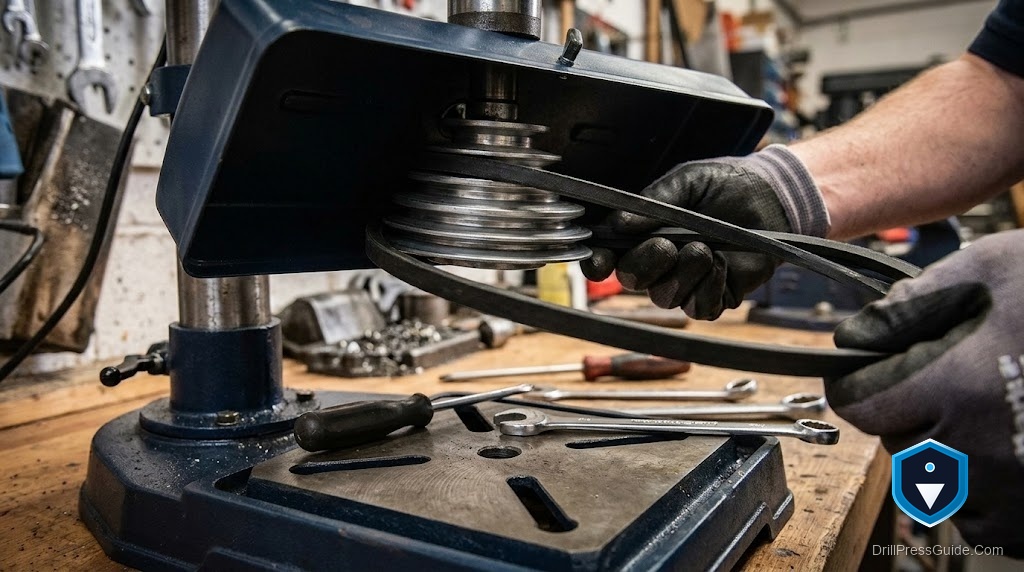
- Open the belt cover and release tension by sliding the motor forward or swinging the tension lever.
- Roll the old belt off the pulleys by hand, turning the pulley rather than prying.
- If you are using a link belt, count out the length by test-wrapping it around the pulley path, then remove or add links until it sits snug with the motor pulled back.
- Seat the belt in the pulley steps that match your target speed, re-tension to about half an inch of deflection, and spin the spindle by hand to confirm it tracks.
A note on why the belt keeps failing
Worth checking before you close the cover: if belts keep dying on this press, the pulleys may be misaligned or a bearing may be dragging, and a fresh belt will just wear out the same way. Sight down the pulleys to confirm they line up, and spin the spindle by hand to feel for roughness. Fix the cause, not just the symptom.
Match the profile, build the length, move on
The reason a Clarke BT1000A belt feels hard to buy is that people search for a name instead of a size. Measure the top width and length, choose a molded A-section belt if you can match the length or a link belt if you cannot, and set tension by feel. The press does not care what the belt is called.
Three takeaways:
- Measure width and length first; you never need the Clarke part number.
- A link belt solves the discontinued-size problem because you build it to fit.
- If belts keep failing, check pulley alignment and bearings before blaming the belt.
FAQ
What size belt does a Clarke BT1000A drill press use? Most presses this size use an A-section (about 1/2 inch top width) V-belt. Measure your old belt’s width and outside length to confirm, since the exact length varies by model and speed setting.
Where can I find a Clarke BT1000A belt if it is discontinued? You do not need the original. Match the belt profile and length with a standard automotive V-belt or build the length with an adjustable link belt.
What is an adjustable link belt? A V-belt made of interlocking links you can add or remove by hand, so you set the exact length. It fits many machines and runs cooler than a molded belt.
How do I measure a broken belt? Wrap a string around the pulley path at your usual speed setting, mark where it meets, and measure that length. Match the top width separately with a ruler.
How tight should the belt be? About half an inch of deflection when pressed midway between two pulleys. Too tight strains the motor bearings; too loose slips and glazes.
My new belt wore out fast. Why? Usually misaligned pulleys or a dragging bearing. Sight the pulleys for alignment and spin the spindle by hand to feel for roughness before fitting another belt.
Can I use a 3L belt instead of an A-section? Only if that is what your press actually uses. A 3L belt is narrower and will sit too deep in an A-section pulley. Match the profile to your pulley grooves.
References
- Fenner Drives, PowerTwist Plus adjustable link belt information: https://www.fennerdrives.com
- Grizzly Industrial, drill press V-belt tensioning and speed-change procedure (representative manual): https://cdn0.grizzly.com/manuals/g7948_m.pdf