
Boky 16mm Drill Press Start Switch Replacement: The Checks That Prevent a Bad Repair
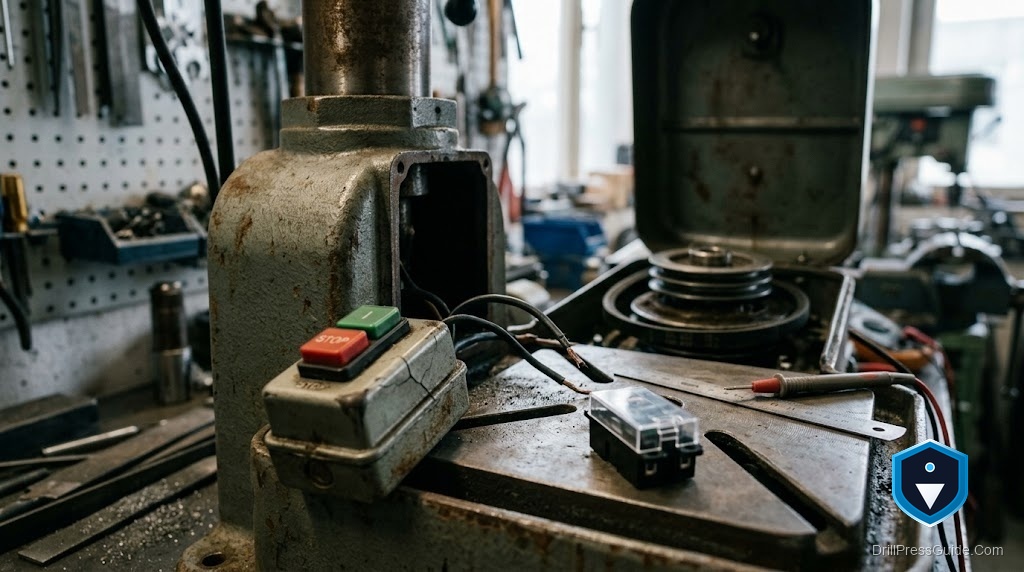
The press was fine yesterday. Today you push the green button and nothing happens, or it starts and then dies the moment you let go. Before you order anything, a Boky 16mm drill press start switch replacement is worth slowing down on, because the wrong switch either will not fit the hole or, worse, strips out the safety feature that stops the press from restarting on its own after a power cut.
A drill press start switch is the on/off control that carries mains power to the motor. On small benchtop presses like the Boky it is usually a no-volt release switch, meaning it will not re-energize by itself when power returns after an outage. That safety behavior is the whole point of the switch, and it is the detail most replacements get wrong.
Short answer: match three things before you buy. The voltage and amperage of your motor, the mounting cutout size, and the switch type (a true no-volt release, not a plain toggle). A KJD-series no-volt release push-button switch is the common, correct-behaving replacement for this class of benchtop press, and it wires in with two conductors on the line side and two on the load side.
First, prove the switch is actually the problem
Do not condemn a switch on a hunch. With the press unplugged, open the switch box and look for a loose spade connector, a scorched terminal, or a wire backed out of its clamp. A surprising number of dead presses are just a connector that vibrated loose.
If the wiring is sound, plug in and, with care, check for power at the switch input. No power in means the fault is upstream in the cord or plug. Power in but nothing out when you press start means the switch contacts have failed, and replacement is the right call.
The three measurements that decide fit
- Voltage and amperage. Read the motor plate. Most Boky-class presses run on 120V. Your replacement switch must be rated at or above the motor’s amp draw and at the correct voltage.
- Mounting cutout. Measure the hole in the switch box, usually a rectangular opening for a snap-in module. A switch body a few millimeters off will not clip in.
- Switch type. This is the one people miss. The original is a no-volt release switch. Drop in a simple rocker or toggle and the press can lurch back to life on its own when power is restored after a trip, which is a real hazard with a chuck ready to spin.
The replacement to use
For a like-for-like fix that keeps the safety behavior, a KJD-series no-volt release start/stop switch is the standard choice for benchtop woodworking and metalworking machines in this size. You get the paddle-style stop, the magnetic release that drops the circuit on power loss, and a body sized for common switch boxes.
The honest drawback: the wiring diagram printed on these units is small and generic, so you have to work slowly and label your wires as you go. Who should skip it: anyone whose press runs on 220V single phase without first checking the rating, since you must confirm the switch matches your voltage and current.
If your press instead uses a simple keyed safety switch (a plastic key that pulls out to lock the machine), a universal power-tool safety key switch is the matching style. It is a simpler device, and the tradeoff is that it does not provide no-volt release, so only use it where the original was that same key-style switch, not where a no-volt release switch was fitted.
Wiring it without turning it into a bad repair
- Photograph the old wiring before you touch anything. This one habit saves more repairs than any tool.
- Unplug the press and confirm it is dead.
- Move wires one at a time from the old switch to the same terminal on the new one. Line (incoming) to the line terminals, load (motor) to the load terminals.
- Seat every spade connector fully. A loose crimp here is a future dead press or a hot terminal.
- Clip the switch into the box, close it, and test with the cover on.
Boky versus buying a whole new press
Worth a sentence, because these presses are entry-level. If the switch is the only failure and the motor and bearings are healthy, a switch swap is by far the simpler fix and keeps a working tool out of the landfill. If the press has also been overheating, bogging under light loads, or the bearings rumble, the switch is a symptom, and you are better off putting the money toward a new machine than chasing one failure after another.
Match the type, not just the shape
A Boky 16mm start switch replacement goes well when you treat it as a matching exercise, not a shopping trip. Confirm the motor’s voltage and amps, measure the cutout, and above all replace a no-volt release switch with another no-volt release switch so the press stays safe after a power blip.
Three takeaways:
- Rule out a loose connector before you buy a switch. Half the time that is the whole repair.
- Match voltage, amperage, and cutout size, and keep the no-volt release behavior.
- Label and move wires one at a time, line to line and load to load.
FAQ
How do I know if my drill press switch is bad? With the press unplugged, check for loose or burnt connections first. If the wiring is good and there is power into the switch but none out when you press start, the contacts have failed.
What is a no-volt release switch and why does it matter? It is a switch that will not restart the motor on its own when power returns after an outage. On a drill press that prevents the chuck from suddenly spinning up while your hands are near it.
Can I replace the Boky switch with any on/off switch? Only if it matches the voltage and amp rating, fits the mounting cutout, and provides the same no-volt release behavior. A plain toggle removes an important safety function.
What voltage is a Boky 16mm drill press? Most benchtop presses in this size run on 120V. Confirm by reading your motor nameplate before buying a switch.
How many wires does the switch use? Typically two on the line (incoming) side and two on the load (motor) side. Photograph the original wiring so you can copy it exactly.
The press hums but will not spin. Is it the switch? A hum usually points to the motor start capacitor or a seized spindle, not the switch. A failed switch normally leaves the motor with no power at all.
Do I need an electrician for this? If you are comfortable working on an unplugged appliance and can match line and load terminals, it is a straightforward swap. If mains wiring makes you uneasy, have an electrician do it.
References
- Drill press switches (OEM parts and function), Fix.com: https://www.fix.com/parts/power-tool/drill-press/switches/
- No-volt release switch operation overview, Beyond Tools: https://beyondtools.com/en-us/products/no-volt-relay-on-off-switch-240v-16a-kjd12-ck-5-dkld-dz-6-2


