Delta Drill Press 11-950 Belt Change: A Workshop Troubleshooting Guide
When a Delta 11-950 starts slipping under load, squealing on startup, or bogging down in a cut, the belt is almost always the reason, and a change is one of the simpler repairs on the machine. The trick is that a belt change is also your chance to catch what the belt has been hiding, a cracked pulley or a glazed drive that will chew through a new belt just as fast. A Delta drill press 11-950 belt change goes smoothly when you match the belt, check the pulleys, and set tension correctly.
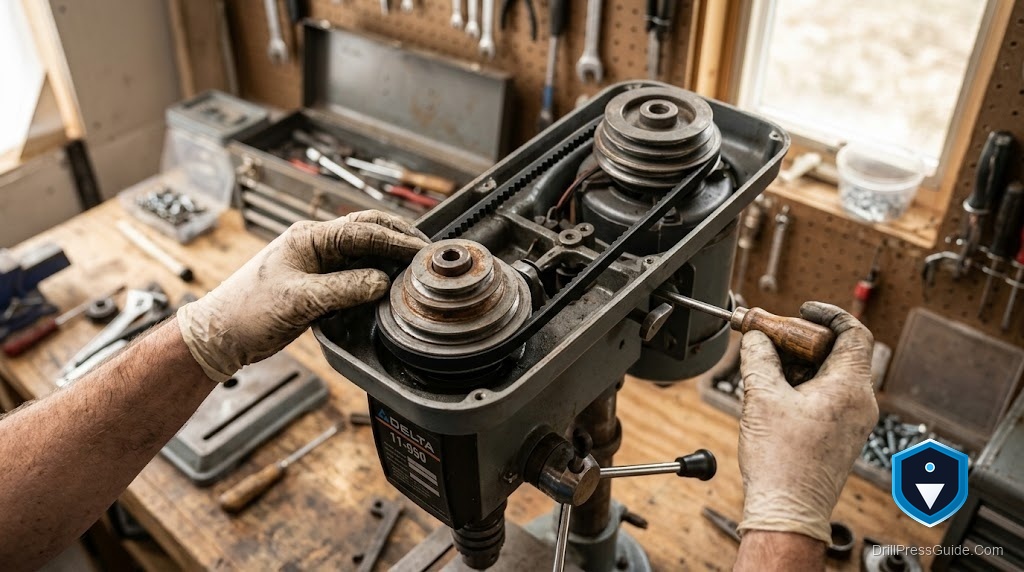
The belt is the V profile loop that carries power from the motor pulley to the spindle pulley across matching steps that set the speed. On the 11-950 the belt rides step pulleys, so the belt size and the speed step both matter.
The direct answer: with the press unplugged, release tension at the motor mount, confirm the correct belt size by measuring the old one, check the pulleys for cracks and alignment, then fit a matching V belt over the right steps and tension it to about 1/2 inch of deflection. Check the pulleys, since slip can be a pulley fault, not just the belt.
Troubleshoot as you change
With the press unplugged and the belt cover open:
- Measure the old belt or read its stamped size so the replacement matches.
- Note the speed step the belt rides, which affects effective length.
- Inspect the pulleys for cracks (common on die cast pulleys) and check the steps align. A pulley fault causes slip a new belt will not cure.
- Look for glazing on the pulley grooves, a sign the old belt was slipping.
Match the belt
Read the 11-950 model details to confirm the specified belt. A matching drill press V belt restores the original drive, and an adjustable link V belt reduces vibration and sizes by hand. If a pulley is cracked, a machined drill press step pulley is the real fix alongside the belt.
The belt change, step by step
- Unplug the press and open the belt cover.
- Loosen the motor mount to release tension and remove the old belt.
- Confirm the new belt matches the old size.
- Route the new belt over the matching motor and spindle steps for your speed.
- Re tension to about 1/2 inch of deflection under moderate thumb pressure.
- Spin by hand, then test under a light cut for smooth, slip free running.
Where people go wrong
The first mistake is changing the belt while ignoring a cracked pulley or misaligned steps that were the real cause of slip. The second is fitting the wrong belt length, so it will not tension correctly. The third is over tensioning the new belt, loading the bearings and wearing the belt fast.
The verdict
A belt change on the 11-950 is quick, and it is your window to fix what the belt was hiding. Unplug the press, measure the old belt, and inspect the pulleys for cracks, misalignment, and glazing before fitting a matching V belt or a link belt. Route it over the right steps and tension to about 1/2 inch of deflection. Check the pulleys and set tension right, and the slip and squeal disappear for good, not just until the new belt wears against a bad pulley.
Three takeaways:
- Match the belt size by measuring the old one.
- Inspect the pulleys; slip can be a pulley fault.
- Tension to about 1/2 inch deflection, not drum tight.
FAQ
How do I change the belt on a Delta 11-950 drill press? Unplug it, loosen the motor mount to release tension, remove the old belt, fit a matching V belt over the correct speed steps, and tension it to about 1/2 inch of deflection.
What belt does the 11-950 use? A V belt sized to the machine. Measure the old belt or read its stamped size to confirm the correct length before ordering.
Why does the press still slip after a new belt? Often a cracked pulley, misaligned steps, or glazed grooves, not the belt. Inspect and spin the pulleys and check alignment.
How tight should the belt be? About 1/2 inch of deflection under moderate thumb pressure. Drum tight belts load the bearings and wear quickly.
Can I use a link belt? Yes. A link belt sizes to length by hand, reduces vibration, and installs without removing pulleys. It is a common upgrade on these presses.
How do I release the tension? Loosen the motor mount so the motor slides toward the spindle, then lift the belt off the pulley steps.
What is glazing on the pulley? A smooth, shiny groove surface from a slipping belt. It reduces grip, so clean or replace a glazed pulley so the new belt does not slip too.
References
- The Engineering ToolBox, Belts: Pulley Diameters vs. Speed. https://www.engineeringtoolbox.com/pulley-diameters-speeds-d_1620.html
- Occupational Safety and Health Administration, Woodworking eTool: Drill Presses. https://www.osha.gov/etools/woodworking/production/machines-tools/drill-press