How to Remove the Spindle from a JT33 Drill Press: What to Check Before You Start
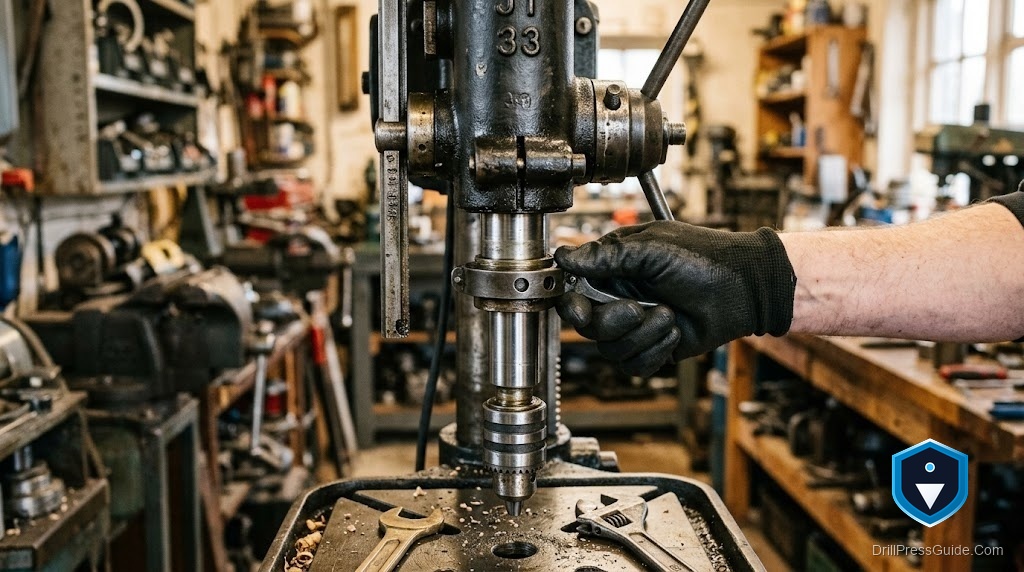
When people say they want to remove the spindle from a JT33 drill press, they usually mean a press whose chuck mounts on a JT33 taper, and what they actually need to pull apart depends on the job: getting the chuck off the arbor, dropping the whole quill and spindle to service the bearings, or separating the arbor from the spindle. Sorting out which of those you mean is the first and most important check, because each is a different operation. Knowing how to remove the spindle from a JT33 drill press starts with naming the part you are really after.
JT33 is a Jacobs taper size, the taper that holds the chuck onto its arbor, not a press model. The arbor’s other end seats in the spindle on a Morse taper, and the spindle itself rides inside the quill, which slides in the head. So three separate joints hide behind one request.
The direct answer: decide which part you need out, then, with the press unplugged, remove the chuck from the JT33 arbor with wedges, drop the arbor from the spindle with a taper drift, or pull the whole quill and spindle assembly out of the head to reach the bearings. Confirm the job first, since each joint comes apart differently.
Check which job you mean
With the press unplugged, name the target:
- Chuck off the arbor (the JT33 joint). For changing or upgrading the chuck. Wedges separate the chuck from the arbor.
- Arbor out of the spindle (the Morse joint). For clearing the spindle bore. A taper drift through the access slot drops the arbor.
- Whole spindle and quill out of the head. For servicing spindle bearings. This means releasing the quill from the head, not just a taper.
- Check for a retaining screw inside the chuck before any taper work, often reverse threaded.
Removing the chuck from the JT33 arbor
- Open the jaws fully.
- Slide drill chuck removal wedges between the chuck top and arbor collar, one each side.
- Tap evenly, alternating sides, and catch the chuck as it releases.
Dropping the arbor from the spindle
- Feed the quill down to expose the access slot.
- Drive a taper drift through with a soft dead blow mallet. Catch the arbor.
Pulling the spindle and quill for bearing service
- Remove the chuck and arbor first.
- Release the quill return spring under control, then the quill lock and any retaining collar.
- Lower the quill fully and ease the spindle and quill assembly out of the head.
- Service the drill press spindle bearing or the full spindle and quill assembly as needed.
Where people go wrong
The first mistake is not defining the job, so someone drops the whole quill when they only needed the chuck off. The second is treating JT33 as a press model rather than a chuck taper, and searching for parts by the wrong term. The third is releasing the quill return spring carelessly during a full teardown, letting it unwind fast.
The verdict
Removing the spindle from a JT33 press is really three possible jobs behind one phrase. Unplug the press and decide first whether you want the chuck off the JT33 arbor, the arbor out of the spindle, or the whole quill and spindle out for bearing service. Check for a retaining screw before any taper work, and control the return spring during a full teardown. Name the joint, use the right tool for it, and the press comes apart cleanly, exactly as far as the job requires and no further.
Three takeaways:
- JT33 is a chuck taper, not a press model.
- Decide which of the three joints you actually need apart.
- Control the return spring during a full quill teardown.
FAQ
How do I remove the spindle from a JT33 drill press? Decide what you need out first. Unplug the press, then remove the chuck from the JT33 arbor with wedges, drop the arbor from the spindle with a taper drift, or pull the whole quill and spindle out of the head to reach the bearings.
Is JT33 a type of drill press? No. JT33 is a Jacobs taper size that holds the chuck on its arbor. A JT33 press simply means one whose chuck uses that taper, not a specific model.
How do I get just the chuck off? Open the jaws, check for and remove any internal retaining screw, then drive the chuck off the JT33 arbor with wedges tapped evenly from both sides.
How do I pull the whole spindle for bearing work? Remove the chuck and arbor, control and release the quill return spring, free the quill lock and retaining collar, then ease the spindle and quill assembly out of the head.
Do I need to remove the arbor to service the bearings? Yes. Clear the chuck and arbor first, then the quill and spindle assembly comes out of the head to reach the spindle bearings.
What about the return spring during a full teardown? Release it under control before pulling the quill, since it stores energy and can unwind fast. Keep hold of the cap and wear eye protection.
How do I know which job I need? Match the job to the symptom: a chuck upgrade needs the chuck off, a blocked bore needs the arbor out, and rough or noisy spindle rotation needs the quill and spindle out for bearing service.
References
- Zoro Resource Hub, Morse vs. Jacobs Tapers. https://www.zoro.com/resourcehub/what-are-the-dimensions-and-angles-of-morse-tapers-and-jacobs-tapers/
- Occupational Safety and Health Administration, Woodworking eTool: Drill Presses. https://www.osha.gov/etools/woodworking/production/machines-tools/drill-press