
Drill Press Switch Replacement: A Workshop Troubleshooting Guide
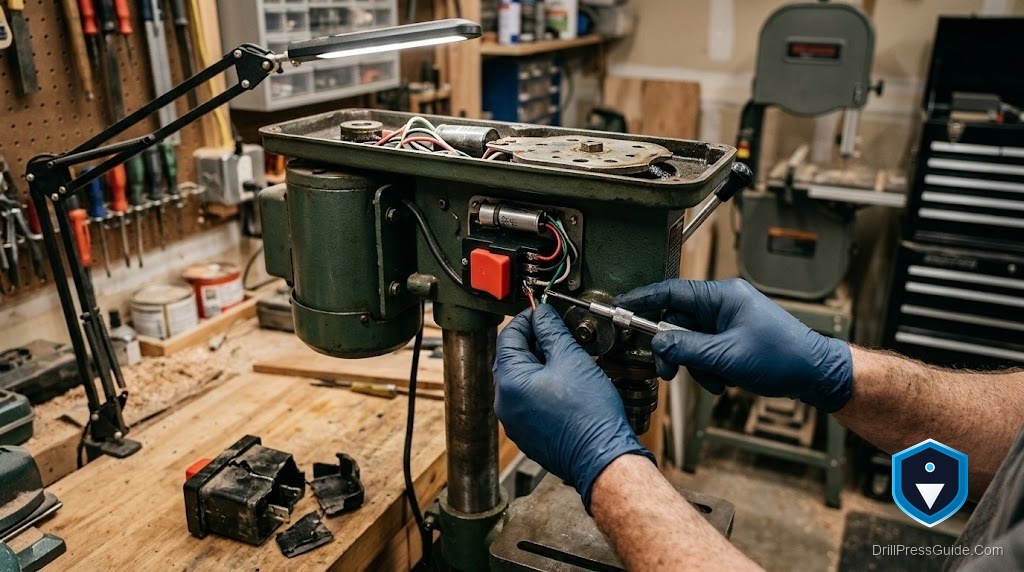
An electrical fault feels more intimidating than a mechanical one, but a drill press switch is one of the friendliest repairs on the machine. The symptoms are clear: the press will not start, or it cuts out mid cut, or the switch feels mushy and unreliable. A drill press switch replacement usually takes a screwdriver and fifteen minutes, and the two things that matter are working safely with the power disconnected and matching the switch to your press’s voltage and wiring.
The switch is the on and off control, often a paddle or a key style safety switch, wired between the incoming power cord and the motor. When it fails internally, the motor loses its signal even though the motor itself is fine.
The direct answer: unplug the press, confirm the switch is the fault rather than the cord or motor, then match a replacement to your voltage, amperage, and terminal layout. A paddle safety switch is a common and worthwhile upgrade while you are in there.
Confirm it is the switch
Before buying, rule out the neighbors, with the press unplugged:
- Check the cord and plug. A damaged cord or loose plug mimics a dead switch. Inspect for breaks.
- Check the switch action. A switch that feels mushy, does not click, or works only when wiggled is failing.
- Test continuity if you can. With a multimeter on the unplugged switch, a good switch shows continuity when on and none when off. No change means a dead switch.
Do not probe a plugged in machine. All of this happens with the press unplugged.
Match the part
Read the model number off the ID label, and read the old switch’s ratings. Match:
- Voltage (commonly 120V on home presses, sometimes 240V).
- Amperage, at or above the motor’s draw.
- Terminal count and layout, so the wires land the same way.
A matching drill press power switch restores the original function. Many owners take the chance to fit a paddle safety switch, which you can slap off with a knee or palm without looking, a genuine safety improvement recommended for shop machines.
The replacement, step by step
- Unplug the press. Confirm it is unplugged, not just switched off.
- Open the switch housing.
- Photograph the wiring before disconnecting anything, so you can match it exactly.
- Move the wires one at a time from the old switch to the same terminals on the new switch, so nothing gets crossed.
- Mount the new switch, close the housing, and confirm no bare wire is exposed.
- Plug in, test start and stop, and confirm the switch holds under a light cut.
Where people go wrong
The first and most serious mistake is working on the switch without unplugging the press. The second is buying a switch that does not match the voltage or amperage, which can fail or overheat. The third is disconnecting all the wires at once with no photo, then guessing at the terminals during reassembly.
The verdict
A switch swap is a quick, satisfying repair as long as you respect the electrical side. Unplug the press, confirm the switch is the fault and not the cord or motor, and match the replacement to your voltage, amperage, and terminal layout. Move wires one at a time from a photo, and consider a paddle safety switch for the upgrade. Do that and the press starts crisply and safely again. If your wiring does not match anything you recognize, a qualified hand is the right call rather than a guess.
Three takeaways:
- Unplug the press and confirm it before touching wiring.
- Match voltage, amperage, and terminal layout to the old switch.
- Move wires one at a time from a photo, and consider a paddle switch.
FAQ
How do I know the switch is bad and not the motor? With the press unplugged, check the cord for damage and test the switch for continuity. A switch that shows no continuity change, feels mushy, or only works when wiggled is the fault, not the motor.
How do I replace a drill press switch? Unplug the press, open the switch housing, photograph the wiring, move the wires one at a time to the matching terminals on the new switch, then reassemble and test.
How do I choose the right switch? Match the voltage, the amperage at or above the motor draw, and the terminal count and layout. Read these off the old switch and your motor plate.
Is it safe to replace a switch myself? Yes, if you unplug the press and match the wiring carefully. If the wiring does not match anything you recognize, have a qualified person do it.
Should I upgrade to a paddle safety switch? Many owners do. A paddle switch lets you stop the press with a knee or palm without looking, which is a real safety gain for a shop machine.
Why does my press cut out mid cut? A failing switch losing contact under vibration is a common cause, along with a loose wire or a damaged cord. Inspect all three with the press unplugged.
Do I need to match the voltage exactly? Yes. Match the voltage and use a switch rated at or above the motor’s amperage, or the switch can overheat or fail.
References
- Emory University EHS, Drill Press Safety Rules. https://ehso.emory.edu/sso/documents/content-guidelines/drillpresssafetyrules.pdf
- Occupational Safety and Health Administration, Woodworking eTool: Drill Presses. https://www.osha.gov/etools/woodworking/production/machines-tools/drill-press


