
A Practical Guide to Drill Press Bearing Replacement
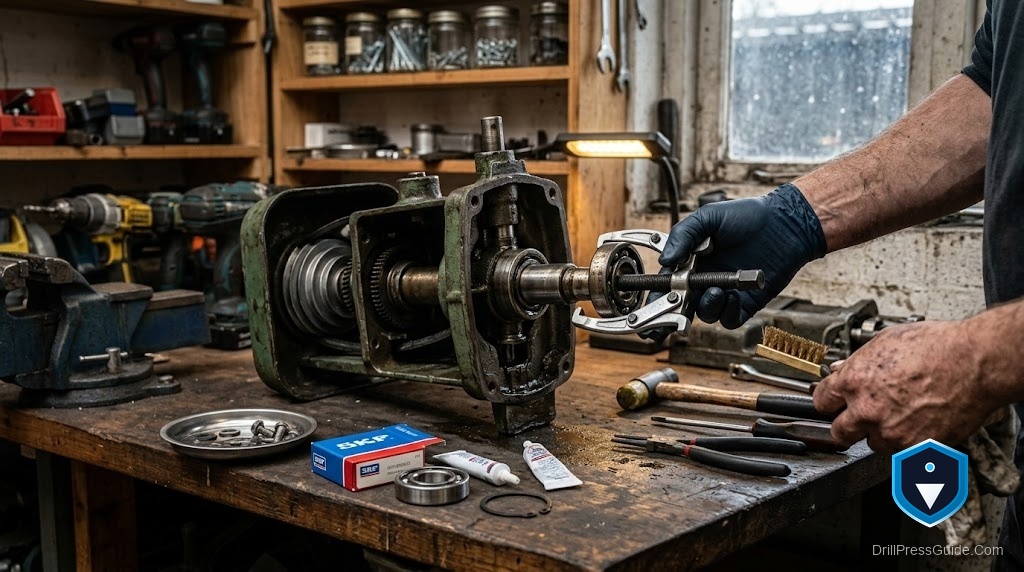
Bearings give you plenty of warning before they fail, if you know the sound. A press that used to spin up silky smooth develops a low rumble, then a whine that rises with speed, and eventually a roughness you can feel in the feed handle. Ignore it long enough and a seized bearing can score the spindle or the quill, turning a small repair into a big one. A drill press bearing replacement stops that slide, and the whole job hinges on identifying the right bearings and pressing them without damaging what they ride in.
Bearing replacement means removing the worn spindle bearings (and sometimes the quill or pulley bearings) and pressing in new ones. Most presses carry two spindle bearings inside the quill, plus bearings at the pulley or countershaft on some designs.
The direct answer: identify which bearings are noisy, read their numbers off the old bearings or an exploded diagram, and press new ones in while supporting the casting. Bearings are standardized by number, so a matching bearing is easy to source once you have read the code.
Find the noisy bearing first
With the press unplugged, turn the spindle by hand and feel for roughness:
- Rumble that rises with speed points at the spindle bearings inside the quill.
- Noise at the top of the head points at the pulley or countershaft bearings.
- Side play at the quill confirms worn spindle bearings rather than a chuck or arbor fault.
Spin each pulley independently where you can, to localize the sound before you tear anything down.
Read the bearing numbers
Here is the good news about bearings: they are standardized. Once you remove an old bearing, the number stamped on its race (for example a 6203 or 6204 style code) tells you exactly what to buy from any bearing supplier. If you cannot read the stamp, an exploded diagram for your model lists them. Match the number, the seal type, and the width. A set of replacement drill press spindle bearings by the correct number restores smooth running regardless of the press brand.
The replacement, in order
- Unplug the press.
- Remove the chuck and arbor, then relieve and remove the quill return spring under control.
- Slide the quill and spindle out of the head.
- Press the old bearings off the spindle and out of the quill, supporting the part so you never press through the casting.
- Press new bearings on, driving only on the correct race: the inner race when fitting to the shaft, the outer race when fitting into a bore. This one habit protects the new bearing.
- Reassemble, rewind the return spring, refit the chuck, and indicate the runout.
An arbor press or bearing driver set makes clean work of this and keeps you from hammering bearings crooked.
Where people go wrong
The first mistake is pressing on the wrong race, which brinells the new bearing and reintroduces the noise you were fixing. The second is not supporting the casting during a press, which can crack an aluminum head. The third is replacing bearings when the actual noise came from a dry, gummed quill that just needed cleaning.
The verdict
Bearing replacement is one of the most satisfying drill press repairs because the parts are standardized and the result is night and day. Localize the noisy bearing, read its number, and press the replacement in on the correct race with the casting supported. Respect the return spring during teardown, indicate the spindle when you are done, and the press comes back quiet and true. Rush the pressing and you simply install fresh noise.
Three takeaways:
- Read the number off the old bearing to source an exact match.
- Press only on the correct race, and support the casting.
- Rule out a gummed quill before condemning the bearings.
FAQ
How do I know my drill press bearings are worn? A rumble or whine that rises with speed, roughness you can feel in the spindle, or side play at the quill all point at worn bearings. Localize the noise before tearing down.
How do I find the right replacement bearings? Read the number stamped on the old bearing’s race, or find it on an exploded diagram. Bearings are standardized, so that number sources an exact match anywhere.
Can I press bearings in at home? Yes, with an arbor press or bearing driver set, while supporting the casting. Drive only on the correct race so you do not damage the new bearing.
What does pressing on the wrong race do? It forces load through the balls and dents the races (brinelling), which makes the new bearing noisy from day one. Always press on the race being fitted.
Are drill press bearings the same across brands? The bearings themselves are standardized by number, so many presses share common sizes. Match the number, seal type, and width to be sure.
Could the noise be something other than bearings? Yes. A dry or gummed quill can rumble, and a bad belt or pulley can whine. Rule those out before replacing bearings.
Do I need to replace all the bearings at once? Replace the noisy ones, but since the press is apart, fitting all the spindle bearings as a set is common practice and saves a second teardown.
References
- The Engineering ToolBox, Belts: Pulley Diameters vs. Speed. https://www.engineeringtoolbox.com/pulley-diameters-speeds-d_1620.html
- Occupational Safety and Health Administration, Woodworking eTool: Drill Presses. https://www.osha.gov/etools/woodworking/production/machines-tools/drill-press


