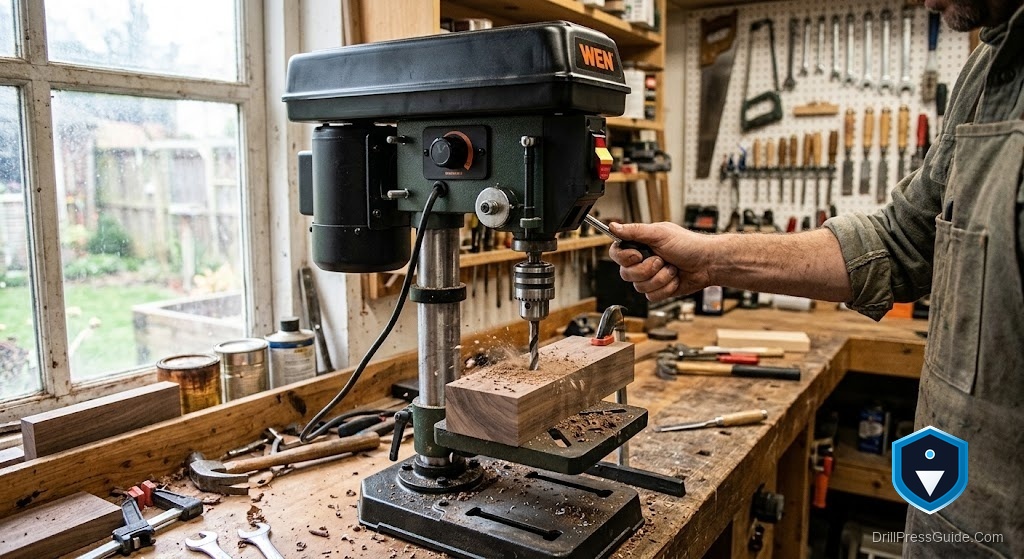
Walker Turner Drill Press Belt Change: Diagnose the Fit Before Replacing Anything

Walker Turner presses have a following for a reason. These are old American machines, built in an era of heavy castings and generous bearings, and a well kept one will outlast anything on the shelf today. The people who own them tend to love them. What they do not love is hunting parts for a machine that left production generations ago, and the belt is the part that wears most. A Walker Turner drill press belt change is simple mechanically, and the real work is matching a modern belt to a vintage machine that never expected to shop online.
Changing the belt means replacing the V belt (or belts) that link the motor pulley to the spindle pulley. Walker Turner presses use stepped pulleys, and on some models a countershaft, so you move the belt between steps to change speed.
The direct answer: measure the old belt’s cross section and length rather than trusting a decades old chart, then buy a matching modern V belt by those dimensions. Walker Turner made several models over many years, so measure your machine instead of assuming a part number still applies.
Measure, because the chart may be long gone
Vintage presses rarely still wear their speed chart, and part numbers from that era often cross to nothing. So measure:
- Belt cross section. Note the top width and the V angle. Common vintage sizes cross to modern A or 4L profiles, but confirm yours.
- Belt length. Measure around the outside of the old belt, or wrap a string around the pulley path if the old belt is missing.
- Countershaft belts. If your model has a countershaft, there are two belts. Measure both.
Take those numbers shopping for a drill press V belt.
V belt or link belt on a vintage machine?
These old presses are a classic case for the link belt debate:
- A modern V belt in the right size runs quiet and matches how the machine was built. It is the purist’s choice and works fine.
- A link belt shines here because vintage pulleys are often cast iron rather than soft die cast, so they tolerate a link belt well, and the link belt cures the cold thump and lets you size it exactly without a part number. A link belt for a drill press is a favorite fix for exactly this situation, where the original belt is unobtainable and you want to size to fit. The honest tradeoff is that a link belt asks more of you up front and some purists prefer to keep a vintage machine original.
On a heavy cast iron Walker Turner, a link belt is a genuinely good option, which is not true of every press.
The change, step by step
- Unplug the press.
- Open the belt guard.
- Release tension. On most Walker Turner presses you loosen the motor mount and slide the motor, or on countershaft models loosen the countershaft bracket.
- Lift the old belt off, noting the pulley steps for your usual speed.
- Fit the new belt on the steps you want.
- Retension so the belt deflects about half an inch under a finger midspan.
- Lock the mount, spin by hand, close the guard, and test.
Where people go wrong
The first mistake is chasing an original part number that no longer exists instead of measuring and buying a modern equivalent. The second is over tightening a belt to stop a slip, which loads the old bearings you are trying to preserve. The third is missing a second countershaft belt on models that have one.
The verdict
A Walker Turner belt change is easy once you stop hunting the past and measure the present. Take the cross section and length off the old belt, buy a modern V belt to match, or fit a link belt, which suits these heavy cast iron machines especially well. Set tension by feel to protect those original bearings. Do that and a machine older than most shops runs quiet and strong again.
Three takeaways:
- Measure the belt, do not chase a discontinued part number.
- Link belts suit these cast iron pulleys well.
- Set tension by feel to protect the vintage bearings.
FAQ
What belt does a Walker Turner drill press use? A V belt sized to your specific model. Measure the old belt’s cross section and length, since vintage part numbers rarely cross to current stock. Countershaft models use two belts.
How do I change the belt on a Walker Turner press? Unplug it, open the guard, loosen the motor or countershaft mount to release tension, lift off the old belt, fit the new one on your speed steps, then retension.
Can I use a link belt on a vintage press? Yes, and it suits these machines well because their pulleys are often cast iron. A link belt also lets you size exactly without a part number.
How do I find the belt size without a chart? Measure the old belt’s top width, V angle, and outside length. If the belt is missing, wrap a string around the pulley path to get the length.
How tight should the belt be? About half an inch of deflection under a finger at midspan. Over tightening stresses the old bearings.
My model has two belts. Is that normal? Yes. Countershaft Walker Turner presses drive through an intermediate shaft, so there are two belts to measure and replace.
Should I keep it original with a V belt? If originality matters to you, a correctly sized modern V belt keeps the character. A link belt is the practical choice when parts are scarce.
References
- The Engineering ToolBox, Belts: Pulley Diameters vs. Speed. https://www.engineeringtoolbox.com/pulley-diameters-speeds-d_1620.html
- Occupational Safety and Health Administration, Woodworking eTool: Drill Presses. https://www.osha.gov/etools/woodworking/production/machines-tools/drill-press