
Ryobi Drill Press Belt Replacement: Diagnose the Fit Before Replacing Anything
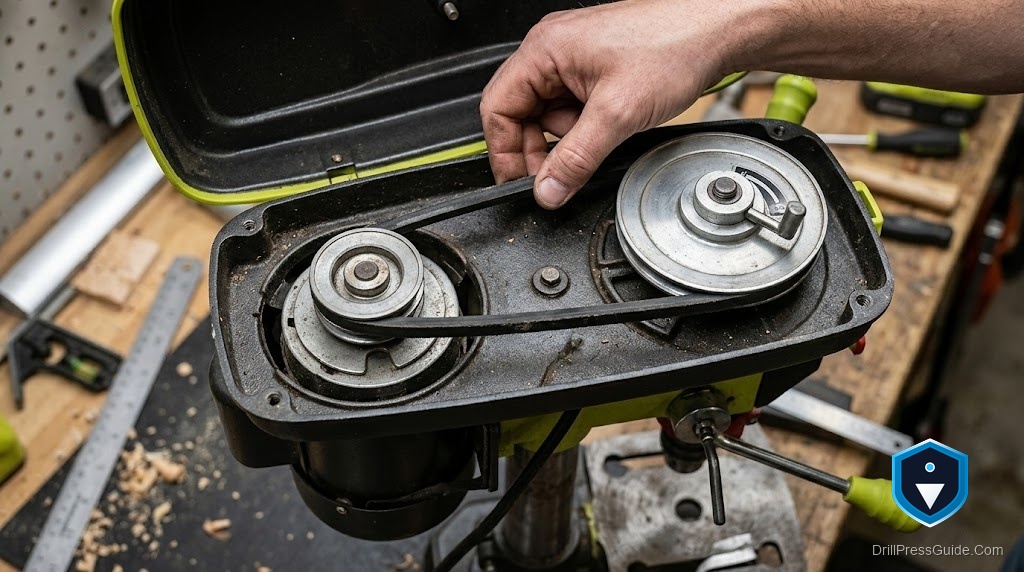
A slipping belt is a quiet thief. The Ryobi still runs, still sounds mostly right, but bits bog down in hardwood, speeds drift, and there is a faint squeal on startup that you have learned to ignore. That is a belt telling you it is glazed, stretched, or cracked. A Ryobi drill press belt replacement is one of the easiest repairs on the machine, and getting the belt size right the first time is the only part that takes any thought.
Replacing the belt means swapping the V belt that connects the motor pulley to the spindle pulley. On Ryobi benchtop presses the belt rides on a stepped pulley set, and you move it between steps to change spindle speed.
The direct answer: measure the old belt’s cross section and length, or read the size off the machine’s speed chart or manual, then buy a matching V belt. Ryobi models differ, so match your exact model rather than buying a belt labeled just “drill press.”
Find your model, then the belt size
Start at the ID label for the model number, serial number, and manufacture date. Ryobi sold several benchtop presses (10 inch units are common), and belt length varies with the frame. The manual or the speed chart inside the pulley cover usually states the belt size. If the chart is long gone, measure the old belt: note the width and the angle of the V, and measure the length around the outside. Take those numbers shopping for a drill press V belt.
V belt or link belt?
Since you are buying anyway, know the tradeoff:
- A standard V belt is what the machine came with. It runs quiet, lasts well if you keep tension right, and asks nothing of you. The catch is that a belt stored coiled can take a set and thump until it warms up.
- A link belt is a segmented belt you build to length by adding or removing links. It is popular because it kills the cold morning thump and never takes a set. A link belt for a drill press is the fix for vibration, and you can size it exactly. The honest downside, which experienced woodworkers raise often, is that link belts can wear pulleys faster, especially soft die cast Ryobi pulleys.
For most Ryobi owners a quality V belt is the right call. Reach for a link belt only if you are chasing vibration a good V belt did not cure.
The swap, start to finish
- Unplug the press.
- Open the pulley cover.
- Release belt tension. On most Ryobi presses you loosen the motor mount and slide the motor toward the spindle.
- Lift the old belt off both pulleys, noting which steps it rode on so you keep your usual speed.
- Set the new belt on the motor and spindle pulley steps you want.
- Slide the motor back to tension the belt. Aim for about half an inch of deflection when you press the belt midspan with a finger. Too tight wears bearings, too loose slips.
- Lock the motor mount, spin by hand, close the cover, and test.
Where people go wrong
The first mistake is buying a belt by machine type instead of by size, then finding it too long to tension. The second is over tightening to stop a slip, which just moves the wear to the bearings. The third is reusing the same tired pulleys with a new belt and blaming the belt when the vibration returns, when a cracked die cast pulley was the culprit.
The verdict
A Ryobi belt swap is a fifteen minute job that restores lost power and quiets a squeal. Match the belt to your exact model by size, set tension by feel rather than by muscle, and only reach for a link belt if a good V belt does not settle the vibration. Keep an eye on those die cast pulleys while you are in there, because a cracked pulley will ruin any belt you fit.
Three takeaways:
- Match the belt by measured size and exact model, not by category.
- Tension for about half an inch of deflection, not drum tight.
- A V belt suits most owners, a link belt only for stubborn vibration.
FAQ
What size belt does a Ryobi drill press use? It varies by model. Read the belt size from the manual or the speed chart under the pulley cover, or measure the old belt’s width and length. Match your exact model.
How do I change the belt on a Ryobi drill press? Unplug it, open the pulley cover, loosen the motor mount to release tension, lift off the old belt, set the new one on the pulley steps you want, then slide the motor back to tension it.
How tight should the belt be? About half an inch of deflection when you press the belt midspan with a finger. Too tight wears the bearings, too loose lets it slip.
Should I use a link belt on my Ryobi? Only if a quality V belt does not cure vibration. Link belts run smoother but can wear soft die cast pulleys faster.
My new belt still squeals. Why? Usually tension is too loose, or a glazed or cracked pulley is the real problem. Check the pulleys for cracks and reset tension.
Where do I find my Ryobi model number? On the ID label, usually on the head or column, with the serial number and manufacture date.
Can a wrong belt damage the press? A belt too long cannot be tensioned and will slip, and over tightening a short belt stresses the bearings. Match the size to avoid both.
References
- The Engineering ToolBox, Belts: Pulley Diameters vs. Speed. https://www.engineeringtoolbox.com/pulley-diameters-speeds-d_1620.html
- Occupational Safety and Health Administration, Woodworking eTool: Drill Presses. https://www.osha.gov/etools/woodworking/production/machines-tools/drill-press


