
How to Identify the Correct Version of Your Delta Drill Press Parts
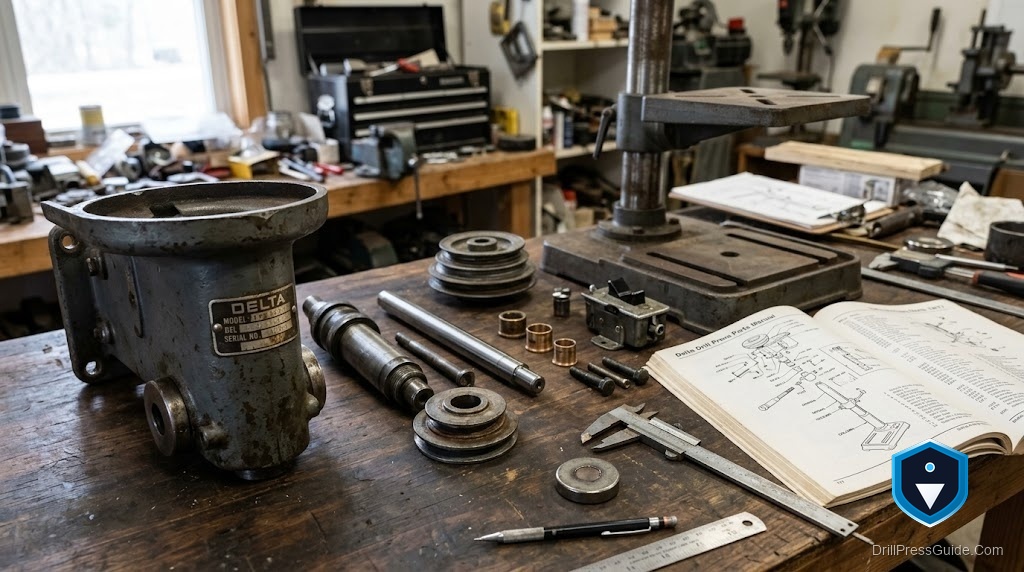
Here is the mistake that costs people a return shipment and a lost weekend: they find a chuck or a switch that looks exactly like the broken one, order it, and discover it does not seat, does not thread, or does not clear the casting. The part looked right. It was the wrong version. With Delta drill presses, the picture is never enough, because the same model number can hide two or three production variants that use different parts. Getting the right version is a small bit of detective work up front that saves the headache later.
Identifying the correct version of a Delta drill press part means matching the replacement to your machine’s exact model number and Type number, and confirming the physical fit details (mount style, capacity, and dimensions) rather than trusting how the part looks. Delta’s long history and changes in ownership mean parts diagrams are organized by model and type, so that is the language you need to speak when ordering.
The quick method: read the ID plate for the model and Type number, pull up the parts diagram for that exact combination, then confirm the three fit details that trip people up. Everything below walks through it.
Start at the ID plate
Every Delta drill press has a metal ID plate or stamped label carrying the model number, and, crucially, a Type number beside it. Common spots:
- The head casting, near the belt cover or motor
- The column, rear or side
- The base, along an edge
- Near the switch or power cord entry
Write down the whole string. A model like 17-900 with Type 2 is a different parts list than 17-900 Type 1 for several components. If the plate is missing or worn illegible, which happens on older machines, you can often narrow it down by matching casting features against archived parts diagrams, but the plate is always the fastest route.
Why the Type number changes the answer
Manufacturers revise a machine during its production run without renaming it. Between Type 1 and Type 2 of the same Delta model, any of these can differ:
- Switch: different toggle or paddle switches with different mounting
- Quill return spring: different tension or housing
- Belt: different length if pulley geometry changed
- Chuck and arbor: different taper or thread
So when a parts seller lists “fits Type 1 only,” believe it. Ordering the Type 2 version of a spring or switch for a Type 1 machine is the single most common Delta parts error.
The three fit details to confirm before you buy
1. Mount style. Does the part thread on, press on, or seat on a tapered arbor? Chucks are the usual culprit. A tapered-arbor chuck is wedged off and pressed on; a threaded chuck spins off. Ordering the wrong mount means the part physically cannot attach.
2. Capacity or size. For chucks, confirm 1/2-inch versus 5/8-inch. For belts, confirm the length. For keys, confirm the pinion size. A 5/8-inch chuck that replaces Delta part 1312022 only helps if your machine actually uses that chuck; the version that replaces the 17-968 chuck is a different part for a different machine.
3. Interference and clearance. Does the replacement clear surrounding castings and the table bracket? On assemblies like quills and depth stops, a part from a similar model can foul the housing even when the mount matches.
Cross-referencing by part number
The most reliable identification skips the model entirely and uses the part number stamped on the old component or listed in your machine’s diagram. Delta parts carry numbers like 1312022 for a chuck or 1313105 for a chuck key. When a replacement lists the Delta number it replaces, you have a direct match regardless of how it looks. If you can read the number off the failed part, search that first; it is the closest thing to a guarantee.
When a part is discontinued, note the dimensions from the diagram (arbor taper, chuck capacity, belt length) and match a current aftermarket equivalent to those numbers. A correctly sized replacement chuck built to fit the Delta 17-900 is a clean substitute when the OEM chuck is no longer made, as long as the arbor matches.
The verdict
Identifying the right Delta part is less about the tool and more about discipline: read the full model and Type number off the ID plate, order from the diagram for that exact combination, and confirm mount style, size, and clearance before you buy. When you can, cross-reference the part number stamped on the old component, since that beats any visual match. Do this and you will order once instead of twice, which on parts for a decades-old machine is the difference between a quick fix and a drawn-out hunt.
For the specific parts that fail most and current replacements, see our Delta drill press replacement parts guide.
Frequently asked questions
How do I find my Delta drill press Type number? It sits next to the model number on the ID plate, usually on the head casting, column, base, or near the switch. Record both, because parts fit is often type-specific.
Why do Delta parts list different types? Delta revised machines during production without changing the model name. Switches, springs, belts, and chucks can differ between Type 1 and Type 2, so the type determines which part fits.
Can I identify a part without the model number? Sometimes. If you can read the part number stamped on the old component, search that directly. Otherwise you can match casting features to archived diagrams, though it is slower.
What if the ID plate is missing? Match physical features (casting shape, chuck size, motor plate) against online parts diagrams to narrow the model, then confirm fit by dimensions. The part number on the failed component, if legible, is the most reliable clue.
How do I know if a chuck will fit? Confirm the mount style (threaded versus tapered arbor) and the capacity (1/2-inch versus 5/8-inch). A matching Delta part number on the replacement listing confirms the fit.
Are aftermarket Delta parts reliable? For wear items like chucks, keys, and belts, a correctly sized aftermarket part is usually fine and sometimes better. For anything that indexes to the casting, prefer OEM.
References
- Sears PartsDirect, Delta drill press model and parts diagrams: https://www.searspartsdirect.com
- Delta Machinery, official manuals and parts resource: https://deltamachinery.com
- eReplacementParts, Delta drill press OEM parts by model and type


