Which Ryobi Drill Press Replacement Parts Fit? A Compatibility-First Guide
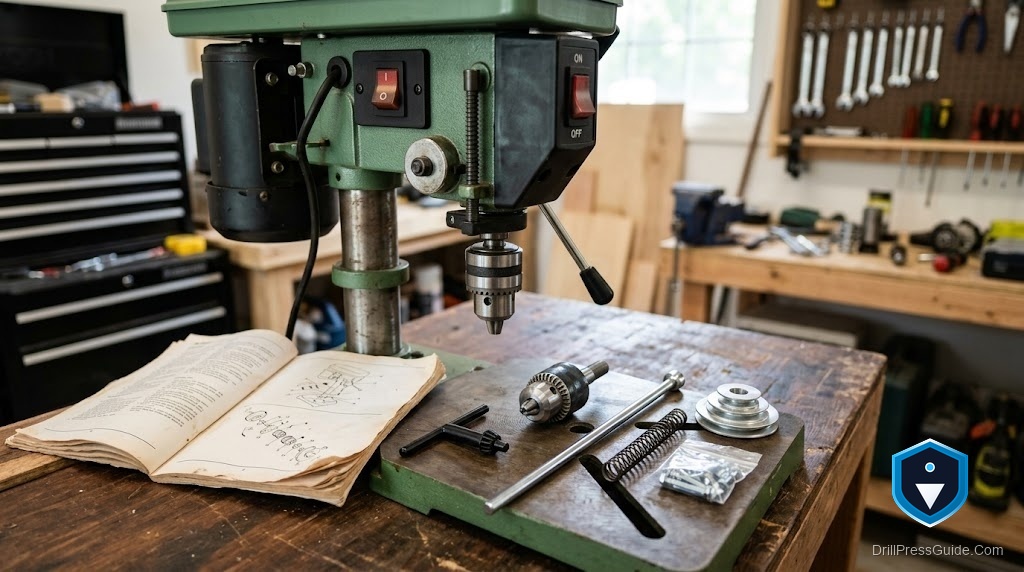
Ryobi’s benchtop drill presses, the DP100, DP102L, DP120, and similar 10-inch models, were popular affordable machines, but they have largely left production in North America, so finding parts today takes a compatibility-first approach. The reassuring part is that these were fairly conventional benchtop presses, so most of what wears out is a standard size shared with other machines. This guide explains which Ryobi drill press replacement parts fit and how to match them without guessing.
Ryobi drill press replacement parts fall into two groups: model-specific parts (pulleys, quills, switches, return springs, castings) that must match your exact Ryobi model and are increasingly hard to find new, and universal consumables (V-belts, chucks, chuck keys, vises) that fit by size regardless of brand. The starting point is the Ryobi model number, such as DP100, DP102L, or DP120, on the machine.
Straight answer: identify your Ryobi model number, check Ryobi and its service network for any remaining model-specific parts, and match everything else by measurement. Because these are conventional benchtop presses, the belt, chuck, and chuck key, the parts most owners actually need, are readily available as universal sizes.
Step 1: identify your Ryobi model
Ryobi drill presses carry a model number (for example DP100, DP102L, or DP120) on a label on the head or column. Record it exactly, because Ryobi used several similar 10-inch models with small differences, and the number is how you tell them apart. It is also your reference for any parts diagram and for measuring consumables. If the label is gone, you can often identify the model by matching its castings, table, and pulley layout to archived diagrams, but the number is far more reliable.
Step 2: check for model-specific parts, then plan around scarcity
For pulleys, the quill and spindle, switches, and the return spring, look first at Ryobi’s service network and parts listings for your model. Because these presses are largely discontinued in North America, some model-specific parts may be out of stock, so plan around that: many owners keep a machine going by cross-referencing a part to a still-available equivalent, or by sourcing a used donor of the same model. The compatibility-first rule is to confirm a part matches your exact model before buying, rather than assuming any “Ryobi drill press” part fits.
Step 3: match universal consumables by size
The parts most owners need are universal:
- Belt: The V-belt glazes and cracks with age. Measure the old loop (length and top width) or the pulley spacing and fit a matching belt.
- Chuck: A worn chuck slips. Identify the spindle taper (many Ryobi benchtop presses use a JT33-style mount) and capacity, then fit a matching chuck; on a Morse spindle a 5/8-inch keyed chuck with an MT2 arbor works once you confirm the taper.
- Chuck key: A lost key is a universal ratcheting chuck key.
- Vise: A drill press vise fits any table and improves safety and accuracy.
The honest flaws
Two honest points. First, because these Ryobi presses are largely discontinued, model-specific structural parts can be hard to find, so a broken proprietary casting or pulley may force a used-donor hunt or end the machine’s life; inspect before you invest. Second, guessing wastes money, a belt or chuck that looks close but is the wrong size will not work, which is why measuring and model-number matching are worth the few minutes. Neither means a Ryobi press is unsupportable, just that method matters for a discontinued machine.
Who can fix theirs easily, and who should reconsider
You can keep a Ryobi press running easily if it needs only consumables, the belt, chuck, or key, and it is otherwise complete and sound. That covers most owners, and it is cheap, worthwhile upkeep on a capable little benchtop press.
Reconsider if the machine needs a discontinued quill, pulley, or casting with no equivalent or donor available. At that point the hunt can cost more than the press is worth, and a running used machine or an inexpensive current one is the better call. Do not chase rare structural parts for a discontinued benchtop press.
Conclusion: match by model, then by measurement
Finding Ryobi drill press parts is manageable once you work from the model number and lean on universal consumables.
- Identify your Ryobi model (DP100, DP102L, DP120, and similar) from the label first.
- Check Ryobi’s service network for model-specific parts; plan around discontinued-part scarcity.
- Match belts, chucks, keys, and vises by measurement, since these are universal sizes.
- Use a used donor for unavailable structural parts, or replace the machine if the fix is not economical.
FAQ
Where is the model number on a Ryobi drill press? On a label on the head or column. Common numbers include DP100, DP102L, and DP120. Record the full number.
Are Ryobi drill press parts still available? Universal consumables are readily available. Model-specific parts are increasingly scarce, since these presses are largely discontinued in North America.
How do I choose the right belt? Measure the old belt’s length and top width (or the pulley spacing) and fit a matching V-belt.
How do I replace the chuck? Identify the spindle taper (often a JT33-style mount) and capacity, then fit a matching chuck. Keep a universal chuck key on hand.
What if a structural part is unavailable? Cross-reference to an equivalent if one exists, or source a used donor of the same model. Otherwise, replacing the machine may be more economical.
Do parts interchange between Ryobi models? Not always. Ryobi used several similar models with small differences, so confirm a part matches your exact model before buying.
Is it worth repairing a Ryobi press? Yes for cheap consumable fixes. Not usually for discontinued structural parts with no equivalent or donor.
References
- Ryobi Tools, support and service network: https://www.ryobitools.com/support
- Ryobi drill press manuals and parts references: https://www.manualslib.com/brand/ryobi/
- Manufacturer-agnostic drill press belt and chuck sizing references: https://vintagemachinery.org