
Which Ellis Drill Press Replacement Parts Fit? A Compatibility-First Guide
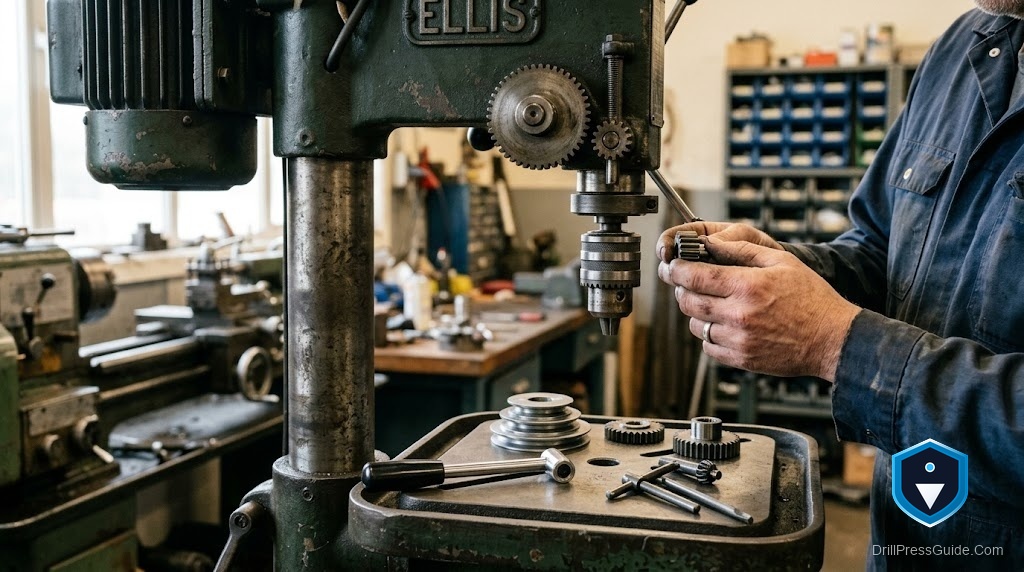
Ellis drill presses are a different animal from the import machines most people search parts for. Ellis Manufacturing is a long-running American maker of industrial drill presses and metal-cutting equipment, and its machines, models like the 9000, 9400, and 9500, are built for shop and production use. That industrial pedigree changes the parts picture in a good way: Ellis still supports its equipment, so genuine parts are often available directly. This compatibility-first guide explains which Ellis drill press parts fit and how to order them correctly.
Ellis drill press replacement parts fall into two groups: genuine Ellis parts (spindles, quills, pulleys, motors, switches, and other model-specific components) available through Ellis Manufacturing by model and serial number, and universal consumables (chucks, chuck keys, drill-press vises, and some belts) that match by size. Because Ellis is still in business and supports older machines, the compatibility question usually has a real answer rather than a dead end.
Straight answer: for an Ellis, start with the manufacturer. Identify your model and serial number, then contact Ellis or use its parts documentation to order genuine components, because Ellis machines are industrial and factory-supported. Use universal consumables only where they genuinely match by size, and never substitute a generic part for a structural component without confirming fit.
Why Ellis is different
Most drill press parts guides deal with discontinued consumer machines, where the maker is gone and you improvise. Ellis is the opposite: an established industrial manufacturer that has produced drill presses and saws for decades and continues to support them. That means the compatibility-first answer is usually “order the genuine part,” because it exists. It also means the machines are heavier and more precise than consumer presses, so fit tolerances matter more, and a close-enough generic part is more likely to compromise accuracy.
The practical upshot: treat an Ellis like the industrial tool it is. Work from the model and serial number, and lean on factory parts for anything structural.
Step 1: identify model and serial number
Ellis machines carry a model designation (for example 9000, 9400, 9500, or 12000) and a serial number on the machine. Record both. Ellis uses these to identify the exact configuration and the correct parts, which matters because industrial machines are often built in variants and updated over long production runs. With the model and serial number in hand, you can confirm which spindle, quill, pulley, or motor your machine takes rather than guessing.
Step 2: order genuine parts for structural components
For the parts that define how the machine runs, spindle, quill, bearings, pulleys, motor, switch, and castings, order genuine Ellis components. These are precision parts on an industrial machine, and substituting a generic equivalent risks poor fit and lost accuracy. Ellis’s parts support and documentation, keyed to your model and serial number, are the reliable source. This is the core of the compatibility-first approach: for anything that carries load or sets alignment, use the part designed for the machine.
Step 3: use universal consumables only where they truly match
Some items are genuinely universal and can be matched by size:
- Chuck: Identify the spindle taper and capacity, then fit a matching chuck; a heavy-duty 5/8-inch keyed chuck with an MT2 arbor suits MT2 spindles common on industrial presses. If a JT33-style chuck is needed on a Morse spindle, an MT2-to-JT33 arbor adapts it.
- Chuck key: A lost key is a universal ratcheting chuck key.
- Vise: A drill press vise fits any table and improves safety and accuracy.
For belts, measure the old one and confirm the size against your model before substituting a generic belt.
The honest flaws
Two honest points. First, genuine industrial parts cost more than generic consumer spares, and lead times can be longer, so budget and plan accordingly; the trade is that the parts are correct and preserve the machine’s precision. Second, verifying the exact model and serial number is essential, because industrial machines have variants, and ordering the wrong structural part for your configuration wastes real money. Neither is a knock on Ellis; both reflect that you are maintaining a precision industrial tool, not a disposable benchtop press.
Who should source parts this way, and who should reconsider
Source genuine Ellis parts if you own one of these industrial machines and value its precision and longevity, which is exactly why people buy Ellis. Factory support makes keeping one running realistic, unlike most vintage consumer presses.
Reconsider only if a machine is so far gone that even factory parts cannot economically restore it, which is rare for an industrial press but possible with severe damage. In that case, weigh the restoration cost against a replacement. For most Ellis owners, though, the compatibility-first, factory-parts path is the right one.
Conclusion: work from the maker, not guesswork
Ellis drill press parts are refreshingly answerable because the manufacturer still supports its machines.
- Ellis is an established industrial maker, so genuine parts are usually available.
- Identify your model and serial number before ordering anything.
- Use genuine Ellis parts for structural components to preserve precision.
- Use universal consumables (chuck, key, vise) only where they truly match by size.
FAQ
Are Ellis drill press parts still available? Yes. Ellis Manufacturing is an established industrial maker that supports its machines, so genuine parts are generally available by model and serial number.
What information do I need to order parts? Your machine’s model designation (such as 9000, 9400, or 9500) and its serial number, which identify the exact configuration.
Can I use generic parts on an Ellis? Use universal consumables (chuck, key, vise) where they match by size. For structural parts, use genuine Ellis components to preserve accuracy.
How do I choose a replacement chuck? Identify the spindle taper and capacity, then fit a matching chuck, using an MT2-to-JT33 arbor if you need a JT33 chuck on a Morse spindle.
How do I replace the belt? Measure the old belt and confirm the size for your model before fitting a replacement, since industrial machines can differ from consumer presses.
Why order genuine parts instead of generic? Ellis machines are precision industrial tools, so correct-fit factory parts preserve alignment and accuracy that generic substitutes may not.
Are Ellis parts expensive? Genuine industrial parts cost more than consumer spares and can have longer lead times, but they are the correct parts for the machine.
References
- Ellis Manufacturing Company, drill presses and parts support: https://www.ellissaw.com
- VintageMachinery.org, Ellis Manufacturing Co. machine references: http://vintagemachinery.org/mfgindex/detail.aspx?id=1067
- Practical Machinist forum, Ellis drill press owner discussions: https://www.practicalmachinist.com


