
JET Drill Press Parts: How to Find the Right One, First Try
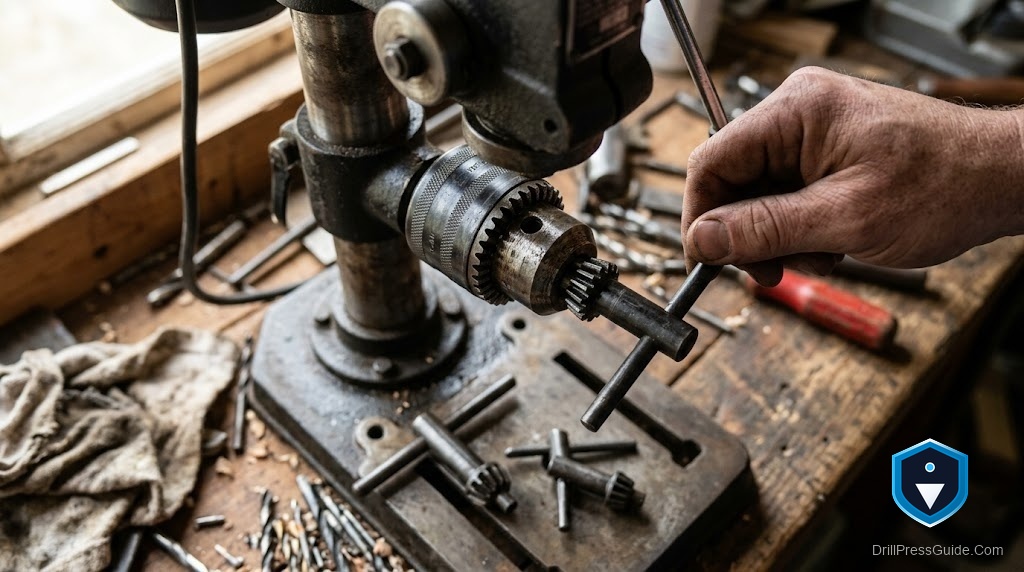
Ordering a drill press part sounds simple until you are staring at three similar-looking belts, two chucks with different tapers, and a parts diagram that assumes you already know your model number. Get it wrong and you wait a week for a part that does not fit. The good news with JET is that the parts system is genuinely good, well-documented, with published diagrams and a real support network, so with the right approach you can get the correct part the first time. Here is exactly how to do that.
JET drill press parts are the replacement components (belts, chucks, quills, springs, pulleys, switches, bearings, and more) for JET drill presses, ordered by matching your exact model number to JET’s published exploded parts diagrams through JET Tools or authorized parts retailers.
Short answer: to find the right JET drill press part the first try, get your exact model number off the machine’s ID plate, pull up that model’s exploded parts diagram, identify the part by its diagram index number and description, and order it by that number from JET or an authorized retailer. Never order by eyeballing; the model number and diagram are what guarantee fit. Here is the full method.
Step 1: Find your exact model number
Everything starts here. JET drill presses carry a model number (for example JDP-17, JDP-17MF, and others across the bench and floor lines) on an ID plate, usually on the head casting or column. Write down the complete model designation, including any suffix like MF, because parts differ between variants that look nearly identical. If you cannot find the plate, check the original manual or purchase records. Our JET drill press lineup guide lists the models to help you confirm which you have.
Step 2: Pull the exploded parts diagram
With the model number, get that model’s exploded parts diagram. JET publishes these, and they show every component with an index number and description. This diagram is the key document: it tells you not only which parts exist but how they relate, so you order the right belt, the right chuck taper, and the right spring for your specific machine. JET Tools (jettools.com) hosts manuals and parts diagrams; authorized parts retailers such as eReplacementParts also present them.
Step 3: Identify the part by index number
On the diagram, find your part and note its index number and description. Common drill press parts and what to confirm:
- V-belt: The most common replacement. Match the length and profile to your model; do not guess from a similar belt.
- Chuck and arbor: Confirm the taper (JET presses commonly use MT2) and chuck capacity (often 5/8 inch). The arbor taper must match the spindle.
- Quill and quill spring (return spring): Match to the model; springs and quills are model-specific.
- Pulleys (motor, spindle, center): Match by diagram number; pulley steps vary by model and speed range.
- Switch: Match the electrical rating and mounting.
- Bearings: Match by the diagram’s bearing number.
Order by the index number and part description rather than by appearance. That is what prevents the wrong-part mistake.
Step 4: Order from JET or an authorized retailer
With the model number and part number in hand, order through JET Tools or an authorized parts retailer. Because JET backs its machines with a warranty and a parts network, in-warranty parts may be covered, and out-of-warranty parts are readily available. Provide the model number and the diagram index number when ordering to guarantee the match.
Common fit mistakes to avoid
Ignoring the model suffix. A JDP-17 and a JDP-17MF can differ in parts. Always include the full designation.
Guessing the belt. Belts look alike but differ in length and profile. Match to the diagram, not to the old belt’s appearance alone (though measuring the old belt is a useful cross-check).
Wrong chuck taper. Confirm MT2 (or your model’s taper) before buying a chuck or arbor. A mismatched taper will not seat.
Assuming cross-model fit. Parts from a similar JET model are not guaranteed to fit yours. Verify against your model’s diagram.
When a part is discontinued
On older JET machines, a specific part may be discontinued. In that case, an authorized retailer or eReplacementParts may list a superseding part number, or a generic equivalent (belts and chucks especially) can work if the specs match. For model-specific parts like a particular quill or casting, check JET support for the current replacement. For the closely related Wilton machines now sold under JET, some parts cross-reference; see our Wilton drill press guide.
The verdict
Finding the right JET drill press part the first try is a repeatable process, not a guessing game: get the exact model number from the ID plate, pull that model’s exploded parts diagram, identify the part by its index number and description, and order by that number from JET or an authorized retailer. JET’s well-documented diagrams and real parts network are a genuine ownership advantage, they are a big part of why the machines are worth buying, so use them. Confirm the belt length, the chuck taper, and the model suffix, and the part will fit. For choosing a machine in the first place, see our JET JDP-17MF guide.
Frequently asked questions
How do I find the right part for my JET drill press? Get your exact model number from the ID plate, pull up that model’s exploded parts diagram, identify the part by its index number and description, and order it by that number from JET or an authorized retailer.
Where do I find my JET drill press model number? On the ID plate, usually on the head casting or column. Record the full designation including any suffix (like MF), since parts differ between similar variants.
Where can I buy JET drill press parts? Through JET Tools (jettools.com), which publishes manuals and parts diagrams, and authorized parts retailers such as eReplacementParts. Order by model number and diagram index number.
What are the most commonly replaced JET drill press parts? V-belts, chucks and arbors, quill return springs, pulleys, switches, and bearings. Match each to your model’s parts diagram rather than by appearance.
How do I choose the right V-belt for a JET drill press? Match the belt length and profile to your model’s parts diagram. Measuring the old belt is a useful cross-check, but the diagram specification is what guarantees fit.
What if my JET drill press part is discontinued? An authorized retailer may list a superseding part number, or a generic equivalent (for belts and chucks) can work if specs match. For model-specific parts, check JET support for the current replacement.
Can I use parts from a different JET drill press model? Not reliably. Similar-looking JET models can differ in parts. Always verify against your specific model’s exploded parts diagram before ordering.
References
- JET Tools, drill press manuals and parts diagrams: https://jettools.com/manuals
- eReplacementParts, JET drill press parts and diagrams: https://www.ereplacementparts.com
- JET Tools, customer support and warranty: https://jettools.com


