Finding Ridgid Drill Press DP15501 Parts Without Guessing at Compatibility
There is a particular kind of frustration that comes with owning a solid, heavy 15-inch floor press that the manufacturer no longer stocks. The DP15501 still bores clean holes, the cast iron still shrugs off vibration, and then one day the belt cracks or the chuck starts slipping, and you are left squinting at photos trying to tell one gray casting from another. The trick to buying Ridgid drill press DP15501 parts is refusing to guess: match by model, then by part number, every single time.
The DP15501 is a 15-inch floor-standing drill press with a 1/2-horsepower motor, twelve spindle speeds from roughly 300 to 3,100 RPM, about 3.75 inches of spindle travel, a 12-by-12-inch table, and a 5/8-inch chuck. It was sold through Home Depot and is now discontinued, so compatibility checking is the whole job.
Quick answer for the impatient: pull the full model and serial number off the nameplate, find your part on the official DP15501 repair diagram, and order by the printed part number rather than by appearance. The DP15501 looks a lot like the earlier DP15000 and the retail R1500, and looking similar is not the same as fitting.
Why the lookalikes trip people up
Ridgid’s 15-inch presses share a family resemblance the way siblings do. The DP15000, DP15501, and R1500 all carry the same general head, column, and table layout, and the casual eye cannot separate them. Their parts lists, though, diverge in the details that matter: pulley steps, switch assemblies, spring housings, and the exact table clamp. A DP15000 table clamp photographed at the right angle looks identical to the DP15501 piece, right up until it does not seat.
Start at the nameplate on the head or motor. Record the model number and the serial or type code. If the plate is missing, verify against known DP15501 specs: 15-inch swing, 1/2-HP motor, 300 to 3,100 RPM across twelve speeds, and a 3.75-inch quill travel. Those numbers, confirmed against the manual, tell you which diagram to trust.
The wear parts, in the order they fail
Belt. The pulley change on this press is manual, and belts stiffen and crack with age. Because the DP15501 is a 15-inch floor unit, it uses a longer V-belt than the small benchtop machines, so measure the old belt around its full length before you order anything.
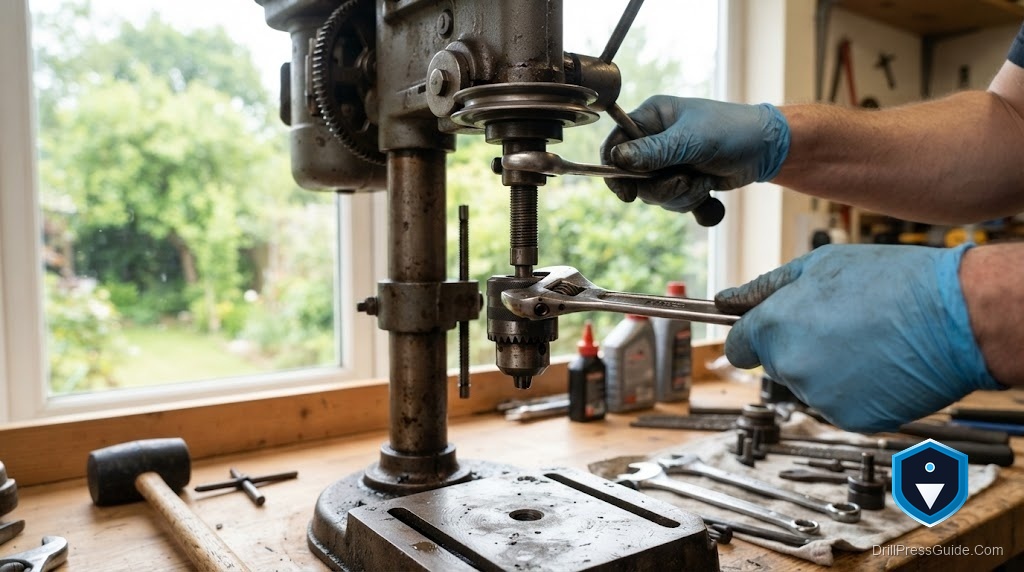
Chuck and key. The 5/8-inch keyed chuck seats on a Morse-taper arbor. A worn chuck that no longer holds torque, or one that drops off the spindle, is the most common complaint. When the chuck itself is shot, a heavy-duty 5/8-inch JT33 keyed chuck on the correct arbor restores grip, provided you confirm your spindle taper first. Lost the key only? A universal ratcheting chuck key is the fast fix.
Quill return spring. These lose tension or snap. The factory service manual walks through the spring adjustment, and getting the pre-load right is fiddly. Budget an afternoon and expect the spring to fight you.
The honest flaw with aftermarket chucks here is the same as on any older press: a generic unit can add a few thousandths of runout. Fine for wood, noticeable in steel. If precision matters to you, chase an OEM-spec arbor.
Reading the diagram like a pro
The DP15501 repair parts figure is published with key numbers and OEM part numbers, and the manual is explicit about ordering by part number, not by key number. One useful detail buried in that manual: the spindle pulley nut has left-hand threads, so if a chuck is not delivering torque, you tighten that nut counterclockwise. Guess the thread direction and you make the problem worse.
Who should skip it
If your DP15501 needs a new motor plus a spindle assembly, the math turns against you. A discontinued floor press swallowing two big OEM orders is competing with a brand-new 15-inch machine that comes with a warranty and stocked parts. Keep the DP15501 alive for consumables and single-part fixes. Retire it, or part it out, when the head itself is failing.
Conclusion: the version is the whole story
The DP15501 rewards patience. Almost every fault on one is a belt, a chuck, or a spring away from solved, and none of those require luck if you match carefully.
- Record model and serial before ordering; treat the DP15000 and R1500 as different machines.
- Order by OEM part number from the DP15501 diagram.
- Measure the belt; confirm the spindle taper before buying a chuck.
- Remember the left-hand-thread pulley nut during any chuck work.
FAQ
What are the DP15501 specifications? A 15-inch floor drill press with a 1/2-HP motor, twelve speeds from about 300 to 3,100 RPM, roughly 3.75 inches of spindle travel, a 12-by-12-inch table, and a 5/8-inch chuck.
Are DP15000 and DP15501 parts interchangeable? Some consumables overlap, but the parts lists differ. Always match to your exact model rather than assuming the two are identical.
Which way does the spindle pulley nut turn? The pulley nut has left-hand threads, so you tighten it counterclockwise, per the factory manual.
What chuck does the DP15501 use? A 5/8-inch keyed chuck on a Morse-taper arbor. Confirm the exact taper before ordering a replacement.
Is the DP15501 still sold? No. It is discontinued, which is why matching parts by number is essential.
Where do I find a DP15501 manual and parts diagram? The operator’s manual and repair parts figure are available as PDFs online, including scans of the original Ridgid documentation.
How do I identify my DP15501 without a nameplate? Measure swing, motor rating, speed range, and quill travel, then match those against the DP15501 manual to confirm.
References
- RIDGID DP15501 Operator’s Manual (PDF): https://uwm.edu/psychology/wp-content/uploads/sites/64/2014/10/Rigid-Drill-Press-Model-DP15501.pdf
- RIDGID 15 in. Drill Press Operator’s Manual (Home Depot PDF): https://homedepot.com/catalog/pdfImages/84/8414de40-3701-4d30-b5c9-e7e44257e554.pdf
- RIDGID Store, Drill Presses (model status): https://store.ridgid.com/us/en/drill-presses