Powermatic 2800 Drill Press Manual: A Complete Owner's Reference
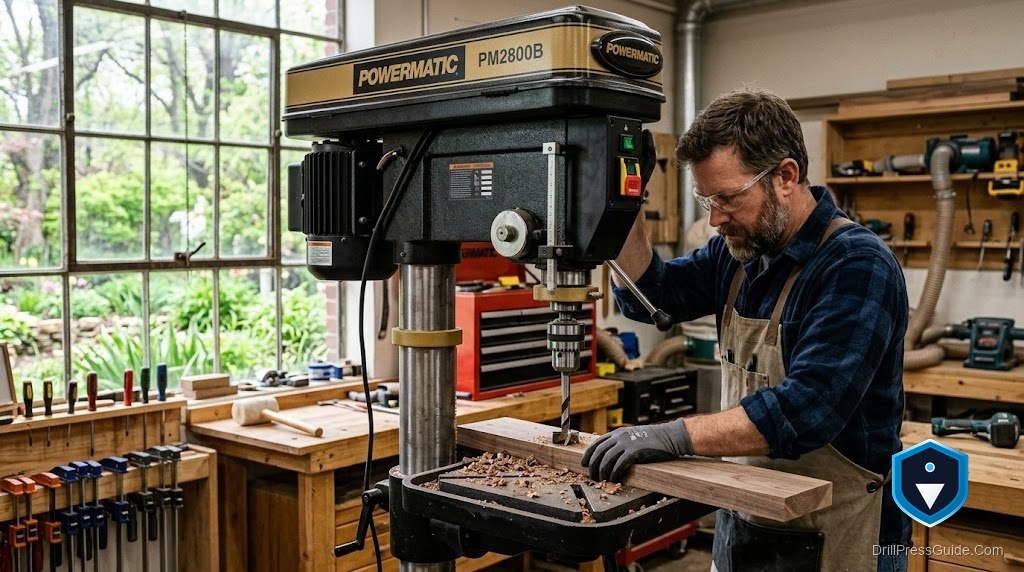
The Powermatic 2800 represents Powermatic’s current flagship drill press — a variable-speed floor-standing machine that brings together everything the brand has learned across decades of manufacturing. If you’ve invested in a 2800 and want to get the most out of it, or if you’re evaluating one, this guide covers the machine from top to bottom.
What Makes the 2800 Different
Unlike earlier Powermatic drill presses that use step-pulley belt systems for speed change, the Powermatic 2800 uses a variable-speed motor control — a dial on the head that continuously adjusts spindle speed without stopping to move belts. This changes the user experience completely.
| Specification | Powermatic 2800 |
|---|---|
| Swing | 20 inches |
| Spindle travel | 6 inches |
| Speed control | Variable speed (infinitely variable within range) |
| RPM range | 170 – 3,000 RPM |
| Motor | 1-3/4 HP, 115V/230V |
| Spindle taper | MT3 |
| Chuck capacity | 5/8 inch |
| Table | 20” × 20” cast iron, T-slots, rack-and-pinion |
| Built-in light | Yes (LED work light) |
| Digital depth readout | Yes |
Finding the Manual
- Powermatic’s website — powermatic.com — look under the 2800 model page
- JPW Customer Service — 1-800-274-6848
- eReplacementParts.com — parts diagrams often available alongside the manual
The 2800 is a current production machine, so documentation and parts support are fully active.
Setup and Commissioning
Initial Assembly
The 2800 ships partially assembled. Assembly sequence:
- Attach the base to the column and torque the fasteners
- Mount the table support and table
- Seat the head assembly on the column
- Square the table to the spindle (procedure below)
- Configure the digital depth stop
Squaring the Table
- Install a precision rod in the MT3 spindle
- Lower the rod to just above the table surface
- Use a machinist’s square or dial indicator to check all four sides
- Adjust the table tilt until square, tighten, and recheck
Digital Depth Stop Setup
The digital depth stop displays plunge depth on an LCD readout. To use:
- Set the quill to the fully retracted position
- Zero the readout
- Lower the quill to your target depth and note the readout
- Set the mechanical hard stop to match
This feature is particularly useful for blind holes — you can dial in exact depth on the first test hole and repeat precisely.
Variable Speed System: Using It Well
The variable speed system on the 2800 allows you to dial speed while the machine is running. Some practical guidelines:
- Start at low speed when the machine has been sitting (allows the drive system to warm up gradually)
- Reduce speed before stopping rather than stopping abruptly at high speed
- Use the speed chart in the manual for your material and bit diameter — the wide speed range means you have the right speed for every operation
Chuck and Tooling
The MT3 spindle on the 2800 takes standard MT3 tooling:
- MT3 chuck arbor assembly for chuck replacement
- JT33 keyed chuck mounted on the MT3 arbor
- Chuck key — keep a spare since the factory key holder is convenient but small
Workholding on the 20” Table
The 20” × 20” T-slot table is one of the most capable surfaces on any drill press in this price class:
- 4-inch drill press vise for precision work
- Palmgren drill press vise for production metalwork
- T-slot step-block clamping sets for plate work and large panels
The Built-In LED Light
The 2800 includes an integrated work light — a genuine convenience. If yours fails, Powermatic supplies the replacement module. A supplemental gooseneck LED positioned from the side eliminates any remaining shadow from the spindle housing.
Is the 2800 Worth It?
For anyone who drills regularly in both wood and metal, across a wide range of material thicknesses and bit diameters, the Powermatic 2800 is a transformative upgrade. Variable speed means never stopping to move belts. Six inches of quill travel means handling deep holes. A 1-3/4 HP motor means nothing in your shop will stall this machine.
SEO Metadata